






Every week I get some version of the same message: “I want to get into security, I have zero tech background, and I can’t afford a bootcamp—is this even realistic?” It is, and if you’ve been quietly searching for how to learn cybersecurity for free without a computer science degree or a spare few thousand dollars, 2027 is genuinely one of the better years to start.
The tools are free, the communities are active, and employers are far less obsessed with pedigree than they were five years ago. This guide is built for exactly that situation: starting a cybersecurity career with no experience, no degree, and no training budget, using a structured 90-day plan instead of a random pile of YouTube tutorials.
What follows isn’t a list of random links you’ll bookmark and never open again. It’s a week-by-week way of thinking about how to learn cybersecurity for free that treats your time like the scarce resource it actually is—because the people who succeed with this approach aren’t smarter than everyone else searching the same question; they’re just more disciplined about finishing one resource before starting the next one.
Why a Cybersecurity Career With No Experience Is More Realistic?
The honest answer to “Can I really do this with no background?” is yes, but only if you stop treating the search for how to learn cybersecurity for free as a one-time Google search and start treating it as a structured 90-day project.
Most people who fail at this don’t fail because the material is too hard—they fail because they bounce between fifteen different free courses, never finish one, and never build anything they can show a hiring manager.
Building a cybersecurity career with no experience is no longer unusual. The Cybersecurity Workforce Study found a global workforce gap of several million unfilled roles, and a large share of hiring managers surveyed said they’d rather bring in a motivated beginner with demonstrated hands-on skills than wait months for a “perfect” resume.
Recruiters increasingly care less about where you studied and more about what you can actually demonstrate, which is good news for anyone starting a cybersecurity career with no experience right now. The real question people ask isn’t whether the field is accessible; it’s how to learn cybersecurity for free without wasting months on the wrong resources—and that’s exactly what the next 90 days are for.
Learning cybersecurity from scratch doesn’t always require expensive courses or prior technical experience. With the right roadmap, beginners can build essential skills in networking, operating systems, threat detection, and security fundamentals within 90 days. A Complete Cyber Security Course can provide structured learning, practical exercises, and industry-relevant knowledge to support this journey. Start with free learning resources, practice in virtual labs, explore beginner-friendly security tools, and gradually build a portfolio that demonstrates your cybersecurity skills to potential employers.
The 90-Day Roadmap for How to Learn Cybersecurity for Free
Here’s the roadmap broken into three clear phases before we go deeper into each one:
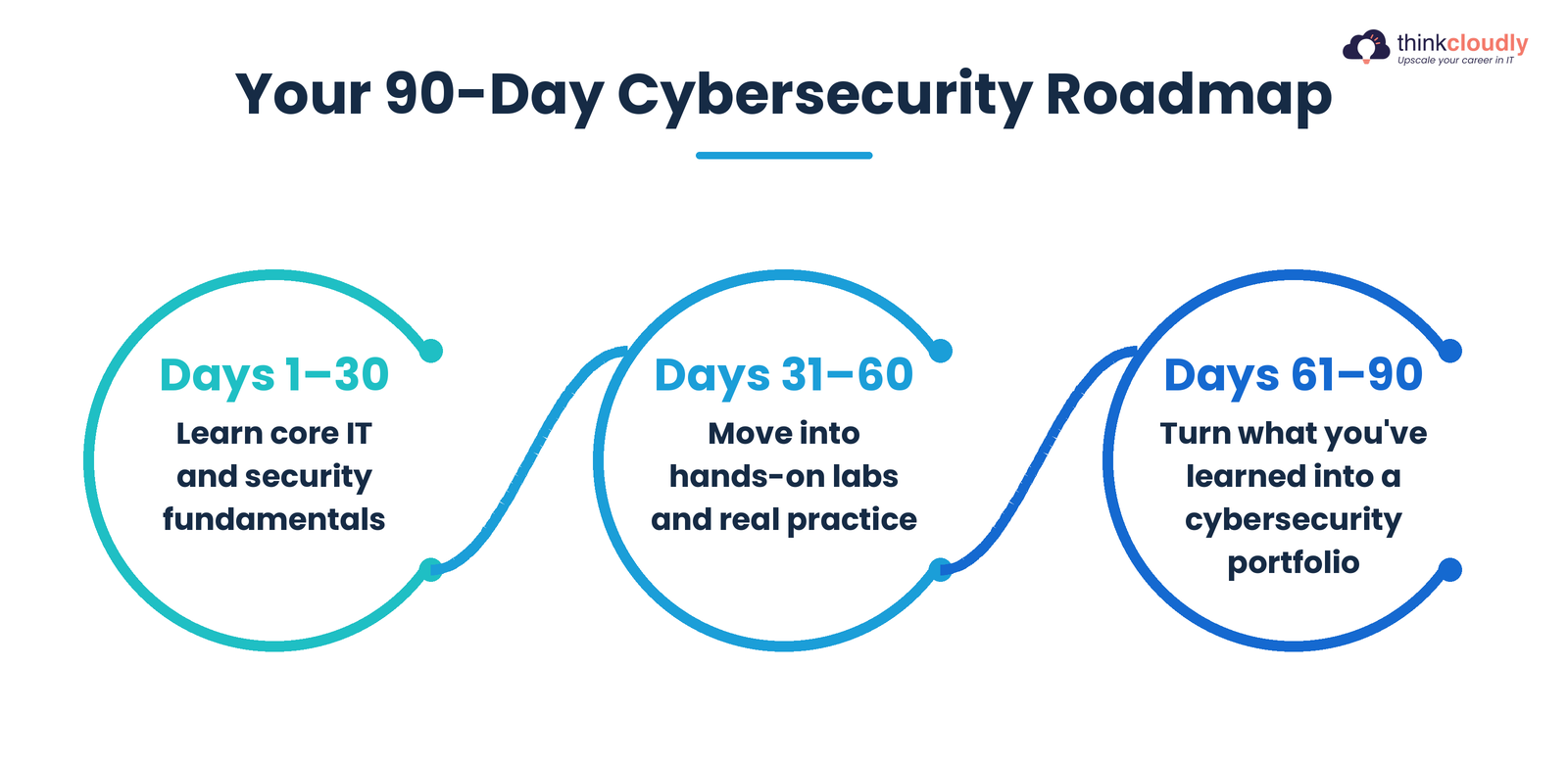
- Days 1–30: Learn core IT and security fundamentals—networking basics, operating systems, common attack types, and foundational terminology.
- Days 31–60: Move into hands-on labs and real practice—simulated attacks, log analysis, and basic incident response in a safe sandbox.
- Days 61–90: Turn what you’ve learned into a cybersecurity portfolio built around two or three finished cybersecurity projects, then start applying.
This table breaks down how to learn cybersecurity for free across three focused months, including what to study and which free resources to lean on each month:
|
Phase |
Focus Area | Free Resources to Use |
Weekly Time Commitment |
|
Month 1 (Days 1–30) |
Networking, OS basics, security terminology | Professor Messer, Cisco Networking Academy, Google Cybersecurity Certificate (audit mode) |
8–10 hours |
|
Month 2 (Days 31–60) |
Hands-on labs, log analysis, basic threat detection | TryHackMe free rooms, LetsDefend, OverTheWire, and YouTube walkthroughs |
10–12 hours |
|
Month 3 (Days 61–90) |
Portfolio building, applying, interview prep | GitHub Pages, personal blog, LinkedIn, Cyber Seek job data. |
10 hours |
These are directional time estimates, not a rigid schedule—someone working a full-time job may need to stretch this to 100–110 days, which is completely fine. What matters far more than hitting an exact day count is finishing each phase before moving to the next one, rather than skipping ahead to the “exciting” hacking labs before the fundamentals are solid.
Month 1: Cybersecurity for Beginners—Build Your Foundations
Most cybersecurity for beginners content overwhelms learners with jargon before covering fundamentals, which is exactly backwards. Start with networking (how data actually moves across a network), basic operating system concepts (Windows and Linux file systems, permissions, processes), and only then move into security-specific terms like confidentiality, integrity, and availability.
A structured path works better for cybersecurity for beginners than jumping straight into advanced tooling. Three free resources carry this entire month on their own:
- Professor Messer’s free video courses—covers CompTIA Security+ and Network+ material at no cost, which is one of the better entry points for cybersecurity for beginners because it requires no prior IT background.
- Cisco Networking Academy—free, self-paced networking fundamentals that map directly onto real job requirements.
- Google’s Cybersecurity Professional Certificate (audited on Coursera)—you won’t get the paid certificate, but the full lecture content is viewable at no cost when audited.
By day 30, you should be able to explain what a firewall does, how DNS resolution works, and the difference between a vulnerability and an exploit—without needing to look any of it up. If any of that still feels shaky, don’t rush ahead on the calendar just to stay “on schedule”—the entire point of a self-paced plan for how to learn cybersecurity for free is that you can repeat a week without penalty, which is a luxury a paid bootcamp with a fixed cohort schedule simply doesn’t give you.
Month 2: Free Cybersecurity Labs and Hands-On Practice
This is the stage where how to learn cybersecurity for free stops being theoretical and starts being something you can actually do with your hands on a keyboard. Reading about security concepts only gets you so far—free cybersecurity labs like TryHackMe and LetsDefend let you practice in a safe, legal sandbox instead of risking anything on a live network.
Spending at least an hour a day in free cybersecurity labs builds muscle memory no textbook can replace. A realistic Month 2 rotation looks like this:
- Free cybersecurity labs: TryHackMe’s free “Pre Security” and “Complete Beginner” learning paths, LetsDefend’s free SOC analyst simulations, and OverTheWire’s Bandit wargame for command-line practice.
- Blue-team focus: Spend at least half your lab time on defensive work (log analysis, alert triage) since most entry-level roles are defensive, not offensive.
- Daily documentation: Keep short notes on every lab you finish—this becomes raw material for your portfolio in Month 3.
Treat free cybersecurity labs as your gym, not your classroom—you go there to apply what you already read, not to learn brand-new concepts cold. If a lab exercise doesn’t make sense, go back to a Month 1 resource and reread the relevant section before continuing.
Month 3: Build a Cybersecurity Portfolio That Gets Noticed
A cybersecurity portfolio doesn’t need to be flashy—three or four well-documented write-ups beat twenty rushed ones. Hiring managers increasingly ask for a project link before they ask about a degree, because it’s the fastest way to see whether a candidate can actually think through a security problem rather than just recite terminology from a study guide.
Pick two or three cybersecurity projects you can realistically finish in a weekend each. Good cybersecurity projects for beginners include setting up a home-lab SIEM with a free tool, documenting a simulated phishing investigation from a free lab, or hardening a virtual machine against a checklist like CIS Benchmarks. Document every one of your cybersecurity projects the way a real analyst would document an incident: what happened, how you investigated, what you found, and what you’d recommend.
Publish your cybersecurity portfolio on a free GitHub Pages site or a simple blog, and link it everywhere—your resume, your LinkedIn headline, and your email signature. Small, finished projects outperform ambitious, unfinished ones every single time, and recruiters skim résumés in seconds, so cybersecurity projects with a short write-up and screenshots do more actual work than a bullet point claiming “security enthusiast.”
Best Free Resources for How to Learn Cybersecurity for Free (Beginner-Friendly List)
Bookmark this list—it covers everything referenced across the 90-day plan in one place, and every single item on it is free to access without a trial, a credit card, or a hidden paywall after lesson three:
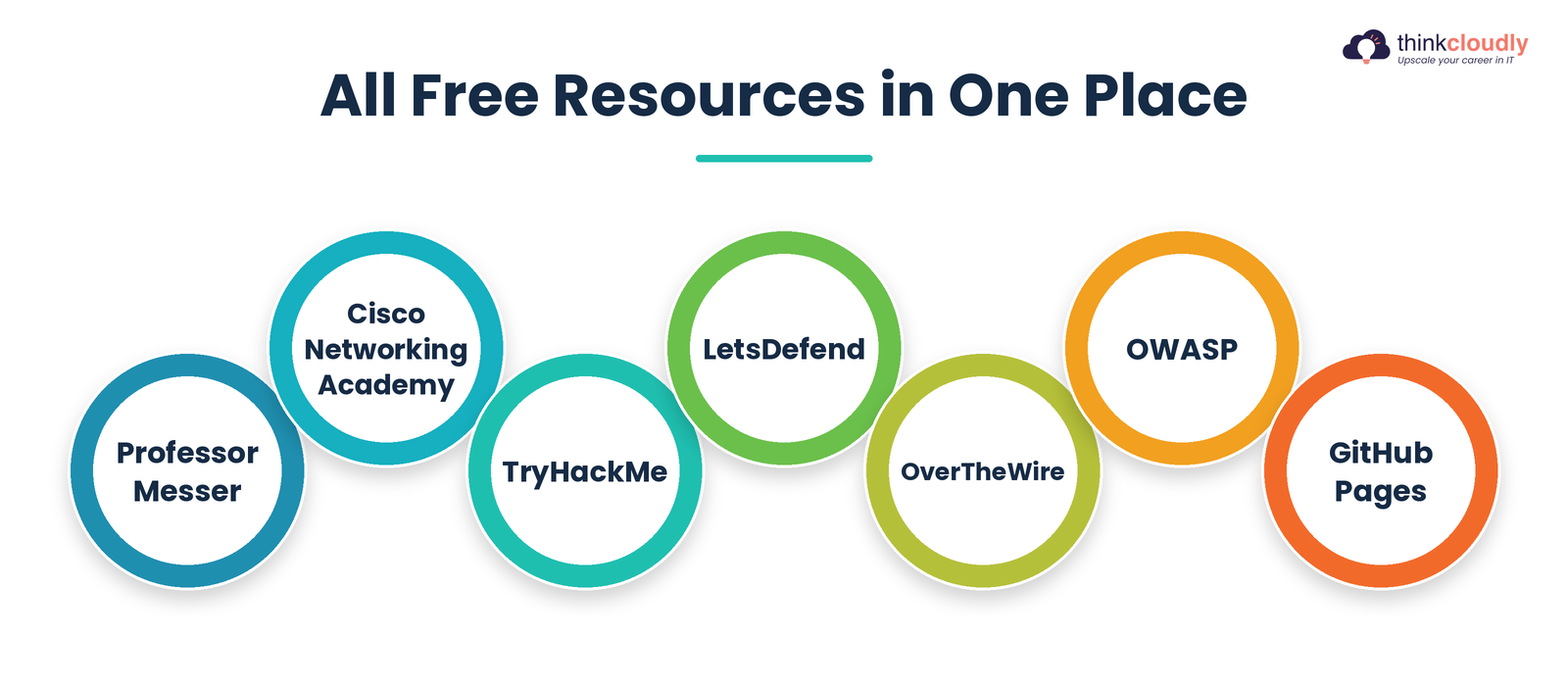
- Professor Messer — free Security+ and Network+ video courses
- Cisco Networking Academy — free self-paced networking fundamentals
- TryHackMe (free rooms) — guided, beginner-friendly hands-on labs
- LetsDefend — free blue-team SOC analyst simulations
- OverTheWire (Bandit) — free command-line and Linux practice wargame
- OWASP — free, community-maintained resources on web application security
- GitHub Pages — free hosting for your project write-ups
Entry-Level Cybersecurity Jobs You Can Target After 90 Days
After 90 focused days, realistic entry-level cybersecurity jobs include SOC Analyst Tier 1, IT support roles with a security focus, junior GRC analyst, or security operations intern—none of which typically require a four-year degree if you can show lab experience and a documented portfolio. Most entry-level cybersecurity jobs today list a certification and a demonstrable project over a specific degree requirement, which is a meaningful shift from hiring norms a decade ago.
The demand for entry-level cybersecurity jobs keeps climbing as organizations face ongoing workforce shortages. The U.S. Bureau of Labor Statistics projects information security roles to grow much faster than the average occupation over the next decade, and a large share of that growth sits in exactly the junior, entry-level tier this 90-day plan targets. Apply broadly, include your portfolio link in every application, and don’t wait until you feel “fully ready” — nobody ever does.
One mistake worth naming directly: a lot of beginners apply only to titles with the word “cybersecurity” in them and skip adjacent postings like “IT support analyst (security focus)” or “junior SOC technician,” which hire from exactly the same talent pool and often move faster. Casting a slightly wider net across job titles, while still targeting genuinely entry-level listings, tends to produce interviews faster than holding out for a single perfect-sounding role.
Is Cybersecurity Without a Degree Actually Possible in 2027?
Pursuing cybersecurity without a degree has gone from rare to fairly common over the last few years, and 2027 is arguably the easiest year yet to make that path work, simply because the free learning material and free lab infrastructure available today didn’t exist in anything close to this quality five years ago.
Employers hiring for cybersecurity without a degree are mostly checking for one thing: can you do the job. A documented portfolio, a foundational certification, and the ability to talk clearly through a lab exercise in an interview usually outweighs a degree on paper, especially at the entry level.
The honest case for cybersecurity without a degree rests on documented proof, not optimism — nobody is handed a job for good intentions, but plenty of people get hired on the strength of three well-written project write-ups and a working knowledge of the fundamentals covered in Month 1.
Groups like OWASP maintain free, community-built resources precisely because the field has always valued demonstrated skill over formal credentials — a tradition that predates the current hiring boom and still holds up in 2027. None of this means a degree is useless; it simply means it’s no longer the only door into the field, and for someone with no budget and no spare years, that matters far more than any single ranking of which path is “better” on paper.
A Personal Note
I didn’t come from a technical background either — my first real exposure to this field was a free weekend course I almost didn’t finish because I assumed I was “too behind” to catch up. The thing nobody tells beginners is that almost everyone in this field felt exactly that lost in their first month.
The difference between the people who make it and the people who quietly give up isn’t talent — it’s whether they kept a messy, imperfect log of what they learned and showed up the next day anyway. If you’re 90 days out from where you want to be, start today, keep your notes ugly and honest, and let the portfolio speak for itself later. It will.