







I’ve sat through enough Novembers watching recycled “mega sale” emails to know most aren’t worth the click. But when a training company puts its entire security catalog on the table instead of discounting three courses nobody was buying anyway that’s a different conversation.
This week, Thinkcloudly is running exactly that kind of offer, and anyone who’s been putting off a credential has a real reason to pay attention to this year’s cyber monday cybersecurity course deals before the window closes.
The timing isn’t an accident. Adobe’s 2026 holiday forecast expects Cyber Monday to pull in roughly $15.1 billion in U.S. online spending, up 6.2% year over year — the first time a single shopping day has crossed the $15 billion mark. Training companies know exactly how much buying attention is concentrated into this one day, which is precisely why a real cybersecurity training discount shows up now instead of being spread evenly across the calendar.
What makes this particular cyber monday cybersecurity course offer worth a second look isn’t the banner — it’s whether the discount applies to a course you’d actually use, with a current blueprint and a voucher that isn’t sold back to you separately three weeks later.
Thinkcloudly’s version this year gives you a choice rather than a single fixed number: 30% off any course in the catalog, or a Buy 1 Get 1 Free structure if you already know you’ll need a second credential down the line. Either way, the security and compliance tracks — including the Security+ course — are included at full strength, not quietly trimmed to make the discount look bigger than it is. Before deciding which structure fits your situation, it’s worth understanding why this year’s security training season matters more than most, what the offer actually covers, and where people usually go wrong with it.
Why This Year’s Cyber Monday Cybersecurity Course Deals Matter
A discount only means something if the skill behind it is in genuine demand, and the data heading into 2027 makes a strong case for cybersecurity specifically. The ISC2 Cybersecurity Workforce Study, based on more than 16,000 practitioners surveyed across North America, EMEA, Asia-Pacific, and Latin America, found that 59% of organizations now report critical or significant skills needs — up sharply from 44% the year before — and that 95% report at least one unmet skills need on their security team. That’s not a shortage confined to one region or one industry; it’s a gap that shows up almost everywhere security teams are asked to do more with the same headcount.
That gap is why a Cyber Monday cybersecurity course purchased this week carries more weight than the same course bought at full price in a random month. Teams aren’t short on tools — they’re short on people who can operate them, interpret an alert correctly, and pass the baseline exams compliance frameworks increasingly require. A well-timed cybersecurity training discount doesn’t manufacture that demand; it just makes it cheaper to close the gap your resume is missing.
What’s Included in This Cybersecurity Training Discount?
A percentage-off banner or a “free course” headline means nothing if the course behind it has been quietly stripped down. Here’s exactly what’s bundled into this year’s offer, so there’s no guesswork before checkout:
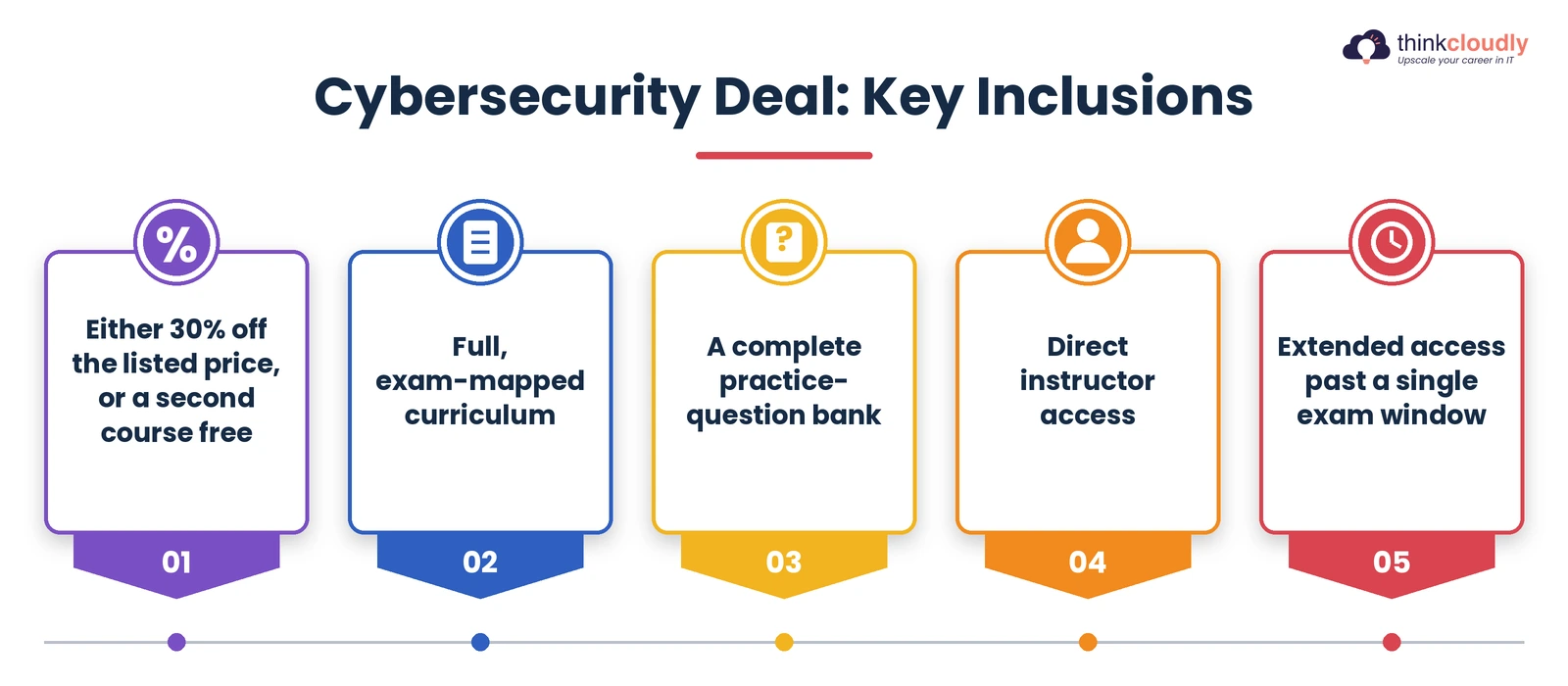
- Either 30% off the listed price, or a second course free, applied automatically at checkout — no separate coupon code that mysteriously only works on courses nobody wants.
- Full, exam-mapped curriculum for every security track, covering the current blueprint rather than a condensed highlight reel.
- A complete practice-question bank, deep enough to sit a full mock exam more than once before the real attempt.
- Direct instructor access, so a confusing scenario-based question on access control or incident response doesn’t sit unanswered for a week.
- Extended access past a single exam window, which matters if a retake is ever needed.
That voucher point is worth sitting with. Standalone exam vouchers for major security certifications routinely run into the hundreds of dollars, so a cybersecurity training discount that quietly excludes the voucher isn’t really a discount — it’s a smaller number today and a second bill in January.
30% Off or Buy 1 Get 1 Free: Which Fits Your Security+ Course Plan
Both structures are live this week, and the better choice depends on what you need, not which banner is louder. If one credential covers your current goal — say, a single Security+ course to meet a job requirement or a compliance mandate at work — the flat 30% off is simpler, with no second access window to track.
Buy 1 Get 1 Free wins if you already know a second certification is coming within a year or two. Pairing a Security+ course with a cloud security track, or a governance course with a hands-on SOC credential, means two usable certifications cost what one normally would. The only trap is picking the “free” course just because it’s free, not because it maps to an actual role.
Cyber Monday Cybersecurity Course Pricing
Pricing swings by track more than by provider, so here’s roughly how the main categories compare this week under either structure Thinkcloudly is running.
|
Course Track |
BOGO Value |
Best Suited For |
|
Security+ course (foundational security) |
Second course included free |
Career starters, help desk staff moving into security |
|
SOC & Threat Detection |
Second course included free |
SOC analysts, incident responders |
|
Cloud Security |
Second course included free |
Cloud engineers adding a security layer |
|
Governance, Risk & Compliance (GRC) |
Second course included free | Risk analysts, audit and compliance staff |
|
Advanced Security (CISSP-track) |
Second course included free | Security leads, aspiring managers |
Every row reflects the same underlying offer, which is the actual test of whether a cyber monday cybersecurity course deal is trustworthy — a provider that applies the same terms across every track isn’t steering buyers toward whatever course happens to be overstocked.
Why a Security+ Course Specifically Is Worth Grabbing This Week?
Out of every track in that table, the Security+ course deserves a specific callout, because it isn’t just another entry-level credential competing for attention. Under the U.S. Department of Defense’s 8140 directive, CompTIA Security+ was approved early and now maps to roughly 20 distinct cyber work roles — more than almost any comparable certification or training offering tracked under that framework, spanning everything from cyber defense analyst to information systems security manager. That breadth is part of why a Security+ course keeps showing up on hiring requirements for government-adjacent and private-sector security roles alike, years after other entry-level credentials have been quietly retired or replaced.
It also lines up with where training budgets are actually headed. Cybersecurity Ventures projects the global security awareness and training market will exceed $10 billion annually by 2027, up from roughly $5.6 billion a few years earlier, driven by organizations that have stopped treating security training as optional. A Security+ course bought through this week’s cybersecurity training discount sits right at the center of that spending curve — it’s the credential employers already expect, at a price that won’t repeat until next November.
Who Should Actually Use This Year’s Cybersecurity Training Discount?
Not every learner benefits equally from either structure, and pretending otherwise just leads to an unfinished course sitting untouched come January. This round of cyber monday cybersecurity course deals tends to make real sense for:
- Help-desk or IT support staff who already handle tickets touching security and want the Security+ course to formalize what they’re doing informally.
- Career changers moving into security from an adjacent IT role who want a structured, exam-mapped course instead of scattered free tutorials.
- SOC analysts and incident responders miss only the paper credential standing between them and the next pay grade.
- Anyone who already knows a second certification is coming within a year or two and can use Buy 1 Get 1 Free to get it at no extra cost.
- Compliance or risk staff whose employer now requires a baseline security certification as a condition of the role.
If none of that describes your situation, there’s no real cost to waiting. This same cybersecurity training discount tends to repeat around this exact week every year, so buying a course before there’s a plan to finish it just moves the spending earlier on the calendar instead of saving anything.
Checks Worth Running Before You Enroll
A steep discount can distract from the questions that decide whether a course is worth having at all. Before locking in any cyber monday cybersecurity course deal this week, confirm the following with the provider:
- Which exam version the Security+ course (or whichever track you’re choosing) is mapped to, by name, not a vague “kept current” claim.
- Whether the exam voucher is bundled into the discounted price, or sold back to you separately after checkout.
- What the retake policy actually covers if the first exam attempt doesn’t go as planned.
- Whether the 30% pricing or the BOGO structure has its own expiration date, separate from the course access window.
- How long you keep access to the practice-question bank once the exam is scheduled.
Skipping these checks is how a seemingly great cybersecurity training discount turns into a course that technically closes before you finish it, or an exam voucher you end up buying twice.
Mistakes That Quietly Undo a Good Cyber Monday Cybersecurity Course Purchase
The same handful of errors shows up every year during this exact sale window. Chasing whichever course has the loudest discount badge instead of picking the track that maps to your current or target role wastes the lower price entirely — a cloud-heavy certification helps little in a job that’s mostly governance and audit work, and the reverse holds just as true.
Grabbing two or three courses at once because the offer feels too good to pass up, then finishing none before access narrows, is another common trap; one finished Security+ course does more for a resume than three half-started tracks.
Skipping the accreditation check is the last mistake worth flagging. Assuming any provider running a cyber monday cybersecurity course offer is automatically an authorized training partner is an easy error to avoid — confirm partner status directly with the certifying body before entering payment details, regardless of how polished the sale page looks.
Making the Discount Count Through 2027
Letting the certification sit half-studied is the single most common way people waste a genuine cybersecurity training discount. Most security certifications, Security+ included, carry continuing-education requirements once passed, so budget that renewal cost the day you pass the exam, not months later when the notice lands.
Given the workforce-gap data cited earlier, a Security+ course or SOC-track credential earned through this week’s discount tends to pay for itself well before the next renewal cycle comes up. Demand for security talent isn’t slowing down heading into 2027, and a discounted certification purchased with an actual plan behind it does more for a career than the same money spent chasing whichever course had the loudest banner.
The Bottom Line
Strip away the marketing language and the math is straightforward: this year’s cyber monday cybersecurity course deals amount to a genuine 30% off or Buy 1 Get 1 Free offer on security training that normally runs into four figures per course, with the voucher and practice bank included rather than carved out. That consistency, not the size of the number on the banner, is what actually makes a cybersecurity training discount worth acting on this week instead of waiting for a smaller version of it later in the year.
A Personal Note
A former teammate messaged me this week asking whether she should finally commit to a Security+ course or wait to see if a bigger number shows up closer to December. My honest answer was that the discount wasn’t really her deciding factor.
She’d already known for months that the one thing standing between her current help-desk role and the SOC analyst job she actually wanted was a credential, not more hands-on experience. For someone already in that position, a cyber monday cybersecurity course deal is simply the week the math finally tips in her favor — the decision was made long before the sale appeared, and the discount just made it cheaper to act on.
The people who end up disappointed by a certification purchase are almost always working backward from the discount instead of forward from an actual goal. If you’re not yet sure which security track genuinely moves your career forward, spend this week figuring that out before spending a cent on it. The price will still be fair once the answer is clear — but if the answer is already clear, there’s very little reason to let this particular window pass by unused.
Note :- Pricing, offer structure, and course inclusions above reflect typical ranges for this sale season and are subject to change without notice — confirm the exact terms, voucher inclusion, and access window directly with Thinkcloudly before enrolling.