

Most students learn security backwards. They memorize the names of attacks—SQL injection, cross-site scripting, buffer overflows—before they ever learn to ask the one question that actually keeps systems safe: what could go wrong here, and who would want to make it go wrong?
That question, asked systematically instead of randomly, is the entire point of a threat modeling methodology. It’s not a tool you buy or a checklist you tick. It’s a structured way of thinking about a system before it’s built, so the expensive mistakes get caught on a whiteboard instead of in a breach report.
This guide walks through what this kind of structured security process actually is, why it matters more in 2026 than it did five years ago, the major frameworks you’ll encounter, and how to run your first threat model without feeling like you need a decade of experience to start.
If you’re a student, a junior developer, or someone studying for a security certification, this is the explanation I wish someone had given me before I read my first framework document cover to cover and understood none of it.
What a Threat Modeling Methodology Actually Is
A threat modeling methodology is a repeatable process for identifying, categorizing, and ranking the security weaknesses in a system before attackers do. It forces you to answer four questions, popularized by security engineer Adam Shostack: What are we building? What can go wrong with it? What are we going to do about it? And did we do a good enough job? Every serious version of this process, no matter which framework it borrows from, is really just a disciplined way of answering those four questions over and over as a system changes.
What makes this different from a general security review is structure. Ad-hoc “let’s think about security” meetings tend to circle the same two or three obvious risks every time. A properly structured process forces coverage—it makes you walk through every entry point, every trust boundary, and every piece of data flowing through the system as part of deliberate attack surface mapping, so you don’t just catch the vulnerability someone happens to remember but build a record of everything that’s actually exposed.
According to the OWASP Cheat Sheet Series on threat modeling, the practice works best when it’s treated as a continuous activity tied to the software development lifecycle, not a one-time exercise performed right before launch.
Why Does This Matter More in 2026 Than It Used To?
Two things changed the urgency around this. First, systems got more distributed—microservices, third-party APIs, serverless functions, and multi-cloud deployments mean the attack surface of a typical application is no longer one server and one database; it’s dozens of interconnected services, each with its own identity, permissions, and failure modes.
“Attack surface mapping” used to mean drawing a network diagram. Today it means tracking API endpoints, cloud storage buckets, CI/CD pipelines, and third-party integrations that change weekly.
Second, the sheer volume of reported vulnerabilities makes it impossible to fix everything, which is exactly why vulnerability prioritization has become its own discipline rather than an afterthought.
Security teams that once relied purely on CVSS severity scores are increasingly layering in exploit-prediction data, because a “critical” vulnerability that nobody is actively exploiting is a lower real-world risk than a “medium” one that’s already being weaponized in the wild—a distinction covered well in recent reporting on how KEV, EPSS, and CVSS scores can disagree when teams try to decide what to patch first.
This is exactly why vulnerability prioritization frameworks now blend several signals instead of trusting a single score, and why students learning this field need to understand more than one scoring system.
Cloud adoption has also made cloud security assessment a near-mandatory companion to any threat modeling methodology, because a huge share of real-world breaches now trace back to misconfiguration rather than a novel exploit.
A 2026 cloud security report from Fortinet found that organizations are increasingly grappling with what researchers call a “complexity gap”—the distance between how sprawling cloud environments have become and how mature the tools and processes are to actually secure them, as detailed in Fortinet’s 2026 Cloud Security Report. An approach that ignores cloud configuration is only looking at half the picture.
The Building Blocks: Assets, Actors, and Attack Vector Identification
Before picking a framework, every threat modeling methodology needs three inputs.
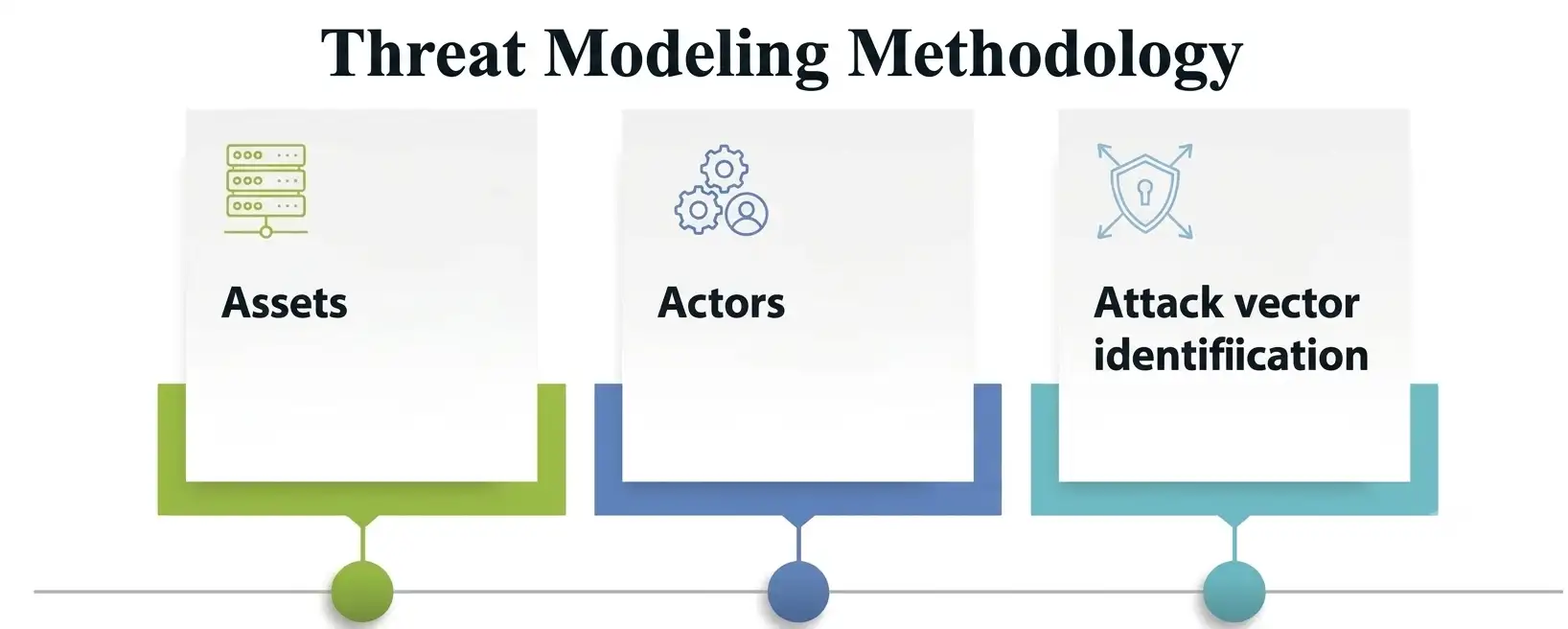
- Assets are what you’re protecting—customer data, authentication tokens, source code, payment information, or the availability of the service itself. You can’t defend something you haven’t named.
- Actors are who might attack it—not just “hackers” in a hoodie stereotype, but disgruntled insiders, automated bots scraping for misconfigured cloud storage, competitors, and nation-state groups depending on what you’re building. Different actors have different motivations and different levels of sophistication, and a good version of this process tailors its depth to the realistic actor profile rather than treating every system as if it faces the same adversary.
- Attack vector identification is the connective tissue between the two—it’s the process of mapping every path an actor could realistically use to reach an asset. Every input field, API call, file upload, third-party dependency, and authentication flow is a potential attack vector, and attack vector identification means walking through each one and asking whether it can be abused, bypassed, or manipulated.
This step is where diagrams earn their keep: a simple data flow diagram, with arrows showing how information moves between components, turns attack vector identification from a guessing game into a checklist you can actually complete.
Attack surface mapping and this narrowing step are two sides of the same coin: attack surface mapping catalogs everything exposed to the outside world, while the step above narrows that list down to what an actor could actually reach and abuse. Do the first without the second, and you end up with an inventory nobody acts on.
The Major Frameworks You’ll Encounter
There is no single official threat modeling methodology—there’s a family of them, each suited to different situations. Here’s a comparison of the ones you’re most likely to run into as a student or early-career practitioner.
|
Framework |
Best For | Core Question It Asks |
Typical Output |
|
STRIDE (Microsoft) |
Software architecture and system design | Which of six threat categories (Spoofing, Tampering, Repudiation, Information Disclosure, Denial of Service, Elevation of Privilege) applies to each component? |
Per-component threat list mapped to a data flow diagram |
|
PASTA (Process for Attack Simulation and Threat Analysis) |
Business-aligned risk analysis | How would a real attacker simulate an attack against this specific business context? |
Attacker-centric risk report tied to business impact |
|
DREAD |
Quick, rough-cut risk scoring | How damaging, reproducible, exploitable, affected, and discoverable is this threat? |
Numeric risk score per threat |
|
VAST (Visual, Agile, Simple Threat Modeling) |
Agile teams shipping continuously | Can threat modeling scale across dozens of sprints without slowing delivery? | Lightweight, automatable threat models per feature |
| Attack Trees | Mapping out how a specific goal could be achieved | What is every sequence of steps that leads to a defined attacker objective? |
Hierarchical tree of attack paths |
Running Your First Threat Model: A Practical Walkthrough
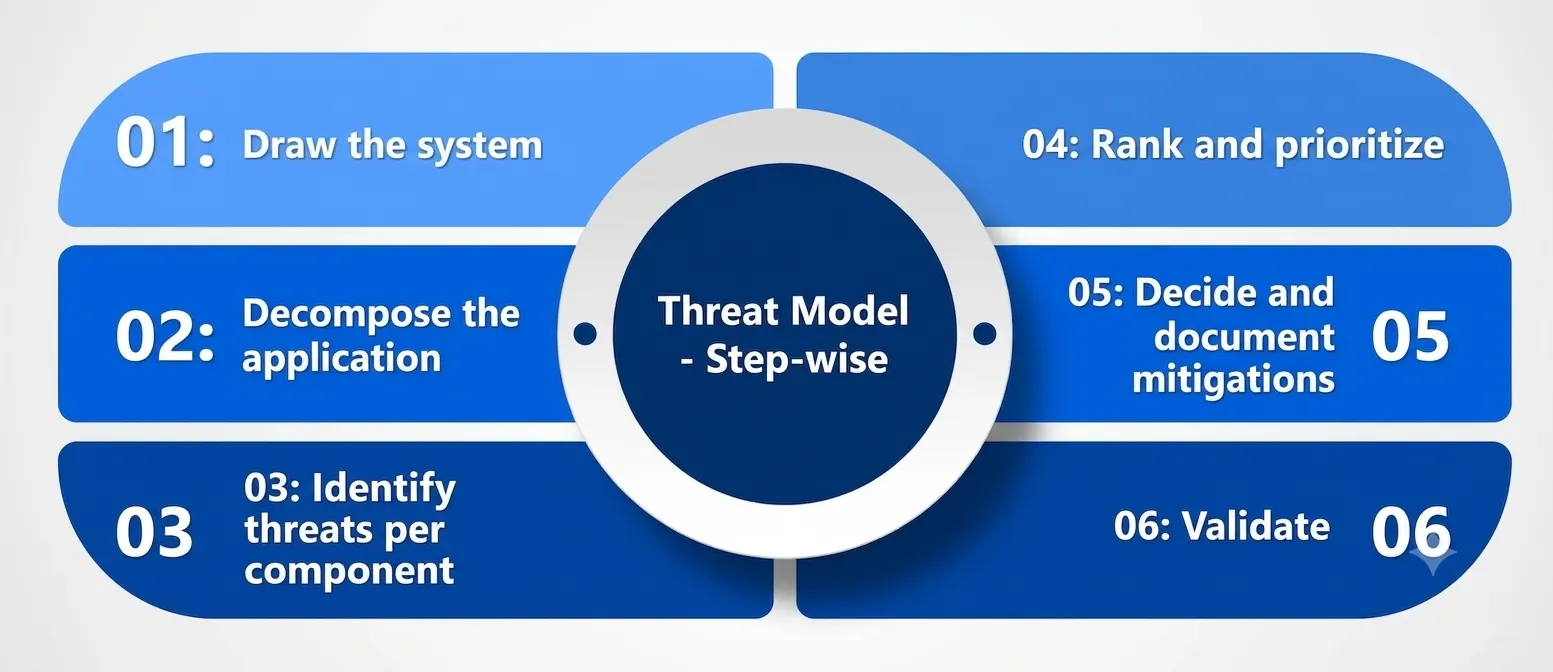
- Step 1: Draw the system. Sketch every component—front end, back end, database, third-party APIs, authentication service—and every line where data crosses a trust boundary. You don’t need fancy software; a whiteboard photo is a legitimate artifact.
- Step 2: Decompose the application. Break it into pieces small enough to reason about individually. This is where application security assessment work typically begins in practice—going component by component rather than trying to evaluate an entire system in one pass, because a full security review of the application on a monolith with no decomposition tends to miss subtle issues at the seams between components.
- Step 3: Identify threats per component. Apply your chosen framework—STRIDE is the easiest starting point for beginners. For each component, ask which of the six STRIDE categories could realistically apply, and use attack vector identification to trace how an attacker would actually reach that component from outside the system.
- Step 4: Rank and prioritize. Not every identified threat deserves the same urgency. This is where vulnerability prioritization comes in—scoring each threat by likelihood and impact, factoring in whether a similar vulnerability class is being actively exploited elsewhere, and deciding which fixes happen this sprint versus which get logged for later. Teams that skip vulnerability prioritization and try to “fix everything” tend to burn out and fix nothing well.
- Step 5: Decide and document mitigations. For each prioritized threat, decide whether you’re going to fix it, accept the risk, transfer it (insurance, third-party contracts), or avoid it (remove the feature). Document the decision—future audits and application security assessment reviews will thank you.
- Step 6: Validate. Revisit the model. Did the mitigations actually close the gap? This is also the natural point to fold in a cloud security assessment if any part of the system touches cloud infrastructure, since misconfigured storage buckets and overly permissive identity roles rarely show up in a pure code-level review.
Threat Modeling Methodology in the Context of Cloud and Application Security
It’s worth being explicit about how this planning process relates to the two assessment types students hear about most: application security assessment and cloud security assessment. An application security assessment typically looks at code, dependencies, authentication logic, and business logic flaws within the application itself.
A cloud security assessment looks at the infrastructure the application runs on—identity and access management, storage permissions, network segmentation, and configuration drift across cloud accounts.
A threat modeling methodology sits above both. It’s the planning layer that decides where an application security assessment and a cloud security assessment should focus their limited time, based on where the highest-value assets and the most exposed attack vectors actually are.
Skipping this step and jumping straight to running scanners is like hiring a home inspector without telling them which rooms you’re worried about—you’ll get a report, but it might miss the thing that actually matters to you.
Common Mistakes Beginners Make
Students new to this tend to make the same handful of errors. They treat the whole exercise as a one-time document instead of a living artifact that gets revisited when the system changes. They skip attack surface mapping and jump straight to listing threats from memory, which means they only catch the vulnerabilities they already know about.
They confuse a long list of threats with a prioritized one, forgetting that vulnerability prioritization is what actually makes the exercise useful to a busy engineering team. And they try to model an entire system in one sitting instead of decomposing it, which is exhausting and produces a shallow result.
The fix for all of these is the same: treat this discipline as a habit built into your development process, not an event. Small, frequent threat modeling sessions tied to design changes beat one exhaustive session that happens once a year and gets forgotten.
A Personal Note
I’ll be honest about where I landed on this after writing it out end to end: the framework you choose matters far less than whether you actually do it consistently. I’ve seen teams with a beautifully documented STRIDE process that gathers dust after the initial review, and I’ve seen scrappy teams with nothing more than a shared doc and fifteen minutes at the start of every sprint catch real, serious issues before they shipped.
If you’re a student trying to decide where to start, don’t get stuck picking the “correct” framework—pick STRIDE, run through one small feature this week, and let the habit teach you more than any single article can, including this one.