




Companies are always searching for skilled DevOps engineers who can manage both development and operations in today’s fast-moving tech world. With the rise of automation and cloud platforms, the DevOps engineer has become one of the most sought-after roles in IT. But a DevOps interview is not simple to crack if you don’t know which questions to expect.
This guide covers the top 25 DevOps interview questions and answers, from basic concepts for freshers to scenario-based questions for experienced candidates. Whether you are preparing for your first DevOps role or for a DevOps or Azure DevOps certification, practicing these questions will help you answer with confidence.
Basic DevOps Interview Questions for Freshers
Q.1 What is DevOps?
DevOps is a combination of two words, Development (Dev) and Operations (Ops). It is a set of practices that enables organizations to deliver software quickly and continuously. A DevOps engineer works with tools and procedures that automate operations, manage infrastructure, and ensure smooth delivery of applications. This is often the first question in any DevOps interview, so learn to answer it in two or three clear sentences.
In simple terms, DevOps is used to optimize the software development, testing, deployment, and maintenance processes.
Q.2 Who is a DevOps Engineer?
A DevOps engineer improves teamwork between development and operations and automates the software delivery process. They are central to cloud DevOps, which uses platforms like AWS and Azure to deploy and manage applications. A DevOps engineer uses different tools and technologies to ensure applications are delivered quickly and without errors.
Role-based questions like this are common in DevOps engineer interviews, so be ready to describe what a DevOps engineer does day to day: building CI/CD pipelines, managing infrastructure, monitoring systems, and fixing production issues. For Azure-specific roles, see our guide to Azure DevOps interview questions.
Q.3 What is CI?
CI stands for Continuous Integration. It is a DevOps practice where developers merge their code changes into a shared repository regularly. Automated tools then build and test the code to detect errors early. This improves code quality and reduces bugs before deployment.
A DevOps engineer uses CI tools like Jenkins or GitHub Actions to automate building and testing code. CI is a core part of the DevOps lifecycle and one of the most common topics for beginners.
Q.4 What is CD?
CD stands for Continuous Delivery or Continuous Deployment. Both start where CI ends, but they differ in one step:
- Continuous Delivery: every change that passes the tests is automatically prepared for release, but a person approves the final push to production.
- Continuous Deployment: every change that passes the tests is released to production automatically, with no manual approval.
In simple terms, CD makes the software delivery process faster and more reliable by automatically delivering tested code to users. DevOps engineers often use scripting languages like Python or Bash to automate these deployment steps. CI and CD together form the CI/CD pipeline, one of the most asked concepts in any DevOps interview.
Q.5 What are the benefits of DevOps?
DevOps offers many benefits to organizations. Some of them are:
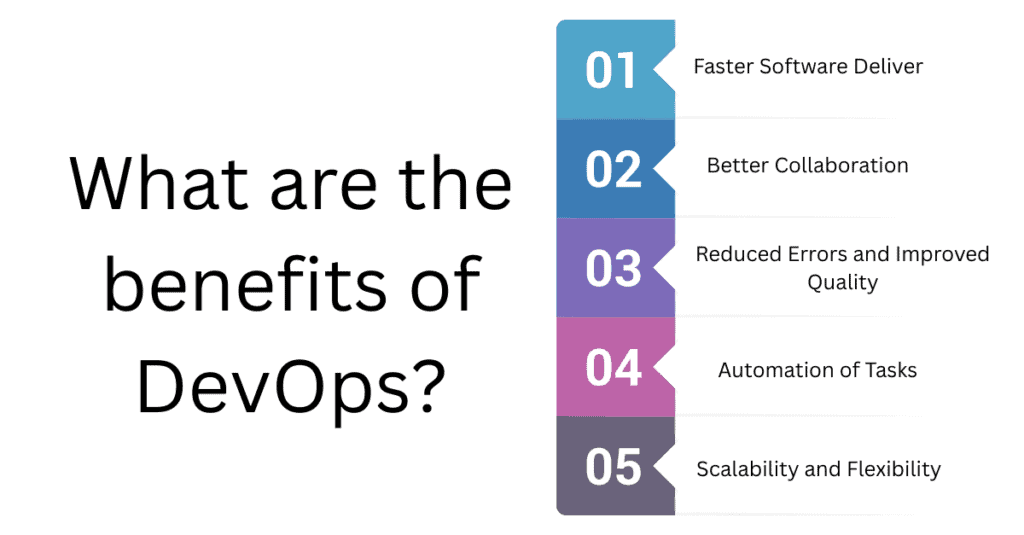
- Faster Software Delivery: Faster delivery is one of the main advantages of DevOps. Using CI/CD, a DevOps engineer can release updates regularly. This matters most in cloud environments, where apps are updated constantly.
- Better Collaboration: DevOps encourages teamwork between developers and operations, which reduces communication gaps and improves productivity.
- Reduced Errors and Improved Quality: Automated testing detects bugs early, before deployment.
- Automation of Tasks: Tools and scripts automate repetitive tasks like testing, deployment, and monitoring.
- Scalability and Flexibility: DevOps practices let systems handle more users easily, which is especially useful in cloud environments.
Interviewers ask this question to check that you understand why companies adopt DevOps, not just the tools.
Q.6 What coding and scripting skills are required to become a successful DevOps engineer?
To become a successful DevOps engineer, you need a combination of programming and scripting skills that support automation, deployment, and infrastructure management.
Here are the languages you should learn:
- Programming languages: Python, Go (Golang), JavaScript, Java.
- Scripting: Bash/Shell scripting, PowerShell, Ruby.
Python for DevOps is the most common starting point because it is used for automation scripts, tooling, and cloud SDKs. Many DevOps interviews include practical coding or command-line tasks, so a foundational knowledge of at least one programming and one scripting language increases your chance of selection.
Q.7 What is the difference between DevOps and Agile?
DevOps and Agile are both important methodologies in software development, and this comparison is one of the most frequently asked DevOps interview questions.
Here are the main differences between DevOps and Agile:
| DevOps | Agile |
|---|---|
|
Focuses on both developmen |
that focuses on iterative development. |
|
Covers end-to-end delivery, including deployment and operations. |
Focuses on software development and teamwork. |
|
Uses CI/CD pipelines and automation. |
Works in short cycles called sprints. |
|
Uses automation tools and scripting. |
Uses project management tools like Jira. |
|
Covers development, deployment, and monitoring. |
Focuses mainly on the development phase. |
The two are not rivals: most teams use Agile to plan and build software and DevOps to deliver and run it.
DevOps Tools Interview Questions: Docker, Kubernetes, Jenkins, Git, Ansible, and Azure DevOps
Q.8 What is Docker?
Docker is a containerization platform that allows developers to package an application along with its dependencies into a container. Interviewers often ask about Docker concepts, commands, and real-world usage, so it is one of the most important topics to prepare.
In simple words, Docker lets you run an application anywhere without worrying about setup or system differences. For example, imagine you send your project to someone and it doesn’t work on their system. Docker solves this problem by packing your application with everything it needs, such as code, settings, and tools, into one box called a container.
A common follow-up is Docker vs a virtual machine: a VM runs a full guest operating system, while containers share the host’s OS kernel, so containers start in seconds and use far less memory.
Q.9 What is Kubernetes?
Kubernetes is an open-source container orchestration platform. It helps you manage and control many Docker containers across multiple servers. Managing many containers manually is challenging, which is why we use Kubernetes.
It works like a manager that starts containers, stops them, scales them, and fixes them if something goes wrong. In Kubernetes, containers run inside pods, and pods run on worker nodes.
Q.10 What is Azure DevOps?
Azure DevOps is a Microsoft platform that helps teams plan, build, test, and deliver software in one place. Let’s understand it with a simple scenario: imagine you are building an app with a team. One person writes code, one tests it, and another team deploys the application. Azure DevOps gives everyone one platform to work together and manage the whole process. Its main services are Azure Boards, Azure Repos, Azure Pipelines, Azure Test Plans, and Azure Artifacts.
Q.11 What is Infrastructure as Code (IaC)?
Infrastructure as Code (IaC) is the practice of creating and managing infrastructure using code instead of manual setup. With IaC, you write the code once, and it creates the same setup automatically anytime you need it. Popular IaC tools include Terraform, AWS CloudFormation, and Azure Bicep or ARM templates. IaC is a core topic in DevOps and Azure DevOps interviews.
Q.12 What is configuration management?
Configuration Management in DevOps is the process of maintaining and managing systems, servers, and software in a consistent and organized way. It helps you set up and manage all systems automatically and ensures they stay identical and up to date without errors. Common tools include Ansible, Chef, and Puppet.
Q.13 What is an Azure DevOps pipeline?
An Azure DevOps pipeline (Azure Pipelines) is a service that automatically builds, tests, and deploys your code. It is the Azure DevOps feature that supports Continuous Integration (CI) and Continuous Deployment (CD), and pipelines are usually defined in a YAML file stored with the code. It is a commonly asked topic in Azure DevOps interviews.
Q.14 What is Jenkins, and how is it used?
Jenkins is an open-source automation server used in DevOps to build, test, and deploy applications automatically. It helps teams deliver software faster by automating CI/CD pipelines and reducing manual work. Pipelines are usually written as code in a Jenkinsfile, and Jenkins jobs can run shell or Python scripts to automate extra tasks. Jenkins and Docker are among the most asked tools in DevOps interviews.
Q.15 What are microservices?
Microservices are a way of breaking a big application into small, independent services. Each service works separately and can be built, deployed, and scaled on its own, usually by the team that owns it, but together they form a complete application. DevOps practices like CI/CD and containers make running many microservices practical.
Q.16 Name three important DevOps KPIs.
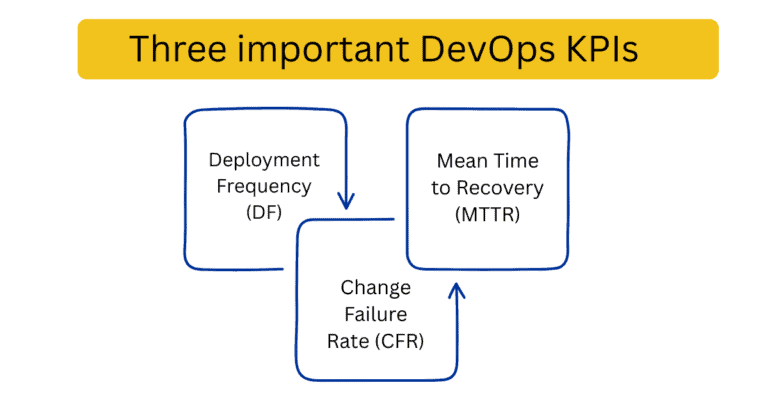
KPIs (Key Performance Indicators) are metrics used to measure how efficiently a DevOps team delivers software. Three important DevOps KPIs are
- Deployment frequency: how often the team releases to production.
- Lead time for changes: how long a code change takes to go from commit to production.
- Mean time to recovery (MTTR): how quickly the team restores service after a failure.
Together with change failure rate, these make up the four DORA metrics, which interviewers often ask about by name.
Q.17 What is the cherry-pick command in Git?
The git cherry-pick command copies a single commit from one branch and applies it to another. If a branch has many changes but you only want one specific change, cherry-pick lets you apply just that one. For example, git cherry-pick a1b2c3d applies the commit with that hash to your current branch. It is often used to move a bug fix to a release branch.
Q.18 What is Ansible?
Ansible is an open-source IT automation tool used for configuration management, application deployment, and task automation. It is developed by Red Hat and is agentless, meaning it connects to servers over SSH without installing anything on them. It helps teams manage systems without doing everything manually.
Let’s take an example. If you want to install one piece of software on 15 computers, you would normally do it manually, one by one. Ansible lets you do it automatically in one step: you just write a playbook of instructions.
A DevOps engineer creates a playbook file with steps like:
- Install software
- Update system
- Start service
Once the playbook is ready, you run a single command, ansible-playbook install.yml, and Ansible will:
- Connect to all systems
- Follow the same instructions
- Complete the task automatically
This is very useful in cloud environments, where managing many servers manually is difficult.
Q.19 What is Azure Repos?
Azure Repos is a service in Azure DevOps that provides version control for your code. It allows developers and DevOps engineers to store, manage, and track changes in their code using Git. It is a common topic in Azure DevOps interviews, especially for roles involving Git and version control.
Q.20 What is Azure Boards?
Azure Boards is a tool for managing tasks, bugs, and project progress using Agile methods like Kanban or Scrum. Project tracking tools like this are part of modern DevOps interview questions because they connect planning with delivery.
Scenario-Based DevOps Interview Questions for Experienced Candidates
Experienced candidates are rarely asked for definitions. Expect questions that test how you handle real problems.
Q.21 What is the difference between blue-green and canary deployments?
In a blue-green deployment, you run two identical environments. The current version runs on blue, the new version is deployed to green, and traffic is switched to green all at once. If something breaks, you switch back to blue.
In a canary deployment, the new version is released to a small share of users first, for example 5%. If error rates and performance stay healthy, traffic is increased step by step until everyone is on the new version.
Q.22 A production deployment has failed. How would you roll it back?
First, restore service, then investigate. Roll back to the last known good version using the method your setup supports: switch traffic back in blue-green, redeploy the previous image tag, or run kubectl rollout undo in Kubernetes. Then check logs and monitoring to confirm the system is stable, find the root cause, and add a test or pipeline check so the same failure can’t reach production again.
Q.23 A Kubernetes pod is stuck in CrashLoopBackOff. How do you troubleshoot it?
CrashLoopBackOff means the container keeps starting and crashing. A good answer walks through the steps:
- Run
kubectl describe pod <pod-name>to check events, exit codes, and restart reasons. - Run
kubectl logs <pod-name> --previousto see the logs from the crashed container. - Check for common causes: a wrong command or image, missing environment variables or secrets, failing liveness probes, or memory limits that are too low (OOMKilled).
- Fix the cause and redeploy, then watch the pod until it stays running.
Q.24 Your CI/CD pipeline has become very slow. How would you speed it up?
Start by measuring which stage takes the longest. Common fixes include caching dependencies and Docker layers, running independent tests in parallel, building only the services that changed, using smaller base images, and adding more or faster build agents. Interviewers want to see that you measure first instead of guessing.
Q.25 How do you manage secrets in a DevOps pipeline?
Never store passwords, API keys, or tokens in code or in plain-text pipeline files. Use a secrets manager such as Azure Key Vault, AWS Secrets Manager, or HashiCorp Vault, and inject secrets into the pipeline at runtime. Limit who can read them, rotate them regularly, and add secret-scanning to the pipeline so a leaked key is caught before it is merged. This practice is part of DevSecOps.
How to Prepare for a DevOps Interview
- Learn the fundamentals first: Linux commands, networking basics, and Git.
- Build one end-to-end project: code in Git, a CI/CD pipeline, a Docker image, and a deployment to Kubernetes or a cloud service.
- Practise explaining your answers out loud, using examples from your own projects.
- Prepare for at least two scenario questions, such as a failed deployment or a slow pipeline.
- Take a practice assessment to find gaps before the real interview.
Conclusion
Whether you are preparing for your first DevOps role, a DevOps certification, or an Azure DevOps certification, a strong foundation in both concepts and practical tools is essential. These DevOps interview questions and answers will help you crack the interview and also build the real-world skills needed in modern software teams.
Interviewers look for candidates who understand the ideas behind DevOps and can use the tools: scripting in languages like Python, building CI/CD pipelines, and working with automation and deployment tools. Practise these 25 questions, build a small project, and you will walk into your DevOps interview prepared.