
I still remember the night before my Ansible exam attempt — three browser tabs open, a half-finished playbook that refused to run idempotently, and a nagging feeling that I had prepared for the “wrong” exam. If you’re reading this because you’ve typed that certification’s name into Google at 11 PM wondering where to even start, you’re not alone, and you’re in the right place.
This guide isn’t a repost of Red Hat’s exam objectives page with a new headline slapped on it. It’s a study plan built the way I’d explain it to a friend over coffee — week by week, mistake by mistake, with the boring-but-important stuff explained in plain English instead of certification-speak.
By the end of this post, you’ll know exactly which certification path fits your career stage, what to study each week, which tools actually matter in 2026, and where the real pitfalls are.
Why Does the Red Hat Ansible Certification Still Matters in 2026?
Let’s get the obvious question out of the way first:
Is it still worth the time and money in 2026, when every job posting seems to want “AI-driven automation” and “cloud-native everything”?
Short answer: yes, and arguably more than ever. Automation hasn’t gotten less important — it’s gotten more central. Every organization moving toward hybrid cloud, DevOps pipelines, or infrastructure-as-code still needs people who can write, test, and maintain Ansible playbooks that actually work in production, not just in a demo. That’s exactly what the Red Hat Ansible Certification proves.
According to a detailed RHCE Complete Guide for 2026, the current Ansible-focused exams are built entirely around hands-on, performance-based tasks: the RHCE exam focuses entirely on Ansible automation, reflecting industry demand for infrastructure-as-code skills, and it builds on the RHCSA foundation by adding automation capabilities that multiply a system administrator’s effectiveness. That single fact tells you everything about why employers still respect this credential: it isn’t multiple-choice trivia, it’s proof you can actually do the job.
If you’re a system administrator who’s tired of SSH-ing into fifty servers one by one to apply the same patch, this certification is basically the natural next step in your career. And if you’re aiming to become a full-time automation engineer, the Red Hat Ansible Certification is often the first credential recruiters look for on your resume.
Understanding the Certification Path
Here’s something a lot of guides gloss over: “Red Hat Ansible Certification” isn’t one single test. It’s a path, and picking the right starting point saves you weeks of wasted effort.
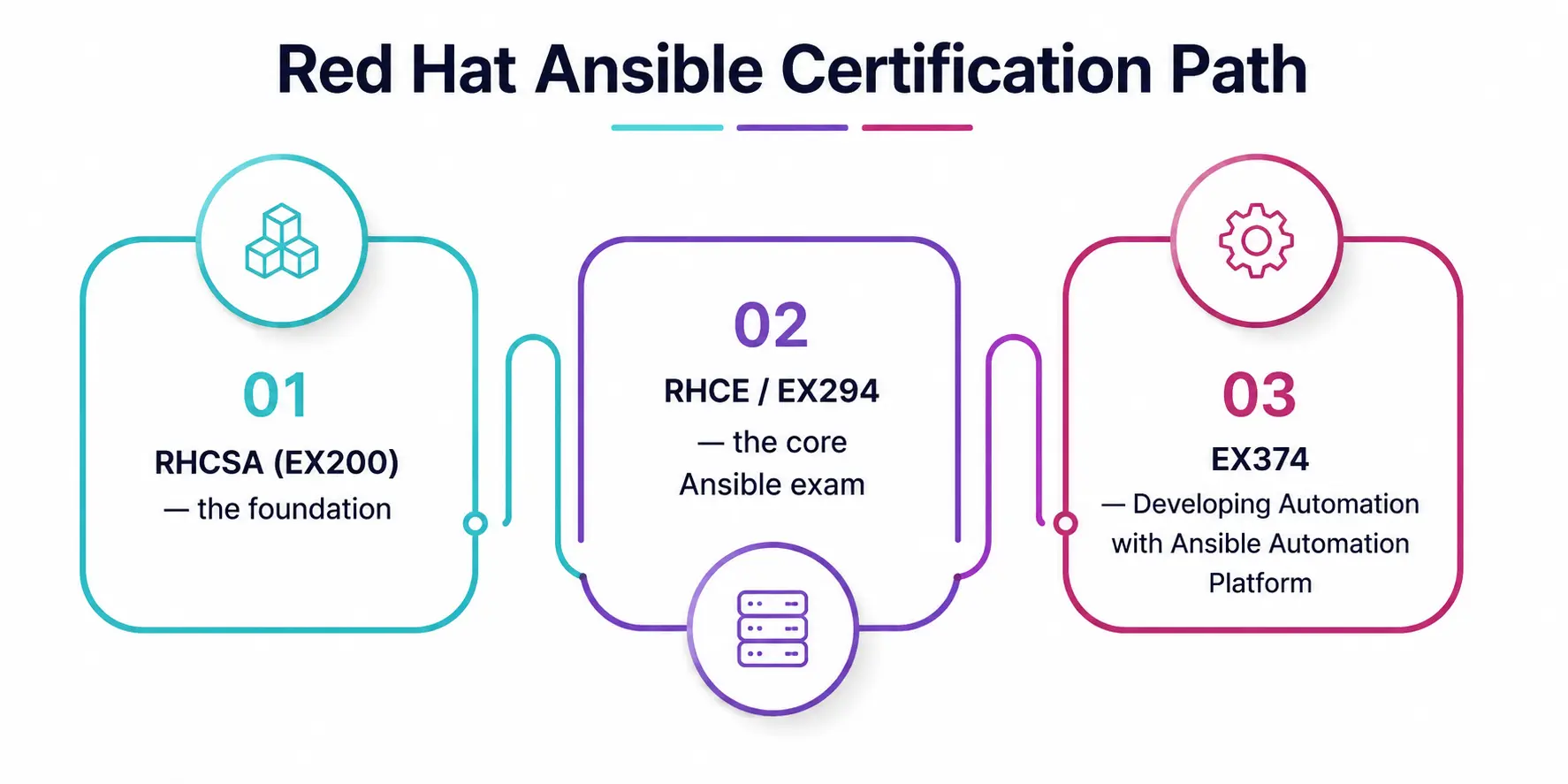
1. RHCSA (EX200) — the foundation
Before you even touch Ansible seriously, Red Hat expects you to know core Linux administration: users, permissions, storage, and networking basics. Most study plans skip this step and regret it later, because Ansible modules are just automated versions of things you’re expected to already know how to do manually.
2. RHCE / EX294 — the core Ansible exam
This is what most people actually mean when they say “Red Hat Ansible Certification.” It’s the Red Hat Certified Engineer exam, and it’s fully hands-on. As the sources puts it plainly: as a performance-based exam, RHCE tests real skills on live systems, and there are no multiple-choice questions — you must complete actual automation tasks using Ansible. No guessing your way through with elimination tricks here.
3. EX374 — Developing Automation with Ansible Automation Platform
This is the advanced specialist exam for people who want to go deeper into automation controllers, automation hub, and more complex enterprise workflows. Red Hat’s exam page notes that this exam is based on Red Hat Ansible Automation Platform 2.5 and is meant for anyone seeking a broader knowledge of Ansible best practices.
If you’re already a Red Hat Certified Engineer and want to push toward RHCA (Red Hat Certified Architect), this is your next stop, since the same official Red Hat page confirms passing this exam also counts toward earning a Red Hat Certified Architect credential.
So before you build your study calendar, be honest with yourself about which exam you’re actually preparing for. A Red Hat Ansible Certification study plan for EX294 looks very different from one built around EX374.
The Full 2026 Study Plan: Week by Week
I’ve broken this into a 10-week plan because that’s roughly how long it takes most working professionals — not full-time students — to go from “I’ve heard of Ansible” to “I’m confident walking into the exam room.” Adjust it up or down based on your existing experience.
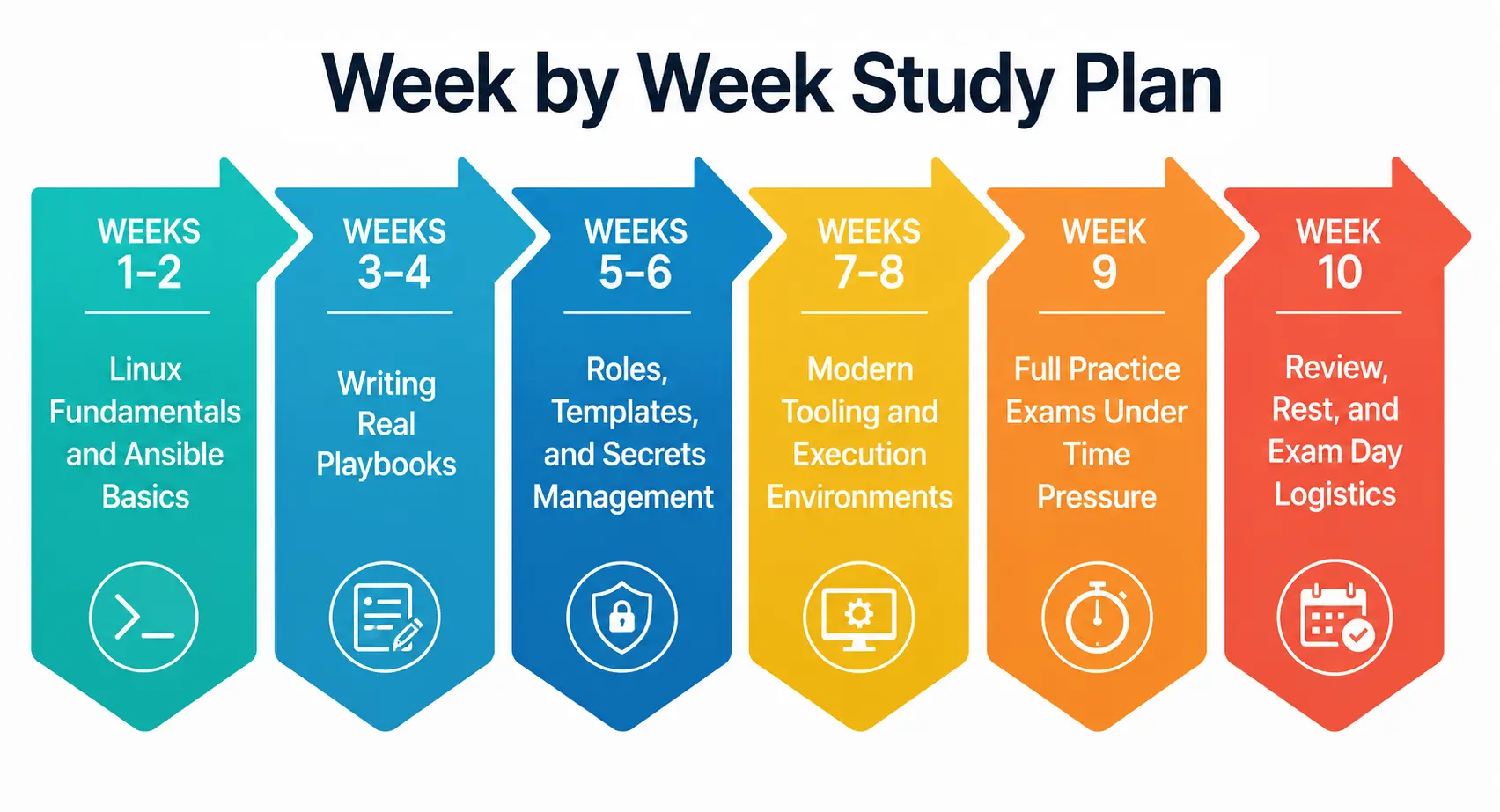
Weeks 1–2: Linux Fundamentals and Ansible Basics
Don’t skip this even if you think you’re “past it.” Review user management, file permissions, SELinux basics, and systemd services. Then install Ansible on a control node and get comfortable with:
- Inventory files (static and dynamic)
- Ad-hoc commands (ansible all -m ping)
- Basic YAML syntax (yes, indentation will annoy you—get over it early)
Weeks 3–4: Writing Real Playbooks
This is where things get interesting. Learn:
- Tasks, handlers, and variables
- Loops and conditionals
- Facts gathering and how to use gather_facts
- Idempotency — writing playbooks that can run twice without breaking anything
This is also the point where most system administrator career changers start feeling like real automation engineer candidates because you stop thinking in single commands and start thinking in repeatable processes.
Weeks 5–6: Roles, Templates, and Secrets Management
Roles are how professional Ansible code is actually organized — stop writing giant single-file playbooks. Learn `ansible-galaxy init` to scaffold roles properly, and get serious about Jinja2 templating for dynamic configuration files.
This is also when you need to sit down properly with Ansible Vault. If you’ve never used it: this tool encrypts sensitive data — passwords, API keys, private variables—so they’re never stored in plain text inside your playbooks or version control. In the exam, and in real jobs, forgetting to encrypt credentials properly is one of the fastest ways to fail a security review, let alone an exam task. Practice encrypting a variable file, editing it in place, and running a playbook that decrypts it at runtime using a vault password file. Do this until it’s muscle memory.
Weeks 7–8: Modern Tooling and Execution Environments
2026 exams reflect 2026 tooling. A recent RHCE EX294 2026 exam prep overview points out that candidates need to master the current toolset—including ansible-navigator and Execution environments—to be prepared for the specific performance-based environment of the 4-hour RHCE exam. If your study materials only mention the old ansible-playbook command and nothing about ansible-navigator or execution environments, they’re outdated. Update your practice environment accordingly.
Week 9: Full Practice Exams Under Time Pressure
By now you should be doing full mock exams with a timer running. The real exam gives you a fixed window, and running out of time is one of the most common reasons candidates fail — not lack of knowledge, but poor time management. A detailed EX294 prep guide sums this up well: time pressure is a real challenge, since completing all tasks within four hours needs practice, and candidates should master time management by allocating sufficient time for each task.
Week 10: Review, Rest, and Exam Day Logistics
Review your weakest domains only — don’t try to relearn everything in the final week. Confirm your exam environment requirements ahead of time. Remember that Red Hat performance-based exams are strict about configurations persisting after reboot, so double-check that habit in your final practice runs.
Red Hat Ansible Certification Exam Comparison
|
Exam |
Focus Area | Best For |
Format |
|
EX200 (RHCSA) |
Core Linux administration | Beginners building a foundation |
Performance-based |
|
EX294 (RHCE) |
Ansible automation for RHEL systems | IT professionals moving into automation roles |
4-hour, fully hands-on |
|
EX374 |
Advanced Ansible Automation Platform development | Experienced professionals aiming higher, including specialists chasing RHCA |
Performance-based, enterprise-focused |
Building a Home Lab That Actually Mirrors the Exam
One thing I wish someone had told me earlier: don’t study Ansible only through slides and videos. Set up a small home lab with two or three virtual machines — one control node and a couple of managed nodes — and treat it like your own miniature data center. Break things on purpose. Change a service’s configuration by hand, then write a playbook to fix it back to the desired state. That single exercise teaches idempotency better than any lecture ever could.
If you have access to a spare laptop, an old desktop, or even just enough RAM to run a few VirtualBox instances, use it. Cloud sandboxes work too, but there’s something about having full control over your own environment — being able to snapshot it, break it, and roll it back — that builds real confidence. Many candidates preparing for the certification report that the hands-on lab time mattered more than any single course or book, simply because the exam itself is entirely about doing, not recalling facts.
As you build out your lab, also practice pairing roles with Ansible Vault so encrypted variables flow naturally into your playbook runs—this combination comes up constantly in real enterprise environments.
Choosing the Right Study Resources in 2026
Not all study material is created equal, and this is where a lot of candidates waste money. A few practical filters that helped me:
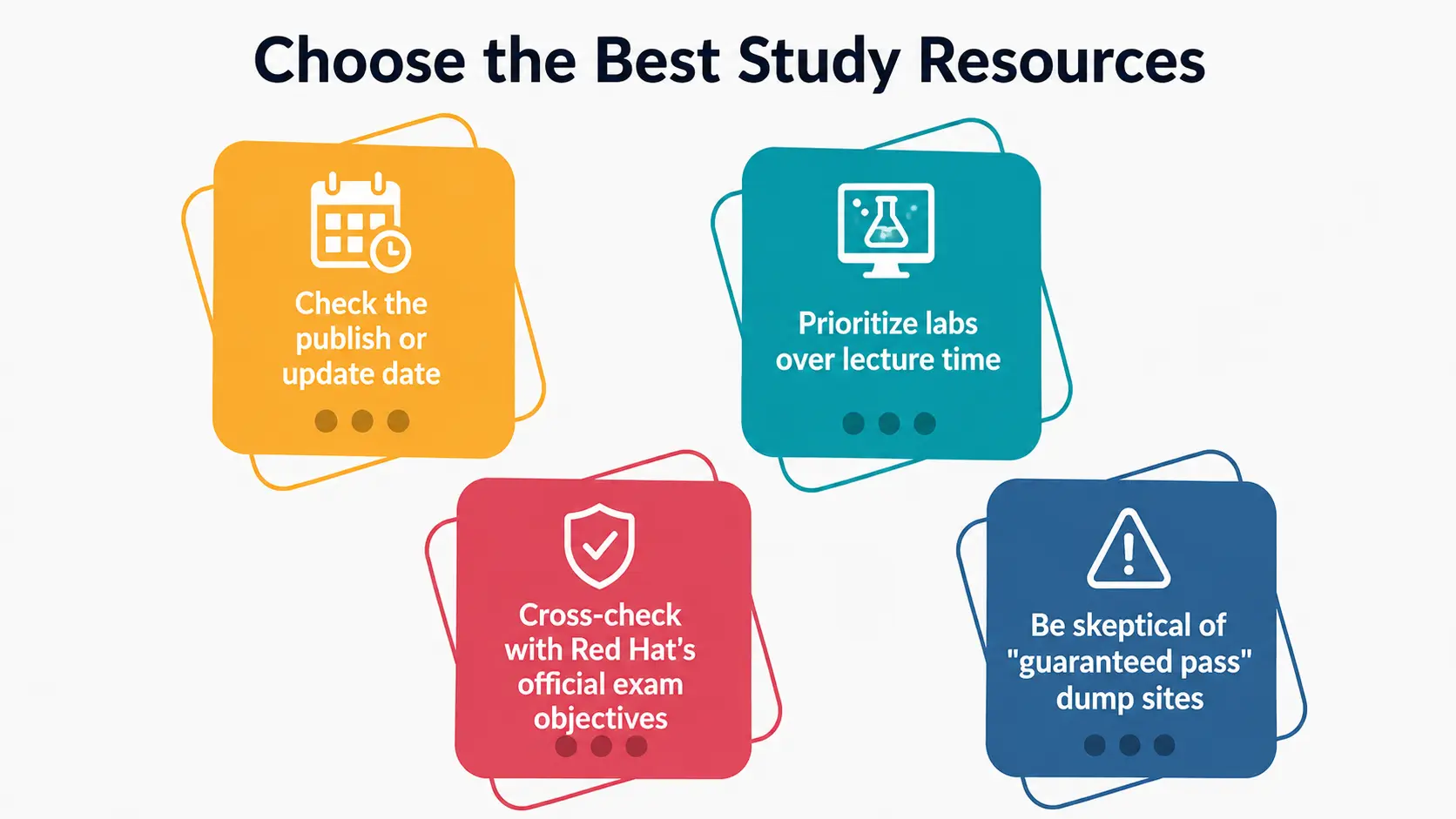
- Check the publish or update date. Ansible and Red Hat’s tooling move quickly. A course recorded even eighteen months ago may already be missing references to newer tooling like ansible-navigator or updated execution-environment workflows.
- Prioritize labs over lecture time. A ten-hour course with two hours of hands-on labs is far less useful than a five-hour course built entirely around guided exercises.
- Cross-check with Red Hat’s official exam objectives. Third-party courses are helpful for explanation, but the official objectives page is the ground truth for what’s actually testable.
- Be skeptical of “guaranteed pass” dump sites. They might contain outdated questions, and depending too heavily on memorized answers leaves you exposed the moment the exam presents a scenario you haven’t literally seen before. Real understanding transfers; memorized answers don’t.
A well-rounded Red Hat Certified Engineer candidate typically mixes three types of resources: one structured course for foundational explanation, one hands-on lab platform for repetition, and the official Red Hat documentation for anything that feels unclear. Relying on just one of the three usually leaves gaps. This mixed approach is also exactly how a working automation engineer keeps skills current after certification, since the platform itself keeps evolving year over year.
Common Mistakes People Make While Preparing
I’ve seen (and made) most of these myself:
- Memorizing modules instead of understanding logic. The exam changes scenarios; memorized answers don’t transfer.
- Ignoring secret encryption until last week. It shows up more often than people expect, and rushing it leads to silly mistakes under time pressure.
- Practicing only in a GUI-based sandbox. The real exam is command-line driven — get comfortable typing, not clicking.
- Underestimating YAML formatting errors. A single misplaced space can break an entire playbook, and under exam stress, that’s exactly when it happens.
Career Impact: What Comes After the Certification
Once you’re certified, the real question is what doors it opens. Employers across finance, telecom, healthcare, and government sectors are actively hiring for automation skills, and an industry write-up on the EX374 specialist track notes that organizations in finance, healthcare, telecom, government, retail, and cloud services are looking for certified automation professionals, and employers prioritize proven automation expertise over informal experience.
Whether you’re staying in your current IT role and adding automation to your toolkit or fully transitioning into a dedicated career path, the Red Hat Ansible Certification acts as evidence—not just a claim on your resume, but proof you can build and maintain automation that survives contact with a real production environment.
Final Thoughts: A Personal Note
I’ll be honest — the first time I sat down to plan my own Ansible study schedule, I overcomplicated it badly. I bought three different courses, tried to study everything at once, and burned out two weeks in. What actually worked was slowing down, building small playbooks that solved real annoyances in my own home lab, and only then moving on to timed practice exams.
If there’s one piece of advice I’d want you to walk away with, it’s this: don’t chase certification for the badge. Chase it because you want to genuinely stop doing repetitive work by hand. The exam pressure fades in a few hours; the skill stays with you for years. Good luck — you’ve got this.