

If you’ve ever studied auditing, cybersecurity, or accounting, you’ve probably run into one question that trips up almost every beginner: what’s the actual, practical difference between a control that stops a problem and a control that catches one? That question sits at the heart of Preventive vs Detective Controls, and once it clicks, half of internal-control theory suddenly makes sense.
This isn’t just textbook trivia. Every organization — a college finance office, a hospital, a bank, a software company — runs on a mix of controls that either block bad things from happening or find them after the fact. Understanding the difference is one of the fastest ways to think like an auditor, a security analyst, or a risk manager, even if you’ve never held any of those job titles.
In this guide, we’ll break down what each type of control actually does, how they fit into the bigger world of organizational safeguards, where follow-up fixes and continuous monitoring come in, why layering both matters, and how everything connects to the wider set of control categories you’ll meet in any audit or cybersecurity course.
By the end, you’ll be able to look at any control — a password policy, a bank reconciliation, a fire alarm — and immediately classify it.
What Are Internal Controls, Really?
Before unpacking Preventive vs Detective Controls, it helps to zoom out. Internal controls are the policies, procedures, and mechanisms an organization puts in place to protect its assets, ensure accurate reporting, and keep operations running the way they’re supposed to.
Think of them as the guardrails of an organization — some guardrails stop your car before it goes off the road, and others just tell you that you already drove off it. The most widely used framework for thinking about internal controls comes from the COSO Internal Control–Integrated Framework, which groups control activities into preventive, detective, and corrective categories.
Auditors, accountants, and IT security teams all lean on some version of this model, whether they call it COSO, ISO 27001, or NIST SP 800-53. Regardless of the label, every control ultimately does one of two jobs: it reduces the chance that something goes wrong, or it catches things quickly once they already have.
Preventive Controls: Head Off the Trouble Before it Starts
Preventive controls are intended to prevent an error, a fraudulent attempt, or a security incident from occurring. They’re checking IDs at the front door before anyone gets in.
Typical examples of preventive controls include:
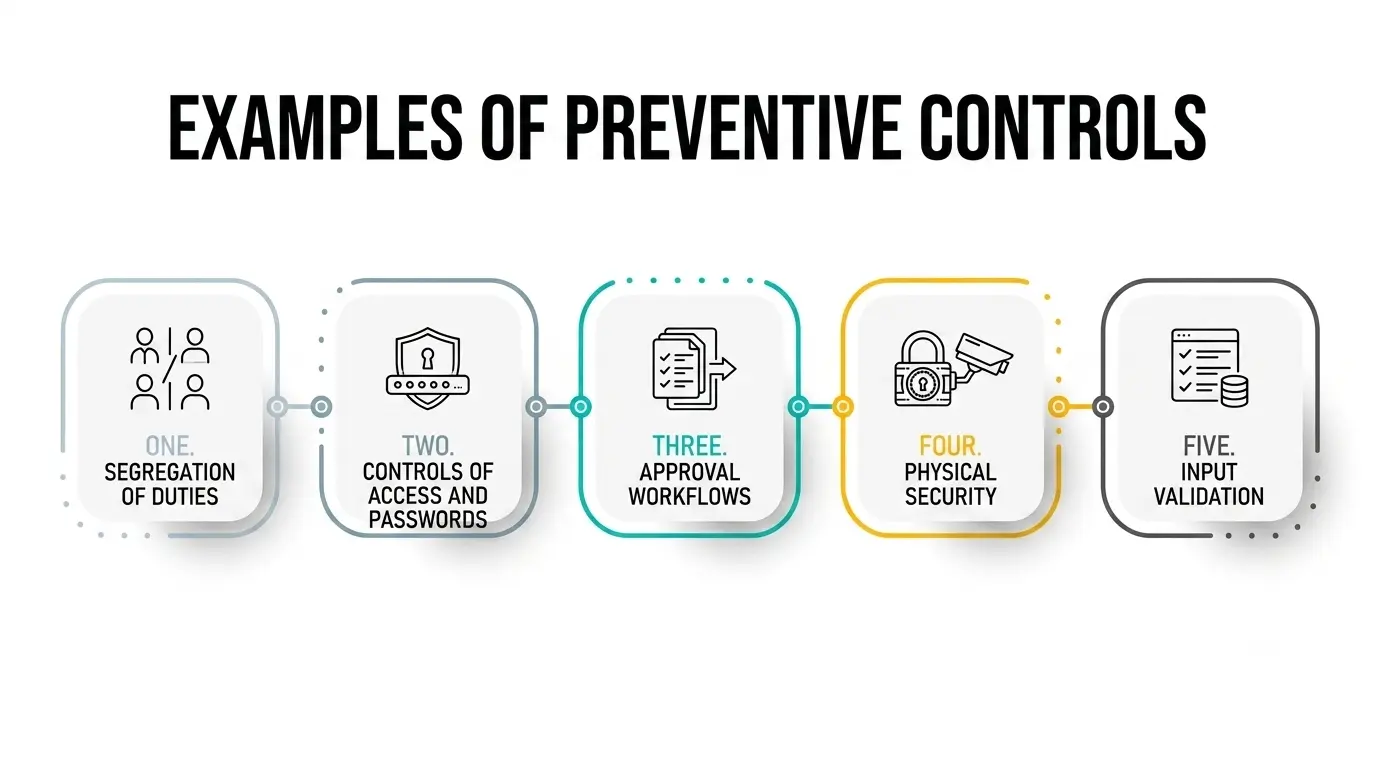
- Segregation of duties — no employee can approve and process a payment.
- Controls of access and passwords – controlling who can log onto a system or open a file
- Approval workflows – a manager needs to approve a purchase order before it is created
- Physical security – locked server rooms, badge access, safes
- Input validation – software that rejects malformed data before it is stored
The appeal of preventive controls is obvious: they’re proactive. Instead of cleaning up a mess, they try to make sure the mess never gets made in the first place. That’s why, in almost every comparison of prevention against detection, preventive measures are described as the first, and usually cheapest, line of defense.
Detective Controls: Catching What Slipped Through
No system of prevention is airtight. That’s where detective controls come in — they’re designed to identify problems, errors, or irregularities after they’ve already occurred. Detective controls don’t stop the event; they surface it so someone can respond.
Typical detective controls are:
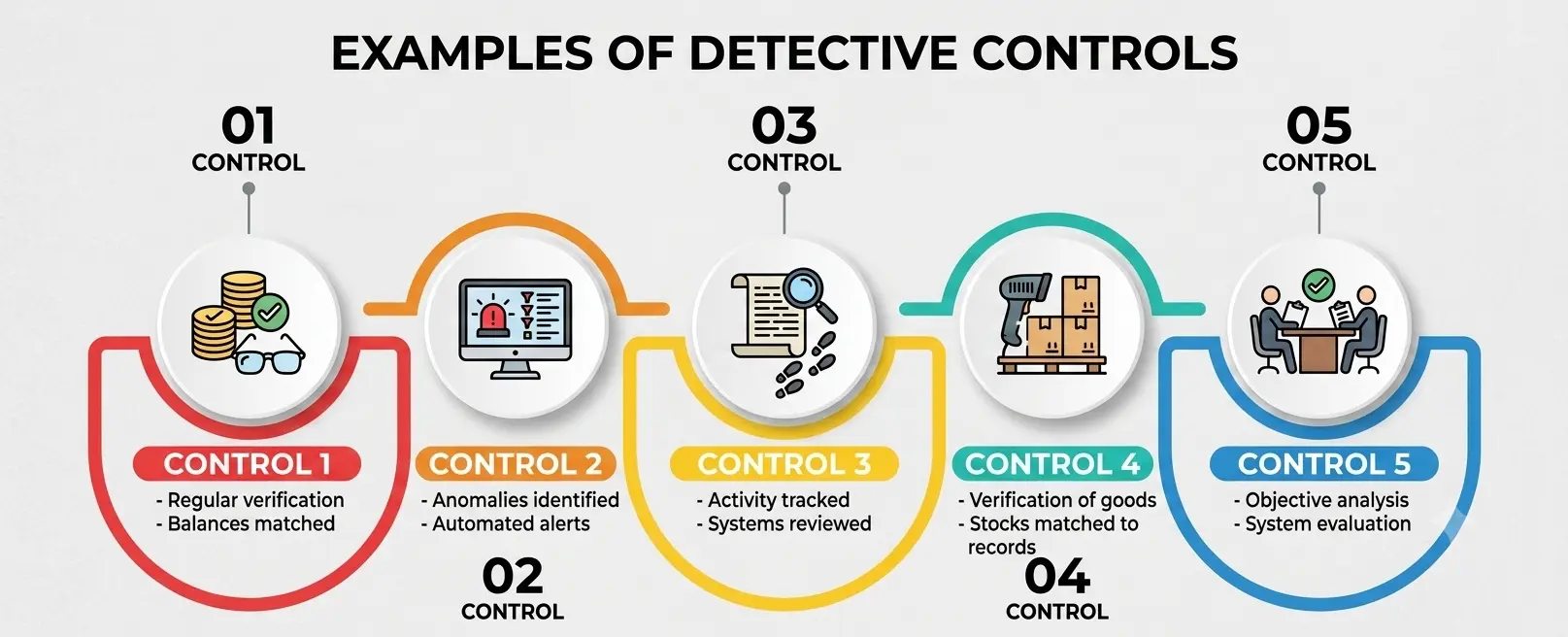
- Bank and account reconciliations – comparing internal records with external statements to spot discrepancies
- Exception reporting – automatic flagging of transactions that fall outside a normal pattern
- Audit trails and log monitoring – reviewing system logs to identify unauthorised access
- Physical inventory counts – verifying that what’s on the books is what’s on the shelf
- Independent reviews and internal audits – second pair of eyes on the work after it’s done
Much of contemporary detective work now relies on automated outlier-flagging, employing statistical models or machine learning to identify transactions, logins, or behaviours that are inconsistent with the expected pattern.
According to ISACA’s overview of AI in information systems auditing, these tools can process large volumes of logs to surface unusual login attempts or irregular data transfers that a human reviewer would likely miss. It’s a good example of how detective work has shifted from a once-a-quarter manual exercise into something closer to continuous monitoring.
Preventive vs Detective Controls: The Key Differences
Here’s where the comparison really matters. Preventive vs Detective Controls isn’t about which one is “better” — it’s about timing, cost, and purpose. Preventive controls act before an event; detective controls act after. The table below lays out the practical differences students are usually tested on.
|
Factor |
Preventive Controls |
Detective Controls |
|
Timing |
Applied before an event occurs |
Applied after an event has occurred |
|
Goal |
Stop errors, fraud, or breaches from happening |
Identify errors, fraud, or breaches that already happened |
|
Examples |
Passwords, approvals, segregation of duties |
Reconciliations, audits, log reviews, anomaly-detection alerts |
|
Cost |
Usually cheaper to maintain long-term |
Can be resource-intensive (investigation, follow-up) |
|
Speed of impact |
Immediate — blocks the action |
Delayed — depends on review frequency |
|
Limitation |
Can be bypassed or fail silently |
Doesn’t undo the original loss or damage |
|
Best paired with |
Detective controls, to catch what slips through |
Corrective fixes, to resolve what’s found |
This table is really the whole comparison in miniature: prevention reduces the likelihood of a problem, while detection reduces the time a problem goes unnoticed. Neither one, on its own, gives an organization full protection — which is exactly why frameworks like COSO and NIST insist on layering both.
Security Controls Types: Where Corrective and Compensating Controls Fit In
Most classroom discussions stop at preventive and detective, but a complete picture of security controls types includes two more categories: corrective and compensating controls.
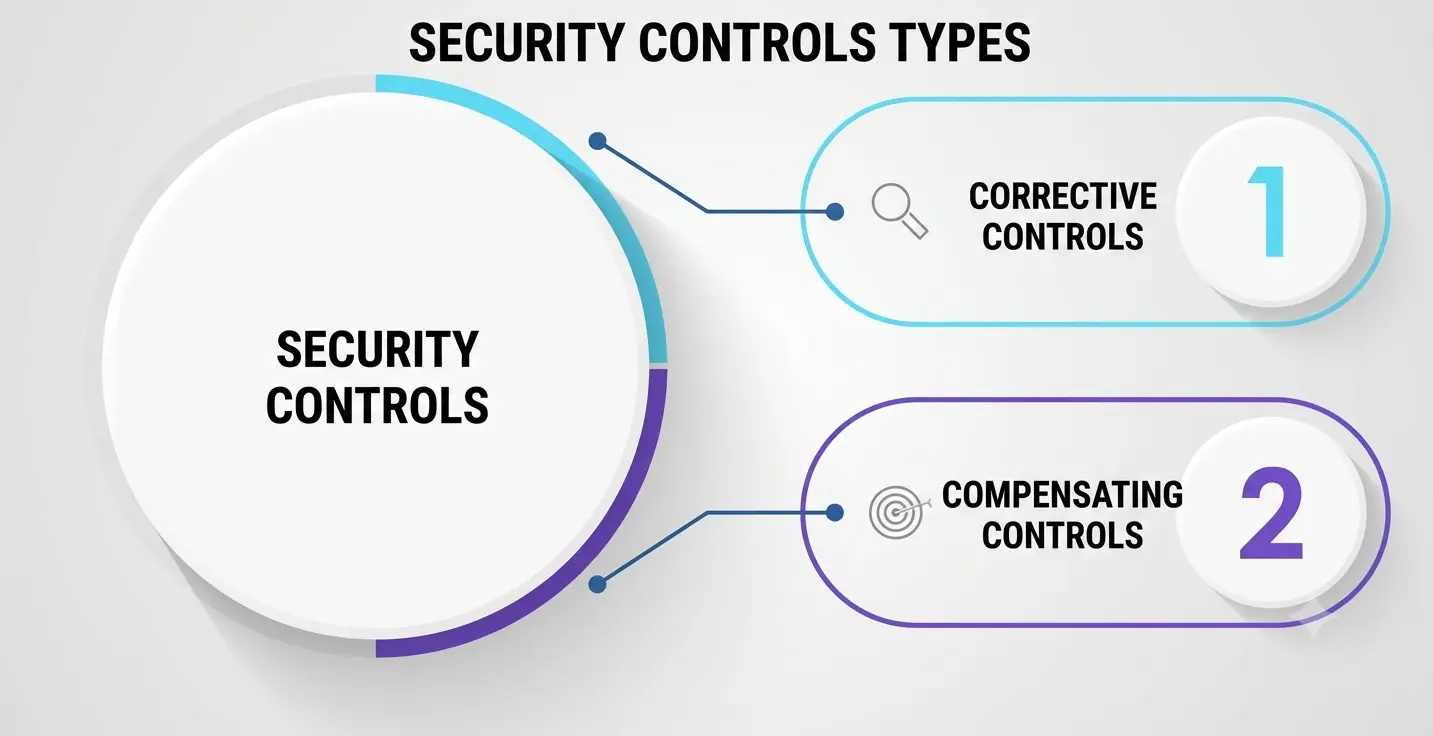
- Corrective controls fix the damage after a problem has been detected — think incident response plans, system patches, or restoring data from backup.
- Compensating controls are alternative safeguards used when a primary control can’t be implemented — for example, extra manual review when automated approval isn’t available.
Frameworks such as NIST SP 800-53 organize more than a thousand individual controls across families like access control, incident response, and system integrity, and each one can usually be sorted into one of these four categories.
Getting comfortable with all the security controls types — not only the pair everyone starts with — is what separates a surface-level understanding of risk management from a genuinely useful one.
Here’s a simple way students can remember the security controls types that show up on almost every exam:
- Preventive — stop it
- Detective — spot it
- Corrective — fix it
- Compensating — work around it
Corrective Actions: Closing the Loop
Detecting a problem is only half the job. Corrective actions are what turn a detective control’s finding into an actual fix. If a reconciliation uncovers a missing $10,000 transaction, the follow-up work might involve correcting the ledger, retraining the employee who made the error, or tightening the approval workflow so the same mistake doesn’t happen again.
Well-run organizations treat this remediation as a formal, tracked process rather than an afterthought. According to a SOX-based internal control framework overview, fixes should be documented, tested, and reported to leadership so that they’re verifiably closed out rather than just noted and forgotten.
Without disciplined follow-through, a business can end up flagging the same issue quarter after quarter without ever actually solving it — which defeats the entire purpose of having detective control in the first place.
This is also where the bigger picture around Preventive vs Detective Controls expands into a three-part cycle: prevent, detect, correct. Each finding should ideally feed back into strengthening prevention, so the same corrective actions aren’t required over and over.
Anomaly Detection: The Modern Engine Behind Detective Controls
It’s worth spending a little more time on anomaly detection, because it’s quietly become one of the most important tools in the modern Preventive vs Detective Controls toolkit. Traditional detective controls — like a monthly reconciliation — only look backward at fixed intervals.
Anomaly-detection systems, by contrast, can run continuously, scanning transactions, network traffic, or user behavior in real time. Research on continuous auditing shows that statistical outlier methods and machine-learning models are increasingly used to flag unusual patterns in financial and security data before they escalate.
Academic work on continuous auditing frameworks stresses that these systems flag suspicious activity but don’t, by themselves, render a full independent judgment on whether controls are actually working — that step still requires a human reviewer.
In other words, this technology strengthens detective controls, but it doesn’t replace the audit or the analyst. For students entering fields like cybersecurity, internal audit, or fraud examination, learning how these monitoring systems are built and tuned is quickly becoming as important as understanding manual reconciliations, simply because the volume of modern transaction and log data has outgrown what any human team can review by hand.
Risk Prevention: Why You Need Both Types of Controls
Ultimately, effective risk prevention isn’t achieved by choosing one side of the Preventive vs Detective Controls debate. It’s achieved by combining both, deliberately, based on the specific risk being addressed.
A strong risk prevention strategy typically layers controls like this:
- Use preventive controls for high-frequency, well-understood risks (like unauthorized system access)
- Use detective controls for risks that are hard to block entirely (like sophisticated fraud schemes)
- Use corrective fixes to close every loop that detection opens
- Use continuous monitoring tools to shrink the time between when something goes wrong and when someone notices
Relying only on prevention creates a false sense of security, since no control is perfect and determined bad actors or simple human error will eventually get through. Relying only on detection means damage has already occurred before anyone responds. A mature risk prevention program treats prevention and detection as complementary layers, not competing options.
A Practical Example: Preventive vs Detective Controls in a University Setting
Imagine a university finance department. A preventive control might require two signatures for any expense over $5,000. A detective control might involve the internal audit office reviewing a sample of expense reports every semester, or running anomaly detection software that flags reimbursement claims submitted just under the approval threshold — a classic red flag.
If the audit finds a policy violation, the fix might be revising the approval workflow or providing additional staff training. This single example touches every piece of the framework: internal controls, security controls types, corrective actions, anomaly detection, and risk prevention, all working together instead of in isolation.
That’s usually how it plays out in the real world too — no organization survives on prevention alone, and none can afford to detect everything after the fact without any upfront safeguards at all.
Common Mistakes Students Make With This Topic
A few habits trip up almost everyone the first time they study this material:
- Assuming one type is always better. Exam questions often test whether you understand that prevention and detection solve different problems, not that one outranks the other.
- Forgetting corrective and compensating controls exist. Many students can define the first two categories but blank on the other two when asked for a full list.
- Treating detection as “good enough.” Finding a problem without fixing it, or without feeding the finding back into stronger prevention, isn’t actually risk management — it’s just bookkeeping.
- Ignoring cost and practicality. Not every risk deserves an expensive preventive control; sometimes a cheaper detective control paired with fast follow-up is the smarter, more efficient choice.
Personal Note
I remember the first time this topic actually clicked for me. It wasn’t in a lecture — it was when I realized my apartment building’s key fob system (preventive) and its hallway cameras (detective) were solving two completely different problems, and neither one alone would have made the building safe.
Internal controls work the exact same way. If you’re a student prepping for an audit, security, or accounting exam, don’t just memorize the definitions. Try classifying a control you interact with every single day, whether it’s a two-factor login prompt or a credit-card fraud alert on your phone. It sticks a lot better that way, and it’s honestly the fastest route to actually understanding Preventive vs Detective Controls instead of just reciting it back on a test.