

Every organization, from a small college club managing its budget to a multinational bank protecting customer data, runs into the same basic problem: things go wrong, and someone has to plan for that before they do.
That planning has a name — Risk Mitigation — and it is one of the most practical skills a student can pick up, whether you are heading into business, IT, engineering, healthcare, or public administration.
This guide walks through what the concept actually means, the methods and tools professionals rely on, and the techniques you can borrow for your own coursework, internships, or side projects. It’s just a clear breakdown you can actually use, with real sources linked along the way so you can dig deeper if you want to.
What Is Risk Mitigation?
Risk Mitigation is the process of reducing the probability of a negative event happening, or shrinking the damage it causes if it does happen anyway. It is not about eliminating every possible risk — that is impossible — it is about making risk manageable and survivable.
Global bodies like the International Organization for Standardization treat this as a core discipline, offering shared guidelines that organizations of any size can adapt to their own context.
In the United States, the National Institute of Standards and Technology plays a similar role for cybersecurity and IT systems, giving teams a structured way to identify, evaluate, and reduce exposure across an organization.
Students often lump this together with “risk management” as a whole, but the two are not identical. Risk management is the umbrella term — it covers spotting risks, ranking them, deciding what to do, and reviewing the outcome afterward.
The piece we are focused on here is the action step inside that cycle: the part where you actually do something to reduce the danger, rather than just writing it down and hoping for the best.
Why Does This Matters for Students?
You may be thinking, “I’m not running a company, why should I care?” Great question. Here’s the real answer: Every group project, dissertation timeline, internship application and your own personal finances involve risk. Structured thinking around Risk Mitigation teaches you to:
- Spot problems before they blow your deadline
- Focus on what really needs your attention, not what appears to be loudest
- Don’t freak out when things break. Have contingency plans
- Clearly communicate risk to teammates, professors, or bosses
In finance, IT, healthcare administration, supply chain, and project management, recruiters look for candidates who know these basic concepts, even at the entry level. It’s also a direct test in professional certifications, to include the Project Management Institute’s standards for portfolio, programme and project risk — so the habits you build now can translate into a resume line later.
How Does This Show Up in Different Fields?
The core idea stays the same everywhere, but the details shift depending on the field.
- In business and finance, it often means diversifying investments, holding cash reserves, or buying insurance against specific losses. A useful, plain-language overview of this angle comes from IBM’s explainer on the topic, which frames it as planning for the disasters you cannot fully prevent.
- In IT and cybersecurity, it usually means patching software, restricting access, and encrypting sensitive data before an attacker ever gets a chance to exploit a weakness.
- In healthcare, it can mean anything from infection control protocols to double-checking medication dosages, where the stakes are measured in patient safety rather than dollars.
- In your own student life, it might just mean keeping a second copy of your thesis in the cloud, submitting assignments a day early, or having a backup teammate lined up before group work even starts. The scale changes; the underlying logic does not.
The Process Behind Every Plan, Step by Step
Before you can reduce a risk, you need to understand it properly. Professionals generally follow three connected stages, and skipping any one of them tends to produce weak, reactive plans later on.
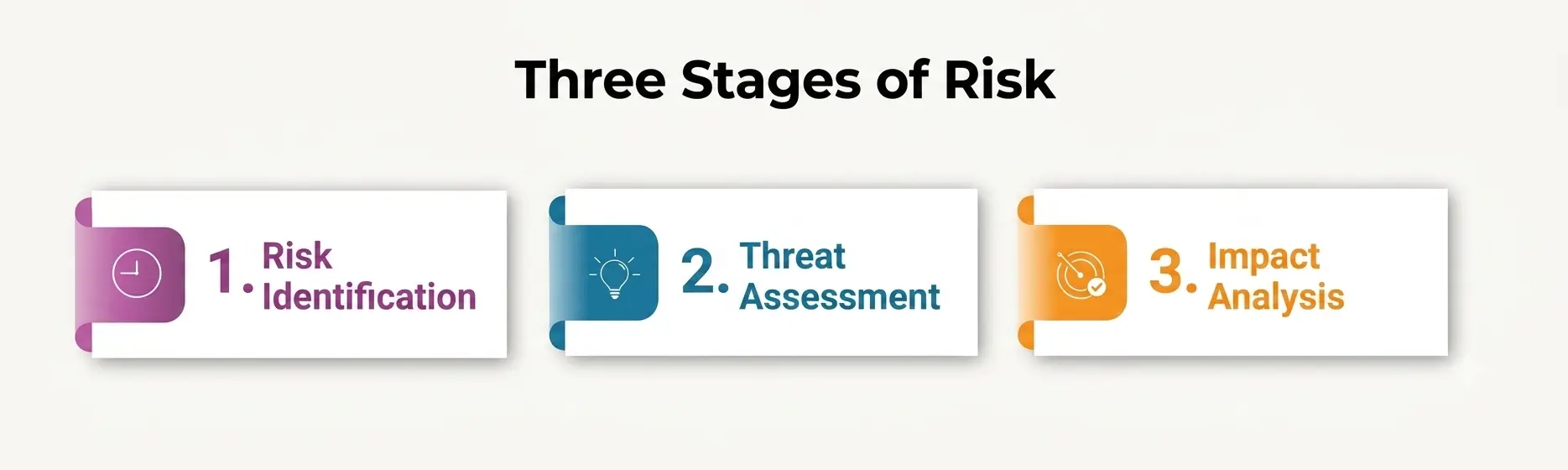
1. Risk Identification
This is the starting line. Risk identification means systematically listing every possible thing that could go wrong — financial, operational, technical, legal, or reputational. Students working on a group assignment might list risks like “a teammate drops out,” “the data source goes offline,” or “we underestimate how long the research will take.”
This step is not a one-time brainstorm. It gets revisited regularly, because new risks appear as a project moves forward. Techniques like SWOT analysis, checklists, and structured stakeholder interviews help keep the list thorough instead of random and incomplete.
2. Threat Assessment
Once risks are on the table, a threat assessment ranks how likely each one is to actually occur. This step separates the risks worth worrying about from the ones that are technically possible but extremely unlikely to happen in practice.
A solid version of this step usually asks a few blunt questions: who or what could cause this? How often has something similar happened before, in this context or a similar one? What conditions make it more or less likely right now?
The Cybersecurity and Infrastructure Security Agency runs this kind of evaluation at a national scale for critical infrastructure, but the same logic scales down easily to a term paper deadline or a small business’s cash flow.
3. Impact Analysis
The final piece of the puzzle is impact analysis — figuring out how bad the consequences would actually be if the risk materialized. A risk that is likely but low-impact might not deserve urgent attention. A risk that is unlikely but catastrophic, like losing every file right before submission, can still deserve serious planning anyway.
A thorough version of this step looks at cost, time lost, reputational damage, and knock-on effects on other tasks or people. Pairing likelihood with consequence gives you a score you can actually rank and act on, instead of relying on gut feeling alone.
Key Methods of Risk Mitigation
Once risks are ranked, the response usually falls into one of four broad strategies:
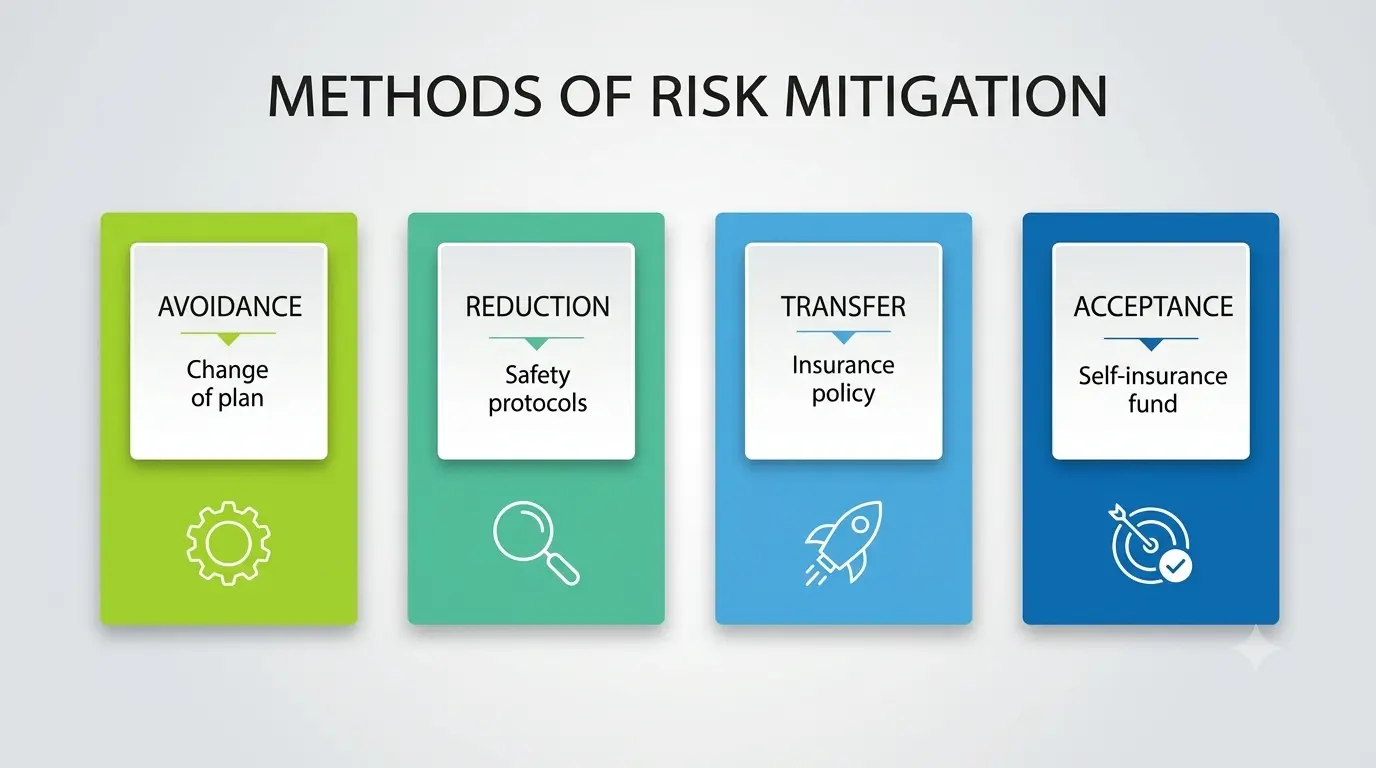
- Avoidance — changing your plan so the risk never gets a chance to occur (for example, choosing a more reliable data source instead of a shaky one).
- Reduction — taking steps that lower either the likelihood or the impact, without necessarily eliminating the risk entirely.
- Transfer — shifting the consequence onto someone else, such as buying insurance or outsourcing a risky task to a specialist who handles it better than you could.
- Acceptance — consciously deciding a risk is small enough to live with, and monitoring it rather than acting on it immediately.
Choosing between these four always comes back to the homework done in the two earlier steps. Skip that groundwork, and teams end up guessing — and guessing is, by far, the most expensive strategy of the bunch.
Essential Tools for Risk Mitigation
You do not need enterprise software to practice this well. Some of the most widely used tools include:
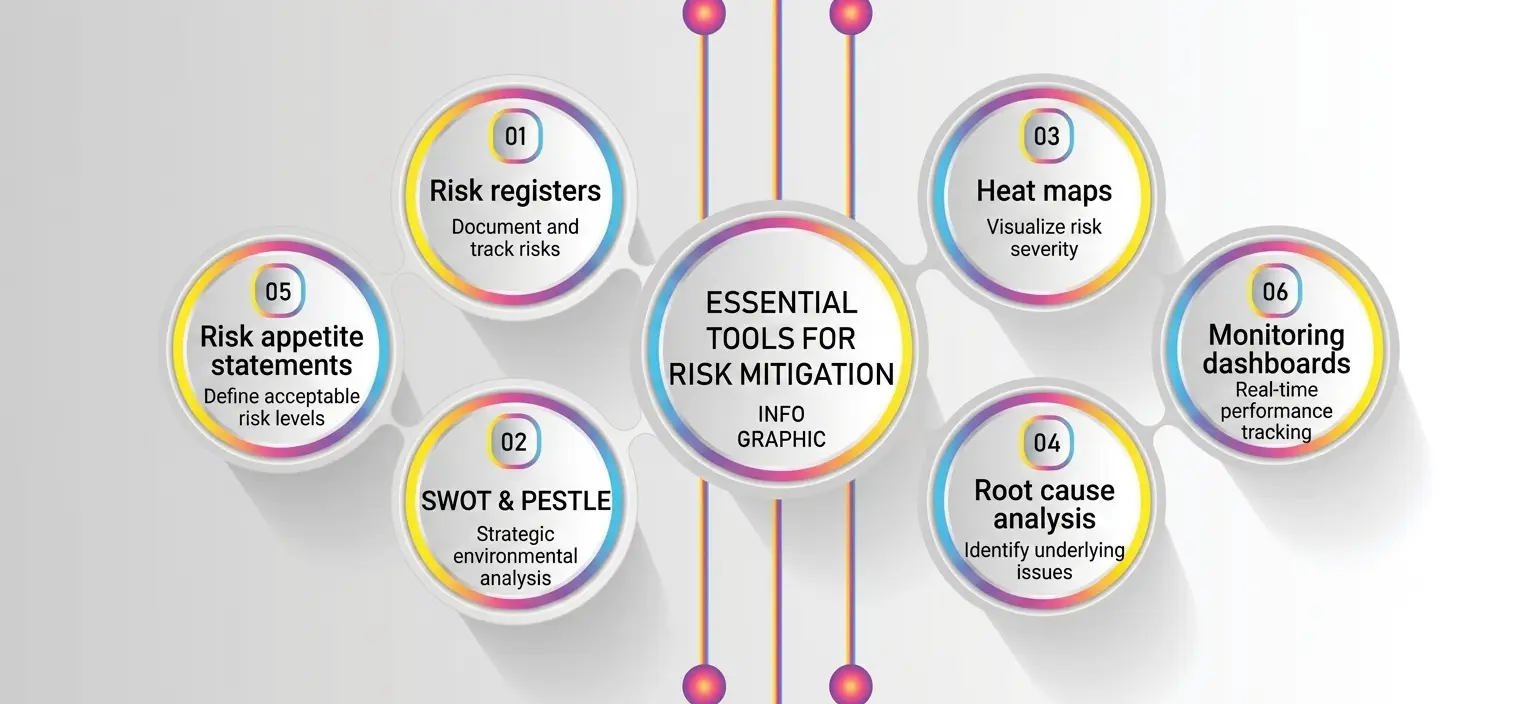
- Risk registers — a simple spreadsheet listing each risk, its likelihood, its impact, the owner responsible, and the planned response.
- SWOT and PESTLE analysis — frameworks that help surface risks you might otherwise miss entirely.
- Heat maps — visual grids that plot likelihood against impact, making it easy to see which risks need attention first.
- Root cause analysis (the “5 Whys”) — helps you dig into why a risk exists in the first place, not just its surface symptoms.
- Risk appetite statements — a short, written sense of how much uncertainty a team or person is actually willing to tolerate before acting.
- Monitoring dashboards — used in larger organizations to track risk indicators in something close to real time.
Professional frameworks such as the NIST Risk Management Framework package many of these tools into a repeatable, documented process, which is a big part of why they are trusted across government and industry alike.
Prevention and Response: Security Measures and Recovery Planning
Two techniques deserve special attention because they show up in nearly every real-world plan: one stops trouble before it starts, and the other cleans up after it happens anyway.
- Security measures are the preventive controls you put in place before anything goes wrong — access controls, encryption, backups, staff training, or simply locking a filing cabinet. Strong preventive controls reduce both the likelihood and the potential damage of a threat, which makes them one of the most cost-effective forms of Risk Mitigation available to any team, regardless of budget.
- Recovery planning, on the other hand, deals with what happens after an incident occurs. A good plan defines who does what, how fast systems or operations need to be restored, and how communication will be handled during the disruption. The Ready.gov Business Continuity Planning guide and its companion IT disaster recovery guidance are excellent, free starting points for understanding how organizations structure this work in practice.
Together, strong preventive controls and a rehearsed response plan form a complete safety net: one stops problems from starting, the other limits the damage once they do happen anyway.
A Quick Reference Table
|
Stage |
What It Answers |
Common Tools |
|
Risk Identification |
What could go wrong? |
Checklists, SWOT, stakeholder interviews |
|
Threat Assessment |
How likely is it? |
Probability scoring, historical data, expert judgment |
|
Impact Analysis |
How bad would it be? |
Cost estimation, impact matrices, scenario planning |
|
Security Measures |
How do we prevent it? |
Access controls, encryption, training, audits |
|
Recovery Planning |
How do we bounce back? |
Continuity plans, backups, communication protocols |
A Real-World Example
Consider a university IT department preparing for exam season. Their risk identification process flags a familiar problem: the online exam portal could crash under heavy traffic. Their threat assessment rates this as highly likely, based on how past exam periods have gone. Their impact analysis shows it would affect thousands of students at once and seriously damage trust in the system.
In response, the department layers in security measures like load balancing and stress-testing the servers weeks in advance, and they also put together a recovery planning document that spells out exactly how staff will communicate with students and reschedule affected exams if the portal does go down anyway.
That combination — prevention plus a rehearsed response — is Risk Mitigation working exactly as intended, and it is the same pattern you will see in almost any well-run plan, regardless of scale.
Common Mistakes Students Make
- Treating it as a one-time exercise. Risks change as a project progresses, so revisit your identification and impact analysis work regularly, not just once at the very start.
- Focusing only on the scariest risk. A low-probability, high-impact risk still needs a plan, but so do the smaller, more likely risks that quietly derail timelines without anyone noticing.
- Skipping documentation. Without something written down, teams forget who is responsible for what once something actually happens.
- Ignoring recovery. Prevention gets nearly all the attention, but a missing response plan turns a manageable setback into a genuine crisis.
- Copying someone else’s plan word for word. A plan built for a different team, budget, or context rarely fits your actual risks — use templates as a starting point, not a finished product.
My Personal Note
I have watched more group projects, internships, and even personal budgets fall apart from a missing “what if” than from any single catastrophic event. The people who handle setbacks well are rarely the ones who predicted the future correctly — they are the ones who built a habit of asking “what could go wrong here, and what would we actually do about it?” before it happened.
That habit, more than any tool or template, is the real skill behind this whole subject. Start small: pick your next assignment or project and write down three things that could derail it, along with one thing you would do about each. You will be surprised how much calmer the rest of the process feels once it is on paper instead of just in your head.