
Walk into almost any IT department today and ask someone who’s been doing this for fifteen years what changed. They won’t talk about a single product launch or a policy memo. They’ll talk about watching their job quietly turn into a different job while they were still doing it.
That’s really what the Cloud Engineer Changed System Administration shift has been about since the mid-2020s—not a sudden replacement, but a slow rewrite of what “keeping the systems running” actually means.
This piece isn’t another career-comparison listicle. It’s a look at how we got here: what System Administration used to demand day to day, what changed as cloud platforms matured through 2026, and what the Cloud Engineer vs System Administrator transition actually looks like for someone doing the work right now, heading into 2027.
If you’re a student trying to figure out which skills are worth your time, or an IT professional watching your own role shift under you, this is meant to be a straight answer rather than a sales pitch for a certification.
The Server Room Era: What System Administration Used to Mean
For most of the 2000s and 2010s, a system administrator’s job was physical in a way that’s easy to forget now. Racking hardware, running cables, applying patches by hand, and rebooting a machine at 3 a.m. because a service quietly died—that was the job.
Server configuration meant literally sitting down at a machine, sometimes physically, sometimes over SSH, and setting it up piece by piece: partitioning drives, installing packages, hardening permissions, and documenting it all in a runbook that only made sense to the person who wrote it.
The Linux administration sat at the center of almost everything. Whether the environment ran Red Hat, Ubuntu, or CentOS, the day-to-day reality was the same: monitor logs, manage users and permissions, keep processes healthy, and troubleshoot when something broke, usually without much warning.
System maintenance wasn’t a scheduled event; it was a constant background task, the digital equivalent of mowing a lawn that never stopped growing. Every patch cycle, every disk that filled up, every certificate that expired without anyone noticing—all of it landed on the same desk.
That world didn’t disappear overnight. But cloud platforms changed the economics of running infrastructure so thoroughly that the job built around that old world couldn’t stay the same shape for long.
Reference Blog: Cloud Engineer Certification: Which One Is Right for You?
What Actually Changed: The Cloud Engineer vs System Administrator Divide
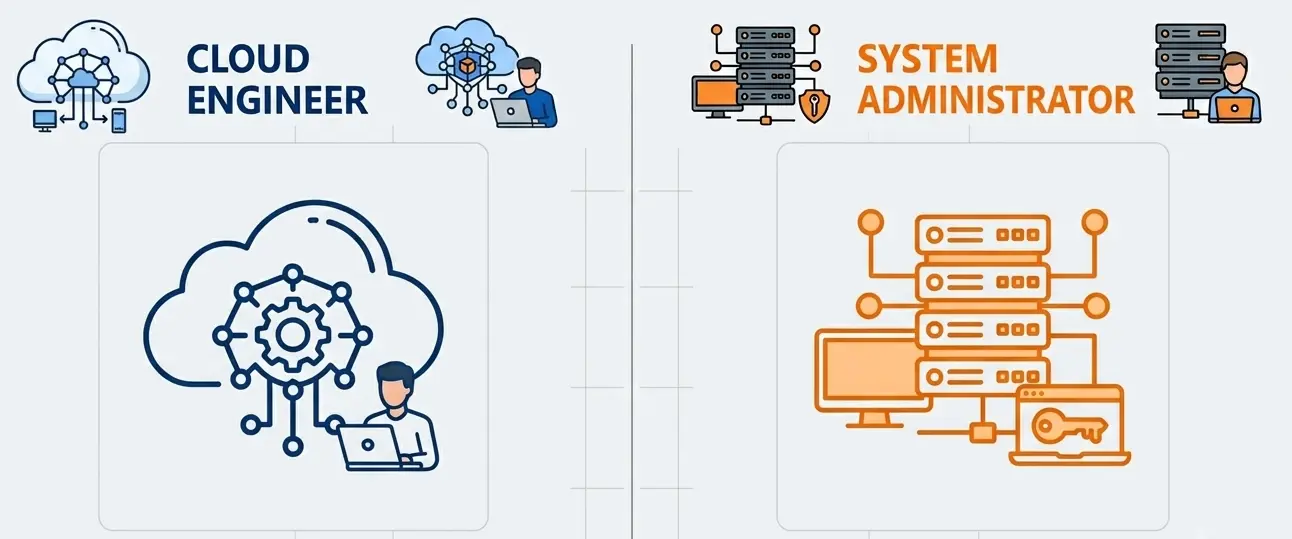
The Cloud Engineer vs System Administrator divide didn’t start as a career choice—it started as an infrastructure choice made by companies, one migration at a time. Once a business moved its workloads to AWS, Azure, or Google Cloud, the physical constraints that shaped traditional system administration mostly vanished.
Nobody needed to rack a server to add capacity. Nobody needed to drive to a data center to swap a failed drive. That work got absorbed by the cloud provider, and a different kind of work took its place: defining infrastructure in code, automating what used to be manual, and treating an entire environment as something you could spin up, tear down, and rebuild in minutes rather than something you physically maintained.
That’s the heart of the cloud engineer vs system administrator transformation. The tasks didn’t vanish—they moved. Server configuration that used to mean SSHing into a box and running commands by hand now often means writing a Terraform module once and applying it to a hundred environments identically.
Cloud infrastructure management replaced the old model of one administrator knowing one server intimately in favor of one engineer managing infrastructure-as-code that defines dozens of environments at once, consistently, and repeatedly.
A Side-by-Side Look at What Moved
|
What used to happen (System Administration) |
What replaced it (cloud engineering)? |
|
Manual server configuration via SSH, one box at a time |
Infrastructure-as-code templates applied across entire environments |
|
Physical hardware racking, cabling, and drive swaps |
Cloud infrastructure management through provider consoles and APIs |
|
Scheduled and reactive maintenance windows |
Automated patch pipelines and self-healing infrastructure |
|
Manually written runbooks for recurring fixes |
Version-controlled automation scripts, peer-reviewed software |
|
Local monitoring tools and on-call pagers |
Centralized cloud service management dashboards with automated alerting |
| Capacity planning based on physical hardware budgets | Elastic scaling that adjusts to real-time demand automatically |
That table isn’t meant to suggest system administration disappeared. It’s meant to show where the same underlying responsibilities landed once cloud platforms took over the physical layer almost entirely and where system maintenance work moved once nobody needed to touch a physical machine to perform it.
Reference Blog: Essential Skills and Tools for Cloud Security Engineers
Automation Didn’t Remove the Job—It Moved Where the Skill Lives
Here’s where a lot of the Cloud Engineer vs System Administrator conversation goes wrong. People assume automation made the sysadmin skill set obsolete. It didn’t. It moved the skill upstream. Instead of manually applying a fix to one server after an incident, a cloud engineer writes automation that prevents the incident from recurring on any server, ever.
Instead of manually checking whether backups ran overnight, cloud service management tools now flag it automatically and often trigger a remediation script before a human even looks at a dashboard.
This is also where Linux administration stopped being optional even for people who now call themselves engineers rather than administrators. Every container, every managed Kubernetes cluster, every serverless function still runs on Linux somewhere underneath the abstraction.
The people who transitioned successfully from system administration into cloud-focused roles weren’t the ones who abandoned those instincts—they were the ones who used that foundation to understand what the automation was actually doing instead of treating it as a black box.
System maintenance itself changed shape rather than vanishing. It used to mean a human manually applying updates during a fixed window and hoping nothing broke. By 2026, most mature cloud environments handle routine patch cycles through automated pipelines—updates roll out in stages, get tested against a canary group, and roll back automatically if a health check fails.
The maintenance still happens; nobody’s typing the commands by hand anymore, and that single change quietly reshaped what companies expect from anyone with “administrator” or “engineer” in their title, whether or not the job posting spells it out directly.
Where Cloud Infrastructure Management Actually Sits Today?
Cloud infrastructure management in 2026 looks less like a single person’s job and more like a shared discipline across a whole engineering org. A cloud engineer today is expected to understand networking, security, cost optimization, and server configuration well enough to encode all of it into repeatable templates—Terraform, CloudFormation, and Pulumi—rather than performing any of it manually, one environment at a time.
That’s a meaningfully different skill from what most system administrators trained for a decade ago, even though the underlying knowledge of how servers, networks, and operating systems behave is still the foundation everything else is built on.
Cloud service management platforms—think AWS Systems Manager, Azure Arc, or Google’s Operations Suite—have absorbed a huge share of what used to require a dedicated administrator watching a screen.
According to Gartner’s infrastructure and operations research, a large majority of enterprises have now adopted some form of infrastructure automation for routine operations, and organizations that haven’t are increasingly the exception rather than the norm.
That shift is exactly why the Cloud Engineer vs System Administrator comparison stopped being theoretical for so many IT professionals—it became a real decision about which skills to invest in, often forced by a company’s own migration timeline rather than personal preference.
There’s also a money story underneath all of this that rarely gets mentioned in career guides. Once cloud spend became one of the largest line items on a company’s budget, finance teams started paying attention to it the way they’d watch payroll or rent.
That gave rise to FinOps as its own discipline, and it pulled the people who used to just keep servers alive into conversations about right-sizing instances, reserved capacity, and why a forgotten test environment had been quietly billing the company for eight months.
Security followed the same path. A misconfigured storage bucket or an overly permissive access policy can now expose an entire company in minutes, so the person responsible for keeping infrastructure running is also expected to understand identity and access management, encryption standards, and compliance frameworks well enough to defend a design choice in an audit.
That combination—cost accountability plus security accountability, layered on top of the operational work that already existed—is a large part of why the job changed shape so quickly rather than gradually over a decade the way earlier technology shifts usually did.
What the Data Actually Shows Going Into 2027?
Numbers help cut through the noise here. The projects that traditional network and computer systems administrator roles will decline slightly through the mid-2030s, even as tens of thousands of openings remain annually—mostly from people moving into other roles or retiring, not from headcount being slashed outright.
Meanwhile, LinkedIn’s Jobs on the Rise research has repeatedly listed cloud-focused engineering roles among the fastest-growing job categories in the United States, a trend that has held steady for several years running as companies keep expanding cloud infrastructure management budgets rather than shrinking them.
None of that means System Administration is finished as a discipline. Plenty of organizations, particularly ones running hybrid environments with on-premises systems that aren’t going anywhere soon, still need someone dedicated to Linux administration, hands-on troubleshooting, and day-to-day system maintenance.
But the center of gravity has clearly shifted, and the Cloud Engineer vs System Administrator gap in job postings, salary, and growth projections keeps widening year over year rather than closing.
What This Means If You’re Starting Out in 2027?
If you’re a student or someone early in an IT career trying to figure out where to focus, the Cloud Engineer vs System Administrator transition actually offers a fairly clear answer: don’t skip the fundamentals to chase the trend.
Every Cloud Engineer worth hiring in 2026 still understands Linux administration at a level most people never bother to learn, because that knowledge is what lets them debug a problem the automation didn’t catch. Learn how a server actually behaves — how processes, permissions, and networking work at a low level — before you learn how to automate managing a thousand of them.
From there, layer in the tools that define modern cloud service management: infrastructure-as-code, version control, CI/CD pipelines, and the monitoring stack your target employer actually uses.
The people who struggle most with this transition usually aren’t the ones who started too late — they’re the ones who tried to skip straight to automation without ever configuring a server by hand, on a single machine, under pressure, with no script to fall back on.
A Stack Overflow developer survey has consistently found that engineers with strong systems fundamentals report higher confidence troubleshooting cloud incidents than those who learned automation tooling first, which tracks with what most hiring managers say off the record.
A Personal Note
I’ve watched enough resumes cross my desk to notice something that surprises people: the strongest Cloud Engineers I’ve come across almost never started as engineers. They started as administrators — the ones who got paged at 2 a.m., who learned to read a log file under pressure, who understood exactly what broke and why before they ever wrote a line of automation to prevent it from breaking again.
None of this is really about one role replacing another. It’s about the same instincts getting expressed at a larger scale, with better tools and a much bigger blast radius when something goes wrong.
If you’re worried your hands-on systems background is becoming irrelevant, I’d push back on that directly — it’s usually the exact foundation that makes the automation trustworthy in the first place, and I’ve seen far more automation projects fail because nobody on the team had ever done the work by hand than because the team lacked modern tooling. The job title changed. The judgment that makes someone good at it really hasn’t, and I don’t expect that to change by 2027 either.