
Pick ten job postings for “Architect” roles in tech, and you’ll find ten different sets of expectations hiding under the same title. That’s the real problem with comparing AWS Architect vs Network Architect skills—the titles sound like variations on the same job, but the day-to-day work, the tools, and even the way each person thinks about a system are genuinely different.
One role lives mostly in the cloud, designing how applications run on rented infrastructure. The other lives at the physical and logical layer of networks, whether that network sits in a data center, an office building, or a hybrid mix of both.
If you’re a student trying to decide which certification path to start with, or an early-career IT professional weighing a move, understanding AWS Architect vs Network Architect skills is the first real decision point in your career—not because one path is better, but because they reward different instincts.
This guide breaks the comparison down to the way it actually plays out in real teams, not the polished version you’d get from a recruiter.
Quick Comparison: AWS Architect vs Network Architect Skills
Before going section by section, here’s a side-by-side look at how the two roles compare across the areas that matter most for anyone weighing these two career paths.
|
Category |
AWS Architect |
Network Architect |
|
Primary focus |
Designing cloud-based systems on AWS—compute, storage, databases, and managed services |
Designing the underlying network—LANs, WANs, routing, and connectivity between sites |
|
Infrastructure design |
Plans multi-account cloud environments, region strategy, and service selection |
Plans physical and logical network topology, including on-premises and hybrid links |
|
Technical architecture |
Broad knowledge across dozens of AWS services, tied together into one working system |
Deep knowledge of routing protocols, switching, and network hardware behavior |
|
Network configuration management |
Manages VPCs, subnets, and route tables inside a cloud console or as code |
Manages routers, switches, firewalls, and configuration across physical and virtual devices |
|
Security controls |
Applies IAM policies, security groups, and encryption within AWS’s shared responsibility model |
Applies firewall rules, access control lists, and segmentation across the entire network perimeter |
|
Resource optimization |
Tune instance types, storage tiers, and autoscaling to control cloud spend. |
Tune bandwidth allocation, QoS policies, and hardware capacity to control latency and cost. |
|
Typical background |
Software engineering, DevOps, or cloud administration |
Network administration, systems engineering, or telecom |
|
US median/average pay (2026) |
~$176,595/year average total pay |
~$134,050/year median |
Reference Blog: Is AWS Solutions Architect Certification Worth It for Your Career
What Each Role Actually Means?
The confusion around AWS Architect vs Network Architect skills usually starts with the word “architect” itself, which gets attached to wildly different jobs depending on the company. At a startup, one person might do both jobs badly rather than either job well. At a larger organization, the split is usually much cleaner, and it’s worth understanding what each title means when the org chart is drawn properly.
An AWS architect designs how applications and data live on Amazon Web Services. They take a business requirement—an app needs to handle a traffic spike, a company needs to migrate off aging on-premises servers, a startup needs a system that won’t fall over during a product launch—and turn it into a working design using AWS services.
Their output is usually a diagram, a set of design documents, and a cost estimate someone else will sign off on. Much of their week involves technical architecture decisions: which database fits the access pattern, whether the workload needs multiple regions, and how to keep the design resilient without over-provisioning.
A network architect designs the infrastructure everything else runs on top of. They plan how data moves between offices, data centers, and cloud environments, deciding on routing protocols, redundancy, and bandwidth capacity. Where an AWS architect might never touch a physical switch, a network architect frequently does—planning hardware refresh cycles, wiring closets, and the WAN links that connect a company’s sites together. Both jobs require serious technical architecture depth; the difference is which layer of the stack that depth sits in.
Infrastructure Design: Cloud-Native vs Physical-First
Infrastructure design is where AWS Architect vs Network Architect skills split most visibly. An AWS Architect approaches it almost entirely in software—defining VPCs, subnets, and account structures through code or a console, provisioning resources that can be spun up or torn down in minutes. Their constraints are largely about cost, region availability, and how AWS services interact with one another.
A network architect approaches this work with physical reality baked in from the start. Cabling, hardware lead times, rack space, and power capacity all shape what’s possible, and a design mistake here is far more expensive to walk back than a misconfigured cloud resource.
This planning for a network architect also has to account for how the physical network connects to cloud environments—meaning the two roles increasingly overlap at exactly this point, which is part of why understanding both sides of this comparison matters even if you only plan to specialize in one.
Technical Architecture: Depth vs Breadth
Technical architecture is one of the clearest dividing lines in the AWS Architect vs Network Architect Skills comparison. An AWS architect’s knowledge here tends to be broad—a working understanding of compute, storage, databases, serverless services, and cost optimization, because a real cloud system touches all of those layers at once. Being a generalist across the AWS catalog is the job, not a side skill.
A network architect’s expertise here runs the other direction: narrow and extremely deep in routing, switching, and network protocols like BGP, OSPF, and MPLS. They understand exactly how a packet moves from one point to another and why a badly placed router can quietly degrade performance across an entire building. Neither depth nor breadth is the “right” answer—most strong engineering teams need both types of thinking represented somewhere on the roster.
Network Configuration Management: A Skill Both Roles Need, Applied Differently
Network configuration management is one area where AWS Architect vs Network Architect skills genuinely overlap, even though the tools look nothing alike. An AWS architect handles this inside the cloud—VPC peering, route tables, NAT gateways, and increasingly, infrastructure-as-code tools like Terraform or CloudFormation that turn configuration into version-controlled files.
A network architect handles this work on physical and virtual devices directly—configuring routers, switches, load balancers, and firewalls, often across multiple vendors and generations of hardware.
Mistakes here tend to be less forgiving: a misconfigured router can take down an entire office, while a cloud misconfiguration is often reversible with one command. Anyone comparing these two roles should treat this area as a genuine common ground, since strong configuration discipline in one environment usually transfers well to the other.
Security Controls: Shared Responsibility vs Full Ownership
Security controls sit at the center of both jobs, but the scope of ownership is different. An AWS architect designs these controls within AWS’s shared responsibility model—IAM roles and policies, security groups, encryption at rest and in transit, and compliance boundaries that AWS itself partially manages. A well-designed set of them in the cloud leans heavily on automation and default-secure configurations.
A network architect owns that responsibility across the entire network perimeter, with no shared model to lean on. Firewalls, intrusion detection systems, VLAN segmentation, and access control lists are all their responsibility end to end, and a gap here can expose every system connected to that network, cloud-hosted or not.
This is one more reason the two career tracks deserve separate, serious study rather than treating one as a subset of the other — the failure modes and the blast radius of a mistake are genuinely different.
Resource Optimization: Cloud Spend vs Hardware Capacity
Resource optimization means something different depending on which side of AWS—architect vs. network architect—skills you’re building. For an AWS architect, this is mostly a cost conversation—right-sizing EC2 instances, choosing the correct storage tier, and setting up autoscaling so the business isn’t paying for idle capacity at 3 a.m. Cloud cost management is an ongoing job, not a one-time setup, since usage patterns and AWS pricing both shift over time.
For a network architect, this is closer to capacity planning—making sure bandwidth, switch ports, and hardware headroom can handle growth without a forklift upgrade next year. Their capacity decisions also touch quality-of-service policies, prioritizing latency-sensitive traffic like voice and video over less time-sensitive data. Both versions of this discipline protect the business from waste, just measured in very different units—dollars per month versus megabits per second.
Certifications and Career Path
The certification path is one of the fastest ways to see AWS Architect vs Network Architect skills diverge in practice. Most people entering the cloud side start with the AWS Certified Solutions Architect – Associate, a 130-minute exam covering resilient, secure, and cost-optimized design across AWS services, before moving toward the professional-level credential as they take on larger systems.
On the networking side, the standard path runs through Cisco’s certification track, typically starting with CCNA and progressing to CCNP Enterprise for anyone aiming at a genuine architect-level role, with security fundamentals and network configuration management showing up as heavily tested topics along the way.
Vendor-neutral options exist too, but most employers still expect Cisco-track experience for senior network roles, the same way most cloud employers expect an AWS credential for architecture positions.
Salary Comparison: What the 2026 Numbers Show
Money isn’t the only reason to choose a path, but it’s a fair question to ask directly. Per 2026 data, average total pay for an AWS Solutions Architect in the United States sits around $176,595 a year, with a typical range between $145,000 and $217,000 depending on experience and employer.
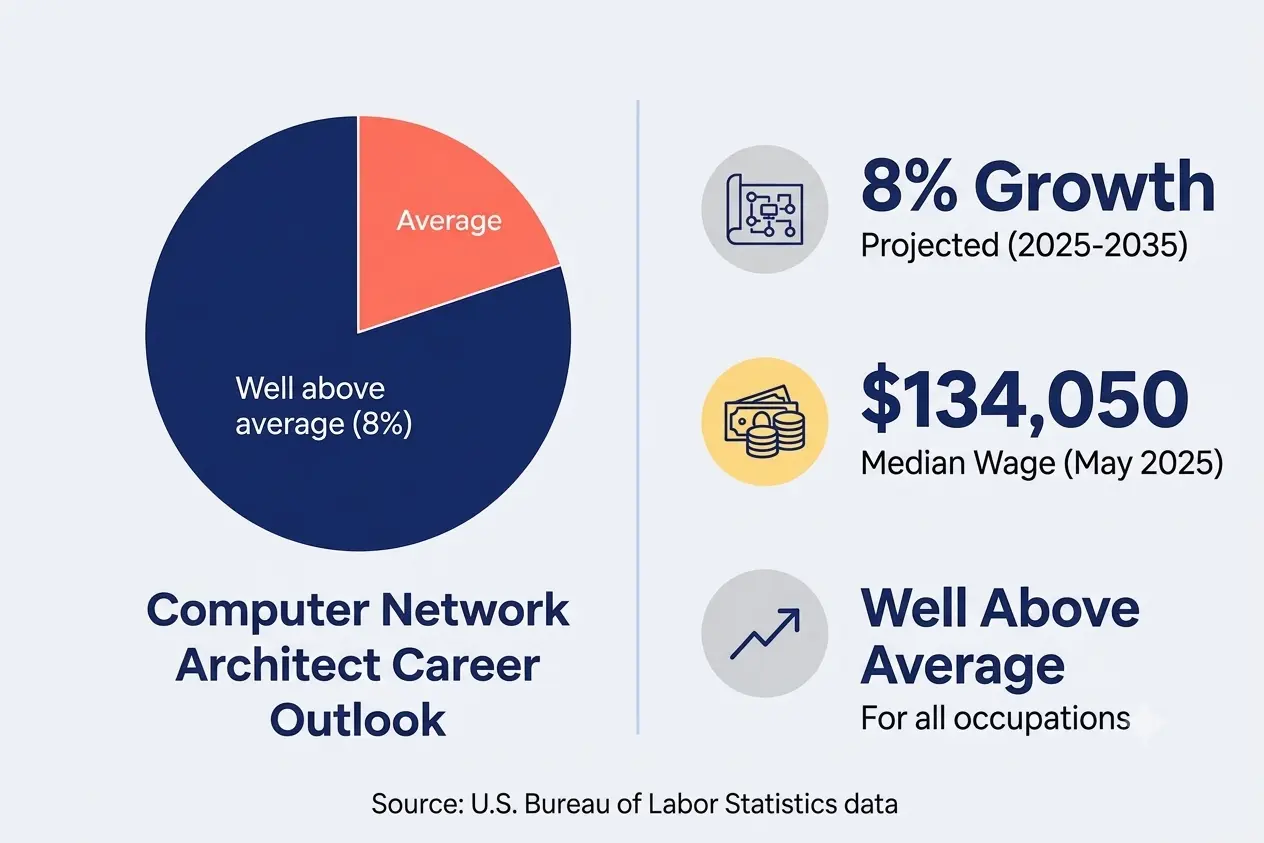
Per the U.S. Bureau of Labor Statistics, Computer Network Architects earned a median of $134,050 a year as of May 2025, with demand projected to grow 8% from 2025 to 2035, well above the average for all occupations.
That gap partly reflects how each field prices this skill — cloud roles are newer, and companies are still paying a premium for people who can control fast-scaling AWS bills, while network architecture is a more mature, stable field with steadier but slower salary growth. Neither number should be the deciding factor on its own; both paths comfortably support a strong career, and the better question is which day-to-day work you’d actually enjoy.
Which One Should You Choose?
If you like working entirely in software, enjoy the pace of a field that changes every few months, and want to design systems that can be rebuilt in an afternoon if you get something wrong, the AWS Architect path fits naturally. If you’d rather work with tangible infrastructure, enjoy the discipline of getting a physical design right the first time, and want deep ownership of a network’s defenses across an entire environment, Network Architecture is the stronger fit.
Deciding between AWS Architect vs Network Architect Skills doesn’t have to be permanent, either. Plenty of experienced professionals cross over mid-career, especially as more companies build hybrid environments that need both cloud and on-premises expertise talking to each other.
Start with whichever path gives you real, hands-on experience first — labs, internships, a home lab with a spare router — and let your daily preferences guide the next move rather than trying to predict them from a job title.
A Personal Note
I’ve watched enough students agonize over this exact decision to notice a pattern: the ones who end up happiest didn’t pick based on which title sounded more impressive at a family dinner. They picked based on what kind of problem-solving actually held their attention at 11 p.m. when nobody was grading them for it.
If you find yourself drawn to a whiteboard and a blank AWS console, chase the cloud path without apologizing for skipping the hardware. If you’re the person who wants to know exactly why a packet took the route it did, the network side will reward that curiosity for decades. Either way, the skills compound faster than you’d expect, and neither choice locks you out of the other later.