

A new AWS badge showed up in my LinkedIn feed almost every week this past spring, and the caption was always some version of “finally passed it. ” That badge was the AWS Generative AI Developer Professional (AIP-C01), and the enthusiasm makes sense once you look at what the exam actually measures.
This isn’t another trivia test about service names. It’s a professional-level check on whether you can take a foundation model and turn it into something a real business can run, monitor, and trust.
This guide walks through what the AWS Generative AI Developer Professional (AIP-C01) covers in 2026, who it’s built for, and how to prepare without wasting weeks on the wrong material.
We’ll also look at where an AWS machine learning certification like this one fits next to AI model development work you might already be doing and why generative AI developer skills have become their own distinct hiring category rather than a subset of general software engineering.
By the end, you should know exactly how much of your limited study time belongs on each content domain, rather than guessing based on whichever topic feels most familiar.
What the AWS Generative AI Developer Professional (AIP-C01) Actually Tests?
According to AWS’s official exam guide, this credential targets people who “perform a GenAI developer role and integrate foundation models into applications and business workflows using AWS technologies. ” That’s a narrower target than it sounds.
The exam explicitly places model training, advanced ML techniques, and feature engineering out of scope—those belong to other AWS machine learning certification tracks. What’s in scope is everything that happens after a model exists: selecting it, wiring it into an application, governing it, and keeping it running well.
AWS recommends at least two years of experience building production applications on AWS or with open-source tools, plus a year of hands-on work implementing generative AI solutions. There’s no mandatory prerequisite exam, but AWS lists the AI Practitioner, Solutions Architect Associate, Machine Learning Engineer Associate, and Data Engineer Associate credentials as useful prior ground.
If your day job already involves AI model development—picking embeddings, tuning retrieval, wiring up agents—you’re closer to ready than the “professional-level” label might suggest.
Exam Format and Logistics
The format is straightforward once you know the numbers, but it’s worth confirming directly since beta and standard versions of the exam differed noticeably in length and cost.
Standard registration opened in March 2026 after the beta window closed, and the current figures below reflect that standard version. If you studied from older beta-era blog posts, double-check the numbers against this table before you plan your test day.
|
Detail |
Specification |
|
Exam code |
AIP-C01 |
|
Duration |
180 minutes |
|
Questions |
75 total (65 scored, 10 unscored) |
|
Question types |
Multiple choice and multiple response |
|
Passing score |
750 out of a scaled 100–1,000 |
|
Cost |
300 USD |
|
Languages |
English, Japanese, Korean, Simplified Chinese |
|
Scoring model |
Compensatory—you pass the whole exam, not each domain separately. |
Unanswered questions count against you, so there’s no benefit to leaving anything blank. And because scoring is compensatory, a weak domain won’t automatically fail you if you’re strong everywhere else—though you’d still want to shore up any obvious gaps before test day.
The Five Domains, Broken Down
AWS organizes the AWS Generative AI Developer Professional (AIP-C01) around five weighted content domains. Knowing the weighting tells you where your study hours should actually go:
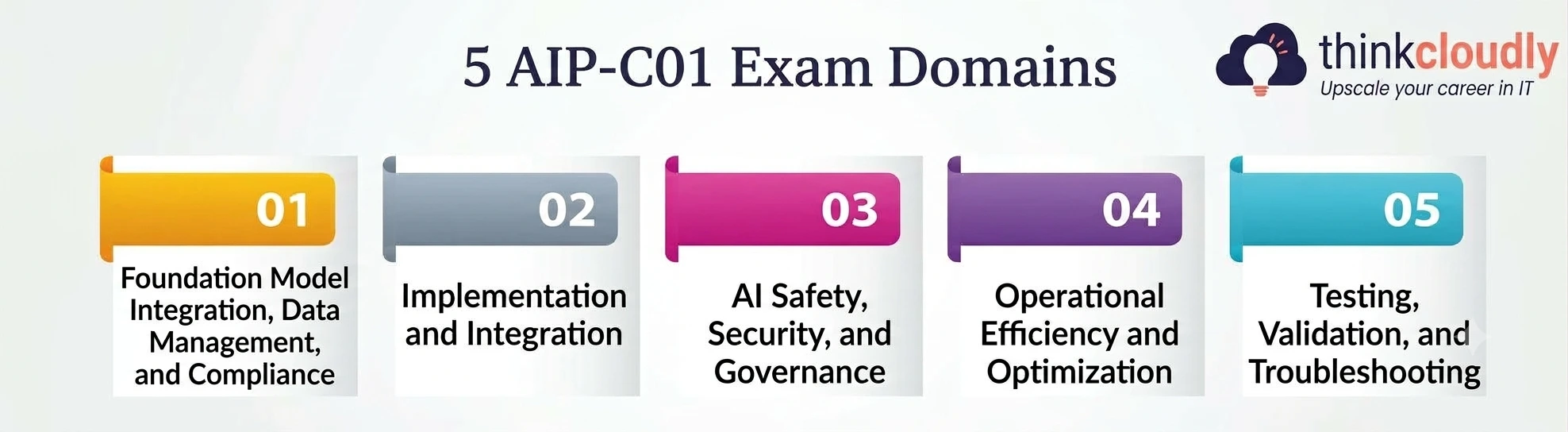
- Domain 1—Foundation Model Integration, Data Management, and Compliance (31%): architectural design, proof-of-concept builds on Amazon Bedrock, model selection, data pipelines for FM consumption, vector store design, retrieval mechanisms, and prompt engineering governance. This is the heaviest domain by a wide margin.
- Domain 2 — Implementation and Integration (26%): agentic AI solutions, tool integrations, deployment strategy choices, enterprise system integration, FM API patterns, and developer tooling like Amazon Q Developer.
- Domain 3—AI Safety, Security, and Governance (20%): input and output safety controls, data privacy protections, compliance frameworks, and responsible AI principles—this is where model governance work concentrates.
- Domain 4 — Operational Efficiency and Optimization (12%): cost optimization, performance tuning, and monitoring systems built specifically for generative AI workloads rather than generic cloud monitoring.
- Domain 5 — Testing, Validation, and Troubleshooting (11%): evaluation systems, quality assurance for model outputs, and diagnosing failures unique to retrieval and prompt-based applications.
Notice that the first two domains alone account for well over half the exam. If you only have time to deeply study two things, make it foundation model integration and implementation patterns—everything else builds on those two foundations.
Core Generative AI Developer Skills the Exam Validates
A second useful lens is the skill list itself, independent of domain weighting. Think of this as the practical generative AI developer skills checklist AWS is actually hiring for across its partner ecosystem:
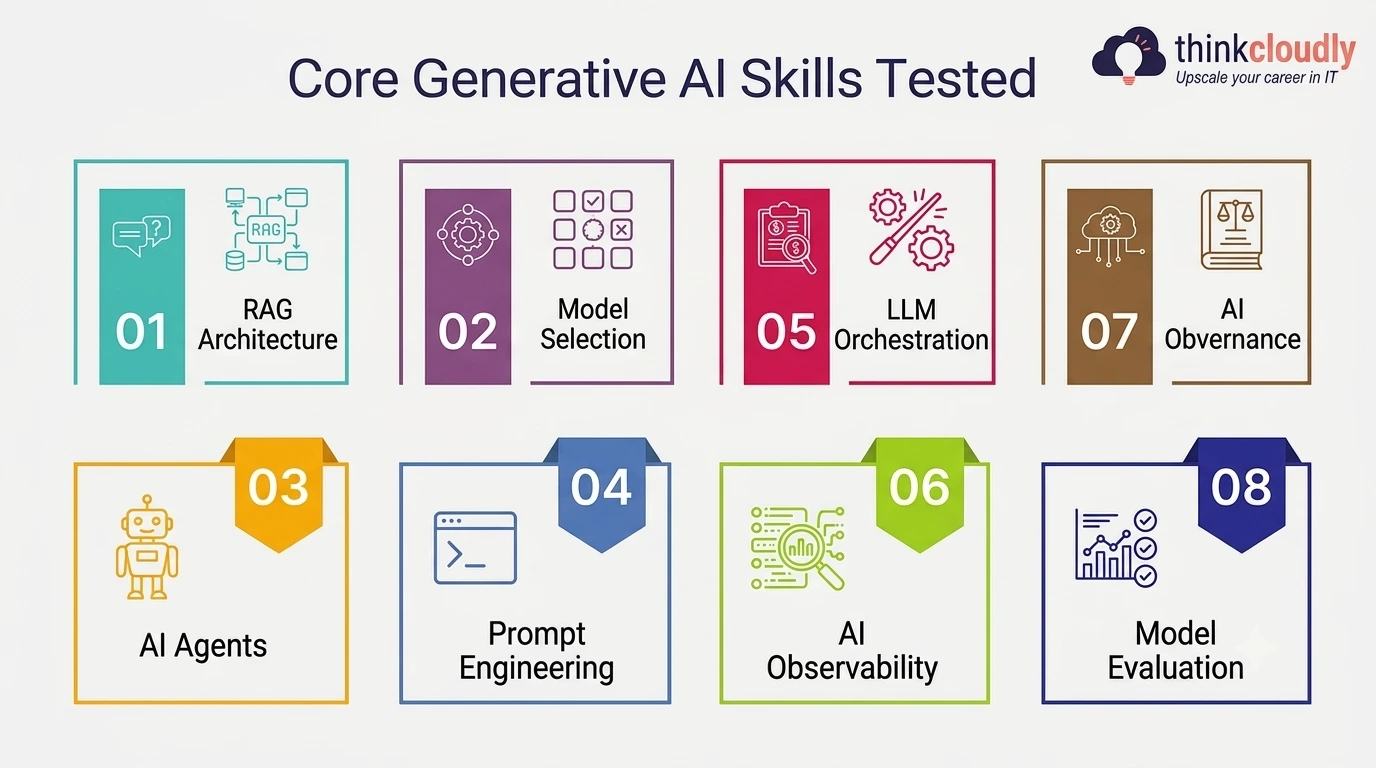
- Designing and building retrieval-augmented generation (RAG) architectures using vector stores, knowledge bases, and hybrid search
- Selecting and swapping foundation models without rewriting application code, often through an abstraction layer
- Building agentic systems with memory, tool use, and safeguards against runaway behavior
- Applying prompt engineering techniques, including structured prompts, chain-of-thought patterns, and reusable prompt flows
- Implementing LLM orchestration across multiple models, including ensemble approaches and model-cascading for cost control
- Enforcing governance controls through audit logging, model cards, data lineage tracking, and documented responsible AI policies, following patterns from Bedrock Guardrails
-
Monitoring token usage, hallucination rates, and latency with observability tooling built for generative workloads
-
Evaluating model and application quality through techniques like LLM-as-a-judge and systematic A/B testing
That list makes it clear this exam sits at the intersection of software engineering and applied AI model development, not purely in either camp.
Why Does This Credential Matter Right Now?
Generative AI roles have matured past the “anyone who’s used an API” phase. Hiring managers are starting to ask for demonstrated LLM orchestration experience and real model governance practices, not just a demo project on GitHub.
An AWS machine learning certification focused specifically on generative AI—rather than classical ML—fills a gap that didn’t really exist two years ago, because the job itself didn’t exist at that scale two years ago.
There’s also a timing advantage worth naming honestly. Because the AWS Generative AI Developer Professional (AIP-C01) only moved out of beta in March 2026, relatively few people hold it yet.
That cuts both ways—it’s a genuine differentiator on a resume right now, but it also means hiring managers are still calibrating how much weight to give it compared to older, more established credentials. Treat it as a strong signal alongside real project work, not a replacement for it.
The emphasis on model governance and responsible AI inside Domain 3 is also a signal about where AWS expects the market to head. Regulatory attention on AI systems has only increased, and organizations that can document their approval and evaluation practices—who signed off on a prompt template, how a model was evaluated for bias, and what data a retrieval system can access—will have an easier time clearing audits and client reviews. That’s a generative AI developer skills gap most teams have today, and it’s exactly what this exam is built to close.
How the AWS Generative AI Developer Professional (AIP-C01) Fits Among Other AWS Credentials?
It helps to place this exam on a map. The AWS Certified AI Practitioner (AIF-C01) is foundational—it checks whether you understand generative AI and machine learning concepts broadly, without requiring you to have built anything.
The AWS Certified Machine Learning Engineer – Associate (MLA-C01) sits closer to classical AI model development: training pipelines, feature engineering, and deployment mechanics that the AWS Generative AI Developer Professional (AIP-C01) explicitly excludes from its scope.
This credential occupies a different lane entirely. It assumes you already know how to ship software on AWS, and it tests whether you can apply that experience specifically to generative AI systems—orchestrating foundation models, building retrieval pipelines, and governing the result end to end.
Think of it as the benchmark for developers whose generative AI developer skills have outgrown “I called the Bedrock API once” and need a professional-level credential that matches what they’re actually shipping in production.
For anyone mapping out a broader certification path in applied AI, a reasonable sequence looks like AI Practitioner for breadth, then this credential for depth on generative AI implementation, with the Machine Learning Engineer Associate running alongside it for anyone who also touches model training directly.
None of these paths formally require each other, but the overlap in prompt design and LLM orchestration concepts makes studying them in sequence genuinely efficient, since vector retrieval and evaluation techniques show up across all three.
Building a Study Plan That Matches the Domain Weighting
A sensible runway is six to eight weeks for someone who already has hands-on AWS and generative AI experience; closer to ten to twelve weeks without it.
- Weeks 1–2: Get hands-on with Amazon Bedrock—model selection, knowledge bases, guardrails, and prompt management. This maps directly to Domain 1, the largest slice of the exam.
- Weeks 3–4: Build or review an agentic application using tool calling and a framework like Strands Agents, then work through enterprise integration patterns for Domain 2. This is also where LLM orchestration gets stress-tested in practice, since real scenarios chain several models together rather than relying on just one.
- Week 5: Focus entirely on AI Safety, Security, and Governance — read through Bedrock Guardrails documentation, PII detection with Comprehend and Macie, and responsible AI evaluation methods.
- Week 6: Cover operational efficiency — token cost tracking, caching strategies, and GenAI-specific observability — plus testing and evaluation approaches for Domain 5.
- Final 1–2 weeks: AWS’s Skill Builder exam prep plan, which includes the official practice question set and a readiness-check practice exam.
Because this is a professional-level exam, passive video watching won’t get you there. Build small proofs of concept for each domain — a RAG pipeline, a guarded prompt flow, a cost-monitored agent — because the exam rewards people who’ve actually wired these pieces together, not just read about them.
Common Mistakes Candidates Make
Even well-prepared candidates with genuine production experience trip up on the same handful of blind spots. A few patterns show up repeatedly among people who don’t pass on the first try:
- Underestimating Domain 1. At 31%, foundation model integration and data pipelines carry more weight than any other domain, yet candidates often rush past vector store design to get to the “more exciting” agentic AI material.
- Treating governance as a checkbox. Model governance questions test whether you can actually implement audit trails, lineage tracking, and bias evaluation — not whether you can define the term.
- Skipping cost optimization scenarios. Token efficiency and caching strategy questions in Domain 4 are easy to under-practice because they feel less technical than architecture questions, but they’re a meaningful 12% of the exam.
- Assuming classical ML knowledge transfers directly. This isn’t a model-training exam. Candidates with a strong AWS machine learning certification background sometimes over-prepare on training concepts that are explicitly out of scope.
- Ignoring the multi-model reality. Real applications increasingly rely on LLM orchestration across several models for cost and capability reasons, and the exam reflects that — a single-model mental model will trip you up on scenario questions.
A Personal Note
I’ve sat through enough certification cycles to know the ones worth taking seriously, and this one earns that seriousness honestly. What struck me most while digging into the AWS Generative AI Developer Professional (AIP-C01) outline wasn’t the technology — Bedrock, agents, vector stores, all familiar territory by now — it was how much weight AWS put on governance and responsible AI without treating it as a compliance afterthought.
That’s a shift worth paying attention to, whether or not you ever sit this exam. If you do decide to pursue it, resist the urge to speed-run the content domains in whatever order feels most interesting. Build something small in each area, break it on purpose, and fix it. That’s the only kind of studying that actually survives contact with a 180-minute exam.