




A former hotel operations manager emailed me in January asking if she was wasting her time looking into cloud security training when she’d never written a line of code or touched a server rack in her life. She wasn’t being dramatic.
Most cloud security job listings still read like they were written for people who’ve spent a decade in a network operations center, and that’s intimidating when your actual background is spreadsheets, vendor calls, and customer escalations.
Six weeks later she had finished her first structured training program built specifically for career-changers and was studying for an entry-level certification. She didn’t become a penetration tester. She became something more useful to her career right now: a credible candidate for a cloud compliance or governance role, with a real technical vocabulary to back it up.
That’s the honest shape of this answer. Cloud security training without an IT background is possible, but “possible” doesn’t mean “identical to the path a computer science graduate takes.” It means a different, slightly longer on-ramp that leans on structured fundamentals instead of assumed experience. This guide walks through what that on-ramp actually looks like in 2027, without pretending the gap doesn’t exist.
Why Are Cloud Security Careers Opening Up to Non-IT Professionals?
The honest starting point is the labor data, because it explains why employers are suddenly more flexible about who they’ll consider. According to the U.S. Bureau of Labor Statistics, information security analyst roles are projected to grow 33% between 2023 and 2033, one of the fastest growth rates the agency tracks across all occupations, with a median annual wage of $120,360 as of May 2023. That kind of growth doesn’t get filled purely by computer science graduates; there simply aren’t enough of them entering the field each year to cover demand of that size.
The global workforce numbers tell a similar story. ISC2’s most recent Cybersecurity Workforce Study reported a worldwide gap of roughly 4.8 million unfilled cybersecurity positions, even as the existing workforce grew to an estimated 5.5 million professionals.
That shortage is precisely why entry-level security-training programs focused on cloud environments, built for career-changers rather than just engineers, have multiplied heading into 2027. Employers have accepted a trade-off: hire someone with verified foundational knowledge and train the specifics in-house, rather than wait indefinitely for a perfectly credentialed unicorn who may never apply.
None of this means cloud security training turns a complete beginner into a senior security architect in a few months. It means the entry tier—security operations support, compliance analyst, cloud governance associate—is realistically reachable for someone without a prior IT title, provided they build real, verifiable knowledge rather than a resume line that just says “interested in cybersecurity.”
For employers, this shift is really about treating the entry barrier as a technical skills development problem that structured courses can solve, rather than an unsolvable experience gap that only a four-year degree closes.
What This Kind of Security Training Actually Teaches You?
Strip away the marketing language from most course catalogs and a solid cloud security training path covers a fairly consistent set of building blocks, usually in this order:
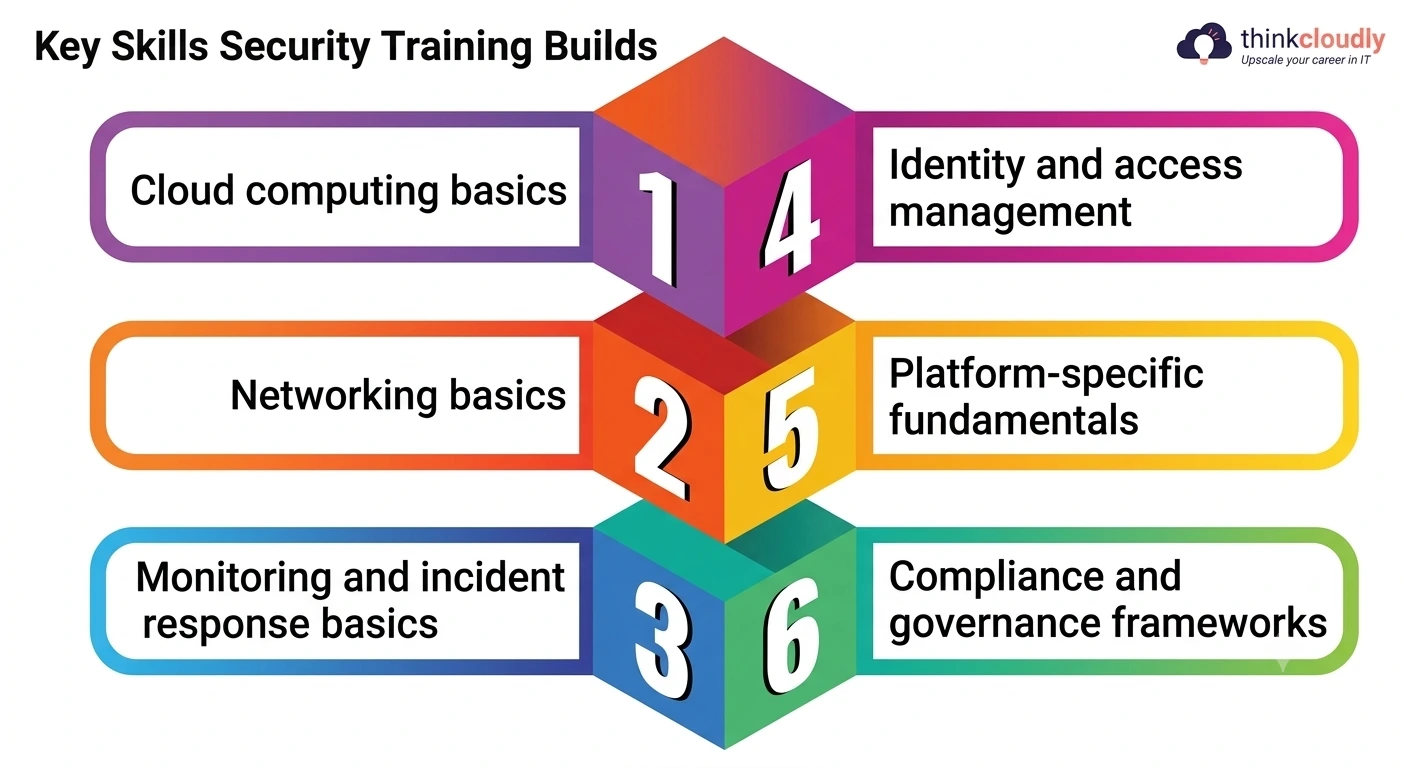
- Cloud computing basics—how cloud providers structure compute, storage, and networking, and what the shared responsibility model means for who secures what.
- Identity and access management—how permissions, roles, and authentication actually control who can touch what inside a cloud environment, which is the single most common source of real-world breaches.
- Networking basics—subnets, firewalls, and how traffic moves (or gets blocked) between cloud resources, because almost every security incident traces back to a misconfigured network boundary somewhere.
- Platform-specific fundamentals—a baseline credential like Azure fundamentals or its AWS equivalent, which proves you understand how a specific provider actually implements these concepts.
- Monitoring and incident response basics—reading logs, recognizing anomalies, and understanding escalation procedures before anyone hands you production access.
- Compliance and governance frameworks — the policy side of security, which matters enormously for non-technical entrants since it leans on documentation and process skills they may already have from another career.
Notice that coding barely shows up on that list. Most entry-level training in this field is concept-and-configuration heavy, not script-heavy, which is exactly why it’s reachable for someone whose background is operations, customer support, finance, or project coordination rather than software engineering.
The sequence matters more than people expect—jumping straight to governance frameworks before the underlying platform vocabulary is in place is usually what makes this material feel harder than it actually is.
Skills to Build Before You Start Formal Cloud Security Training
Before enrolling in anything, there are a handful of foundational areas worth strengthening on your own, since they make every later course click faster instead of feeling like a foreign language:
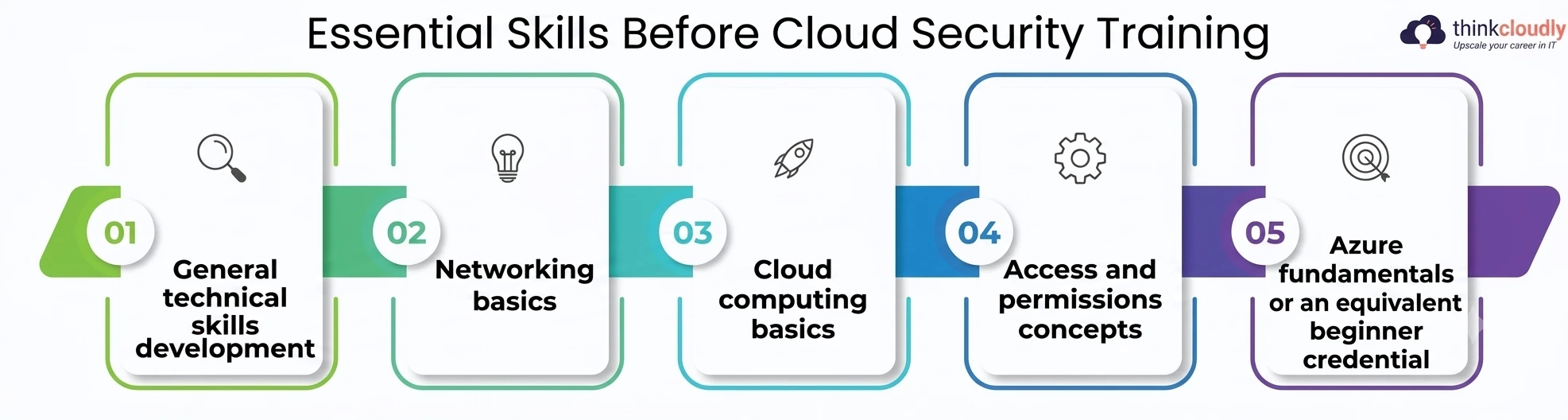
- General technical skills development—comfort navigating a command line, understanding how files and permissions work, and getting used to reading technical documentation instead of avoiding it.
- Networking basics—a working sense of what an IP address, a firewall, and a VPN actually do, even at a conceptual level, before diving into cloud-specific networking.
- Cloud computing basics—the vocabulary of virtual machines, storage buckets, and regions, so this stage isn’t simultaneously teaching you security and basic cloud vocabulary at the same time.
- Access and permissions concepts—the idea of roles, least-privilege access, and separating duties between accounts, since IAM underpins almost every cloud security control that follows it.
- Azure fundamentals or an equivalent beginner credential—a low-stakes, genuinely beginner-friendly certification that proves baseline platform literacy before you attempt anything security-specific.
Building this technical skills development habit early, even informally through free tutorials, means the formal cloud security training that follows spends its time on security concepts instead of re-teaching basic cloud literacy from scratch.
Two Realistic Entry Paths Into Cloud Security
Not everyone without an IT background is aiming for the same end role, and the right starting point genuinely differs depending on which direction appeals more. Here’s how the two most common non-technical entry paths compare:
|
Factor |
Compliance/Governance Path |
Technical Security Operations Path |
|
Best for |
People from audit, legal, policy, or operations backgrounds |
People willing to go deeper into hands-on configuration |
|
Core early skills |
Frameworks, documentation, risk assessment basics |
Networking basics, identity and access management, log analysis |
|
Typical first certification |
CompTIA Security+ or a GRC-focused credential |
Azure fundamentals plus a security-specific add-on exam |
|
Coding required |
Minimal to none |
Light scripting eventually helps, not required to start |
|
Realistic entry role |
Compliance analyst, GRC associate, risk analyst |
Security operations support, junior cloud security analyst |
|
Typical ramp-up time |
3–5 months |
5–8 months |
Neither column is the “real” security path, and the other is a lesser substitute. Both are genuine, hireable outcomes of structured cloud security training, and plenty of people start in the compliance column and migrate toward the technical one once they’ve built confidence and a verified track record. Employers hiring for either path care less about which column someone started in than whether the candidate can explain, in plain language, why a particular control or policy exists—that’s a much more reliable signal than the certification logo on a resume.
A Step-by-Step Roadmap for Non-IT Learners
Here’s a reasonable order to actually move through this, rather than jumping between random courses:
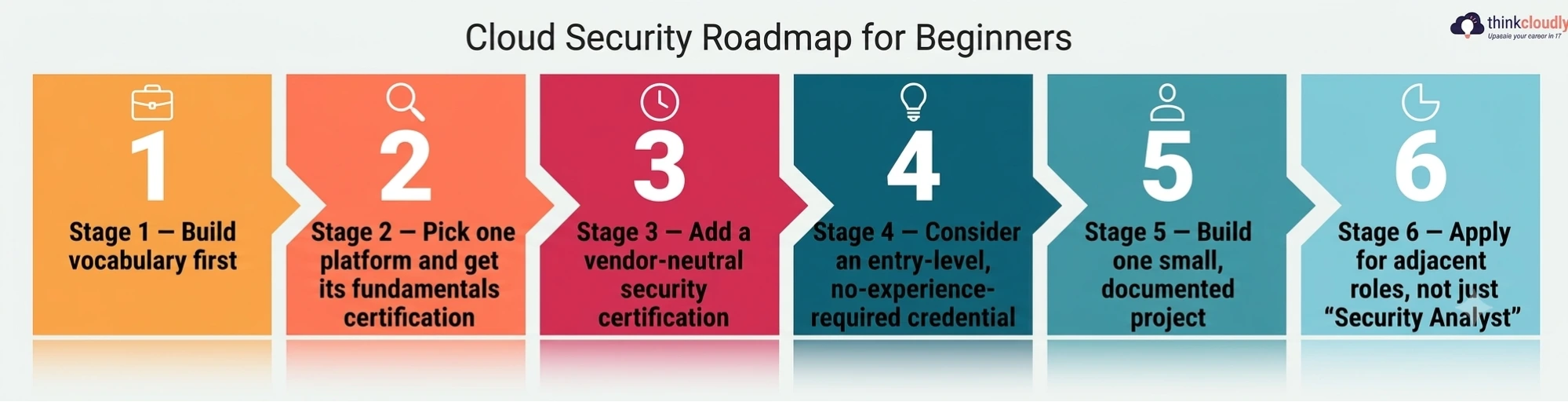
- Stage 1—Build vocabulary first. Spend two to three weeks on free introductory material covering cloud computing basics and general networking basics before paying for anything formal, treating this stage as pure technical skills development rather than certification chasing.
- Stage 2—Pick one platform and get its fundamentals certification. Microsoft’s SC-900 exam covers security, compliance, and identity concepts, including identity and access management, without requiring any prior technical role, and pairs well with a general Azure fundamentals credential if you haven’t already earned one.
- Stage 3—Add a vendor-neutral security certification. CompTIA Security+ is widely recognized by employers as a baseline credential and doesn’t require a technology degree or prior job experience to sit for it.
- Stage 4—Consider an entry-level, no-experience-required credential. ISC2’s Certified in Cybersecurity was specifically built for career-changers with no prior security experience, and ISC2 has offered free exam attempts for eligible candidates as part of its push to close the workforce gap.
- Stage 5—Build one small, documented project. Configure a free-tier cloud account with basic IAM rules, document a sample incident-response checklist, or map out a compliance framework for a fictional small business. The goal is proof of applied understanding, not perfection, and a short written explanation of what each setting does is often more impressive to a reviewer than the configuration itself.
- Stage 6—Apply for adjacent roles, not just “Security Analyst.” Compliance associate, IT risk coordinator, cloud governance assistant, and security operations support roles are realistic landing spots for someone completing this kind of training without a prior technical title.
Common Mistakes Non-Technical Learners Make
- Trying to learn everything at once. Attempting foundational cloud concepts, basic networking fundamentals, scripting, and three certifications simultaneously usually produces burnout rather than depth, and the material rarely sticks when it’s rushed this way.
- Skipping identity and access management because it sounds administrative. It’s actually one of the most tested, most interview-relevant concepts in the entire field, and glossing over it is the single most common gap reviewers notice in a candidate’s project write-up.
- Collecting certifications without ever touching a free-tier account. A credential with zero hands-on practice behind it is a thinner signal than most candidates realize.
- Assuming the compliance path is “easier” and therefore less valuable. It isn’t lesser; it’s a different skill emphasis that plenty of organizations actively need filled, and it often pays comparably once someone reaches a mid-level role.
- Waiting to apply until every certification is finished. Most hiring managers for entry-level roles are evaluating trajectory and foundational knowledge, not a complete trophy case.
- Underestimating how much existing experience actually transfers. Documentation habits from audit, legal, or operations work map directly onto governance and risk-assessment tasks, and that transferable experience is worth naming explicitly on a resume rather than leaving implied.
How Long Does This Realistically Take?
Most people moving from a non-IT background into an entry-level cloud security role land somewhere between four and eight months, depending on how many hours a week they can dedicate and which of the two paths above they’re pursuing.
Someone coming from an audit, legal, or operations background tends to move faster through the compliance route, since documentation and risk-assessment habits often transfer directly. Someone starting without any adjacent professional background should expect the longer end of that window, and that’s not a sign of falling behind — it reflects the actual size of the knowledge gap being closed through structured study rather than assumption.
Timelines also slip far more often because people study passively, rewatching videos instead of configuring anything themselves, than because the underlying material is genuinely too difficult for a non-technical learner to grasp.
A Personal Note
I’ll say the part most course marketing pages leave out: the hardest stretch isn’t the material itself, it’s the first few weeks of feeling like an imposter in a field that still has a reputation for being hoodie-and-hacker coded. I’ve watched people with backgrounds in retail management, nursing administration, and customer support talk themselves out of starting because they assumed everyone else in the room had a computer science degree. Most of them didn’t.
The people who actually make it through aren’t the ones who felt ready on day one — they’re the ones who treated their first course as a rough draft of competence rather than a final exam, and kept going anyway. If you’re sitting with the same question that the hotel operations manager emailed me about, the honest answer is that the door is open wider than it looks from outside. Walking through it just takes a plan instead of a leap of faith.
She emailed me again recently, about a year into her compliance analyst role, mostly to say that the thing she worried about most going in — not having a “real” technical background — barely comes up anymore; what her team actually relies on her for is the same careful, process-minded thinking she brought with her from hospitality operations, just pointed at a different kind of risk.