






Searching for a SOC threat hunting course in Canada usually turns up the same problem every cybersecurity career search runs into: dozens of landing pages promising a six-figure job and almost nothing that explains what the role demands once you’re three months into the seat. Threat hunting isn’t SOC monitoring with a fancier title.
It asks you to go looking for intrusions nobody has alerted on yet; using judgment, a syllabus alone can’t hand you. This guide walks through what a serious program should teach, which SOC analyst threat hunting skills actually get you hired for, the tools and framework you’re expected to know on day one, and what the career path and pay realistically look like across Canada heading into 2027.
What a SOC Threat Hunting Course Should Actually Teach You?
Strip the marketing language off any SOC threat hunting course, and the real promise is narrow: can it teach someone to find an intruder who has already slipped past every automated alert in the building?
That’s a different skill than Tier 1 triage. A credible program builds hypothesis-driven investigation first—starting from a hunch about attacker behavior, then proving or disproving it across logs, endpoints, and identity systems—rather than waiting for a dashboard to light up on its own.
Good programs spend real hours on the SOC analyst threat hunting skills most beginners never get a chance to practice: writing a hunting hypothesis from a piece of threat intelligence, pivoting across data sources when the first query comes back empty, and documenting a hunt clearly enough that a teammate can pick it up mid-investigation without starting over.
Skip that layer and you finish such a program, able to describe hunting in an interview, without having actually practiced the judgment calls that make a hunt worth running in the first place.
Why Threat Hunting Careers Are Heating Up in Canada for 2027?
The shortage behind this demand isn’t a talking point invented by course providers—it’s tracked. Canadian employers posted 2,448 unique cybersecurity roles between March 2025 and February 2026, against a shortage estimated at more than 26,000 cybersecurity professionals heading into 2026, a gap that hasn’t closed going into 2027.
National security analyst pay runs from roughly $62,400 to $150,000 a year, with a median near $103,000, and threat hunting sits toward the senior, better-paid end of that range once the Tier 1 and Tier 2 years are behind you.
Part of why demand keeps climbing is that attackers have gotten quieter. Proactive threat hunting exists because waiting for an alert increasingly means waiting for nothing—agrowing share of intrusions now lean on legitimate admin tools and valid stolen credentials instead of a file a signature would ever flag.
Automated detection still catches the obvious cases; this kind of hunting is how a team catches the ones built specifically to avoid looking obvious. That shift is exactly why Canadian employers are now willing to pay a premium for analysts fluent in real threat hunting tools, not just an alert queue.
Geography matters too. Toronto, Vancouver, and Ottawa carry the deepest concentration of hunting-adjacent postings, split mostly between managed security service providers, financial institutions, and federal contractors who can justify a dedicated hunting function.
Smaller markets rarely post a standalone “threat hunter” title at all—the function usually gets folded into a senior SOC analyst’s job description instead, which is worth knowing before you go searching for the exact title and conclude the role doesn’t exist where you live.
5 SOC Analyst Threat Hunting Skills Employers Screen For in 2027
A finished SOC threat hunting course should leave you able to demonstrate these five SOC analyst threat hunting skills in an interview, not just recite them from memory:
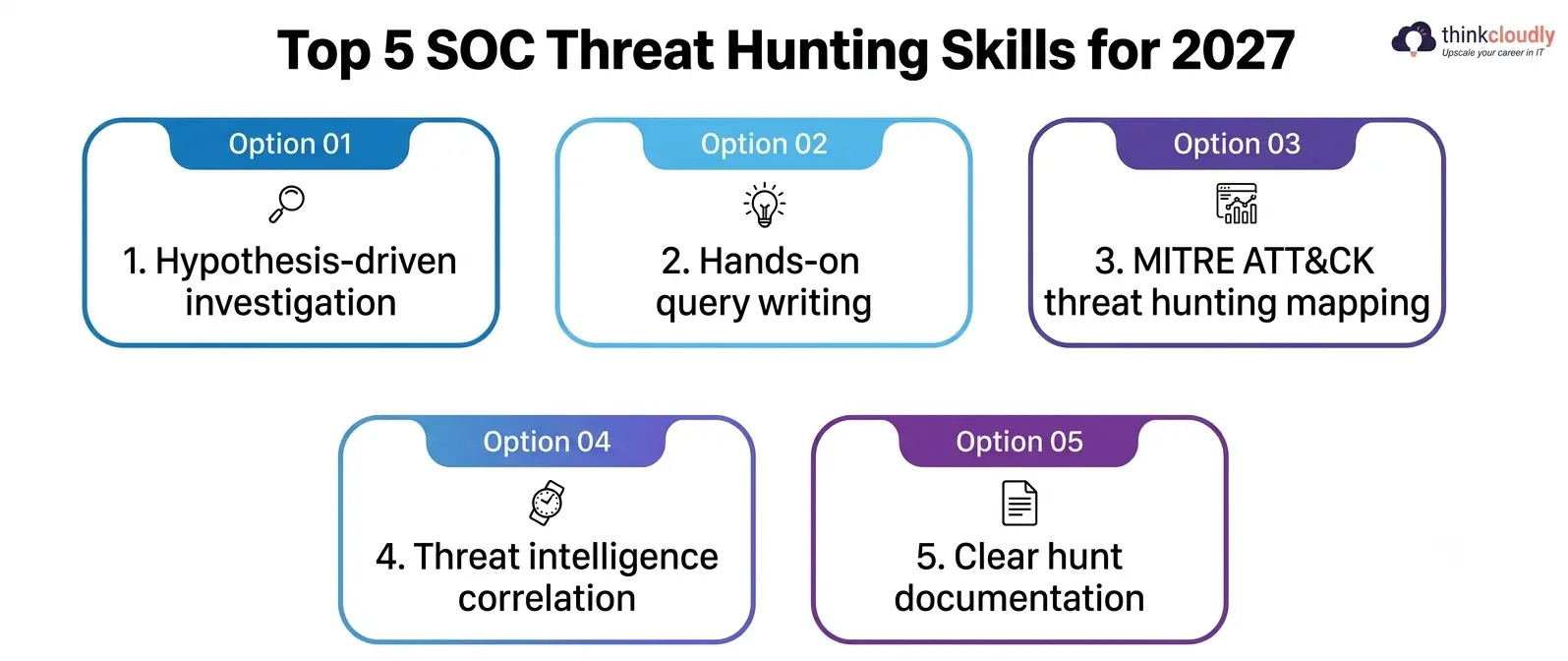
- Hypothesis-driven investigation—starting a hunt from a specific theory about attacker behavior, not a random log sweep.
- Hands-on query writing—pulling precise evidence out of SIEM and EDR data using SPL, KQL, or a similar query language.
- MITRE ATT&CK threat hunting mapping—describing suspicious behavior by tactic and technique instead of a vague “this looks off.”
- Threat intelligence correlation—matching internal findings against known adversary infrastructure and tradecraft.
- Clear hunt documentation—writing up a completed hunt so a Tier 2 analyst or threat intel team can act on it immediately.
Most free and low-cost programs teach the first two of these reasonably well and barely touch the last three, which is exactly where a stronger program tends to earn its price tag.
MITRE ATT&CK and Threat Hunting: The Shared Language Behind Every Hunt
If hunting proactively is the mindset, MITRE ATT&CK is the map. The framework organizes known adversary behavior into roughly 14 tactics, 211 techniques, and 468 sub-techniques across its enterprise matrix, giving hunters a shared vocabulary instead of a pile of disconnected alerts.
MITRE ATT&CK threat hunting in practice means starting a hunt from one specific technique—a particular lateral movement method, say—and searching logs for evidence of it, rather than hoping something anomalous jumps out on its own.
A SOC threat hunting course that treats MITRE ATT&CK threat hunting as a footnote is teaching half the job. Detection engineers use the framework to find coverage gaps in existing SIEM rules; hunters use it to decide which technique to chase next, based on what’s currently trending among active adversary groups.
Courses that skip straight to tool mechanics without this layer leave graduates able to run a query but unable to explain why that particular technique mattered enough to hunt for in the first place.
Threat Hunting Tools Canadian SOC Teams Actually Use
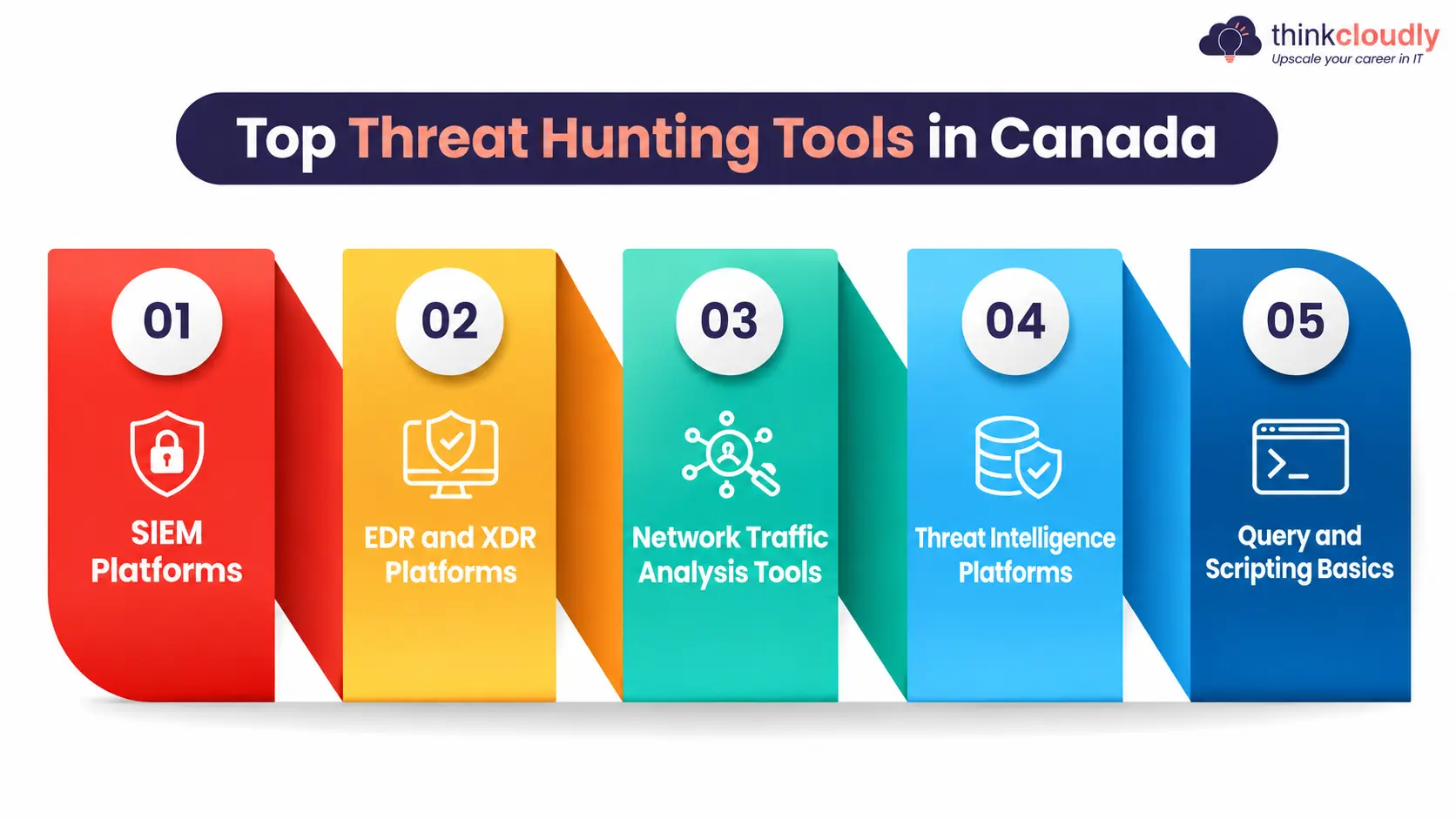
- SIEM platforms—Splunk and Microsoft Sentinel dominate Canadian job postings, used for correlation searches and KQL or SPL hunting queries.
- EDR and XDR platforms—CrowdStrike Falcon, Microsoft Defender, and SentinelOne, for endpoint-level process and behavior visibility.
- Network traffic analysis tools—Zeek and similar packet-level tools for spotting unusual outbound connections or beaconing patterns.
- Threat intelligence platforms—feeds and platforms that map external adversary activity back to internal findings.
- Query and scripting basics—KQL, SPL, and simple Python or PowerShell for pulling custom evidence out of large datasets quickly.
The threat hunting tools named above show up again and again in Canadian postings, and a quality program worth its price should put you inside most of them rather than just describing what they do on a slide.
Employers don’t expect mastery of every item on that list on day one, but a candidate who has touched real threat hunting tools in a lab environment interviews completely differently from one who has only read about them in a course transcript.
Proactive Threat Hunting vs. Reactive Alert Triage
The distinction matters more than most course marketing admits. Reactive triage waits for a SIEM or EDR platform to raise a flag, then investigates that one alert. Proactive threat hunting starts before any alert fires, working from a hypothesis about what an adversary might already be doing, undetected, inside the environment right now.
CrowdStrike’s Threat Hunting Report found that AI-assisted detection now surfaces 2.5 times more threat leads than manually driven hunting activity alone and that its OverWatch team worked through more than 800 hunting leads across over 80 victim organizations in just four days following one major vulnerability disclosure.
That pace is only possible when hunting proactively is built into daily operations rather than treated as an occasional special project. A course that teaches triage alone, while calling itself hunting-focused, is preparing graduates for the last decade’s threat model, not this one.
SOC Threat Hunting Course Path: From Tier 1 Analyst to Threat Hunter
|
Career Stage |
Typical Focus | Core Skill Added |
Approx. Canadian Salary (CAD) |
|
Tier 1 SOC Analyst |
Alert triage and escalation | Log reading, basic SIEM queries |
55,000–70,000 |
|
Tier 2 SOC Analyst |
Deeper investigation, correlation | Cross-source analysis, incident handling |
70,000–95,000 |
|
Threat Hunting Trainee |
First structured hunts, supervised | Hypothesis building, ATT&CK mapping |
85,000–110,000 |
|
Threat Hunter / Threat Analyst |
Independent proactive hunts | Threat intel correlation, tool fluency |
105,000–135,000 |
|
Senior Threat Hunter / Detection Engineer |
Building hunt playbooks, mentoring | Automation, detection engineering |
$135,000 and up |
These figures line up with the Morgan McKinley Toronto threat analyst salary guide, which lists median Toronto threat analyst pay at $110,000 a year, with a range of roughly $85,000 to $135,000 depending on seniority and employer size.
Threat Hunting Certification Options Worth Pursuing After Your Course
A solid program gets you to a demonstrable baseline; a threat hunting certification afterward gives employers a third-party-verified signal they don’t have to take on faith. A roundup of threat hunting credentials breaks the field roughly into entry-level and advanced options. SANS FOR508 sits at the advanced end, built around real incident-response and hunting scenarios for people already working the role.
EC-Council’s Certified Threat Intelligence Analyst covers the full threat intelligence lifecycle and suits hunters who lean toward intelligence correlation over pure technical hunting. Mandiant’s Practical Threat Hunting, delivered through Google Cloud, is a hands-on, instructor-led option built for working SOC practitioners rather than total beginners.
Picking the right threat-hunting certification depends entirely on where you are in the path. Someone straight out of a foundational program is usually better served starting with a broader credential, such as CompTIA CySA+, before stretching toward SANS-level material. Earning a specialist credential too early, before the underlying skills are solid, tends to prove less to an interviewer than a well-documented lab portfolio built during the course itself.
How to Choose the Right SOC Threat Hunting Course in Canada?
A few filters cut through most of the marketing noise when comparing programs:
- Ask for lab hours, not just a syllabus. A course heavy on slides and light on live hunting exercises leaves you unprepared for a technical interview.
- Confirm MITRE ATT&CK threat hunting is taught in depth, not mentioned once and left behind. It should shape how every lab exercise is structured.
- Check which threat hunting tools you’ll actually touch. Reading about Splunk is not the same as querying inside it under time pressure.
- Look for documentation practice built into the grading, since a hunt nobody can read is a hunt that didn’t help the next shift.
- Match the course to your target employer’s stack. A deep dive into one SIEM platform only pays off if the companies you’re applying to actually run it.
Final Thoughts
A quality program like this won’t hand you a job on its own, and the strongest ones don’t pretend otherwise. What a good program does is close the gap between knowing the theory of an intrusion and actually finding one buried in weeks of ordinary-looking log data — the exact gap Canadian employers are screening for as detection keeps shifting toward hunting rather than waiting on alerts across 2027.
Build the core analyst instincts first, get hands-on with the platforms your target employers actually run, get fluent in MITRE ATT&CK threat hunting before you ever sit an exam, and treat any credential as confirmation of skill you already have, not a substitute for building it.
A Personal Note
The part that stood out most while researching this piece wasn’t the salary numbers, it was how many threat hunter job postings in Canada still list triage experience as a hard requirement rather than a preference. That tells you something a course brochure won’t: hunting is a specialization built on top of a SOC foundation, not a shortcut around one.
If you’re mapping out a SOC threat hunting course right now, don’t skip the unglamorous Tier 1 years to get there faster. The hunters who actually hold these roles down are the ones who spend enough time in the noise to recognize, instantly, when something quiet is actually wrong.