




I’ve spent the last few months talking to recruiters, reading hiring reports, and scrolling through a LinkedIn feed that says the same thing on repeat: companies cannot find enough people who genuinely know how to work with AI. Not people who have “used ChatGPT a few times,” but people who can build with it, govern it, and explain it to a room full of executives who are nervous about getting left behind.
That gap is exactly why AI skills demand in 2027 have become one of the most searched phrases among job seekers, career switchers, and even seasoned engineers who feel like the ground shifted under them this year.
This isn’t hype. A ManpowerGroup survey found that AI skills are now the hardest skillset for employers to find anywhere in the world—ahead of IT, engineering, and every category that topped the list for the past decade. In the United States alone, 69% of employers reported difficulty filling AI-related roles.
If you’re trying to work out which future AI skills are worth your time and which courses will actually get you hired rather than hand you a certificate to frame and forget, this guide walks through both, as honestly as I can manage, down to the exact essential AI skills to learn first and the specific courses worth paying for.
Why AI Skills in Demand 2027 Is the Conversation Everyone’s Having?
A few years ago, “knowing AI” meant you could write a decent prompt. That bar has moved fast. Recruiters I’ve spoken with describe a labor market where AI skills in demand in 2027 aren’t a forecast anymore; it’s the present tense wearing next year’s label. Job postings mentioning AI expertise have roughly tripled compared to two years ago, and generative AI openings went from almost nonexistent in 2021 to thousands of live listings today.
A few things are driving this shift at once:
- Companies have moved past AI pilots and are now deploying AI inside real workflows, which means they need people who can maintain, audit, and improve those systems, not just demo them.
- The cost of getting it wrong—bad data, biased models, compliance failures—has made employers far pickier about who they trust with AI projects.
- Generative and agentic AI tools changed so quickly that most university curriculums simply haven’t caught up, so employers are hiring on demonstrated skill rather than degree titles.
Because of this, the skills businesses actually value are no longer confined to data science teams. Marketing, finance, operations, HR, even legal departments now expect at least working fluency. A content strategist who can direct an AI workflow is suddenly more valuable than one who can’t, and a financial analyst who understands model limitations is trusted with bigger decisions than one who treats AI output as gospel.
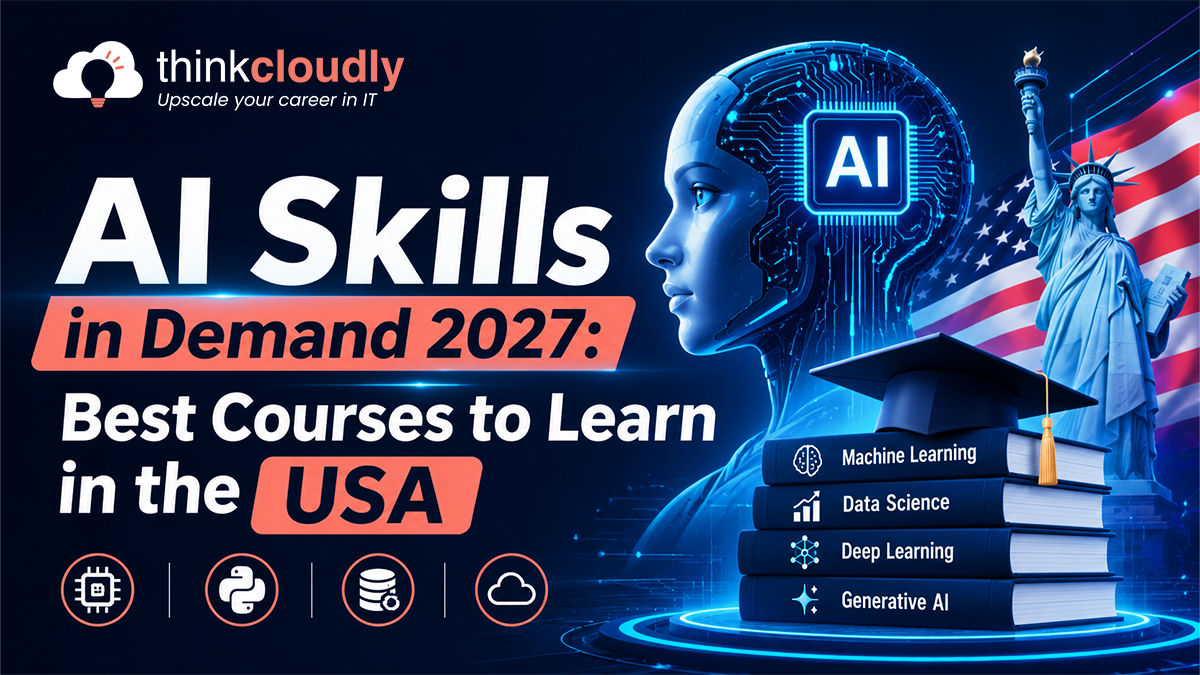
Discover the top AI skills in demand for 2027 and explore the best courses to learn in the USA. From machine learning and generative AI to data analytics and automation, find the right skills to advance your career. Enroll in an Artificial Intelligence and Data Science Training Program to gain practical knowledge, industry-relevant skills, and career opportunities.
Future AI Skills Employers Are Actually Hiring For
This is the hands-on part. Here’s what the future AI skills are that are popping up again and again across US job boards, based on current hiring data and what recruiters are flagging in job descriptions right now. Together, they make up the backbone of AI skills in demand in 2027:
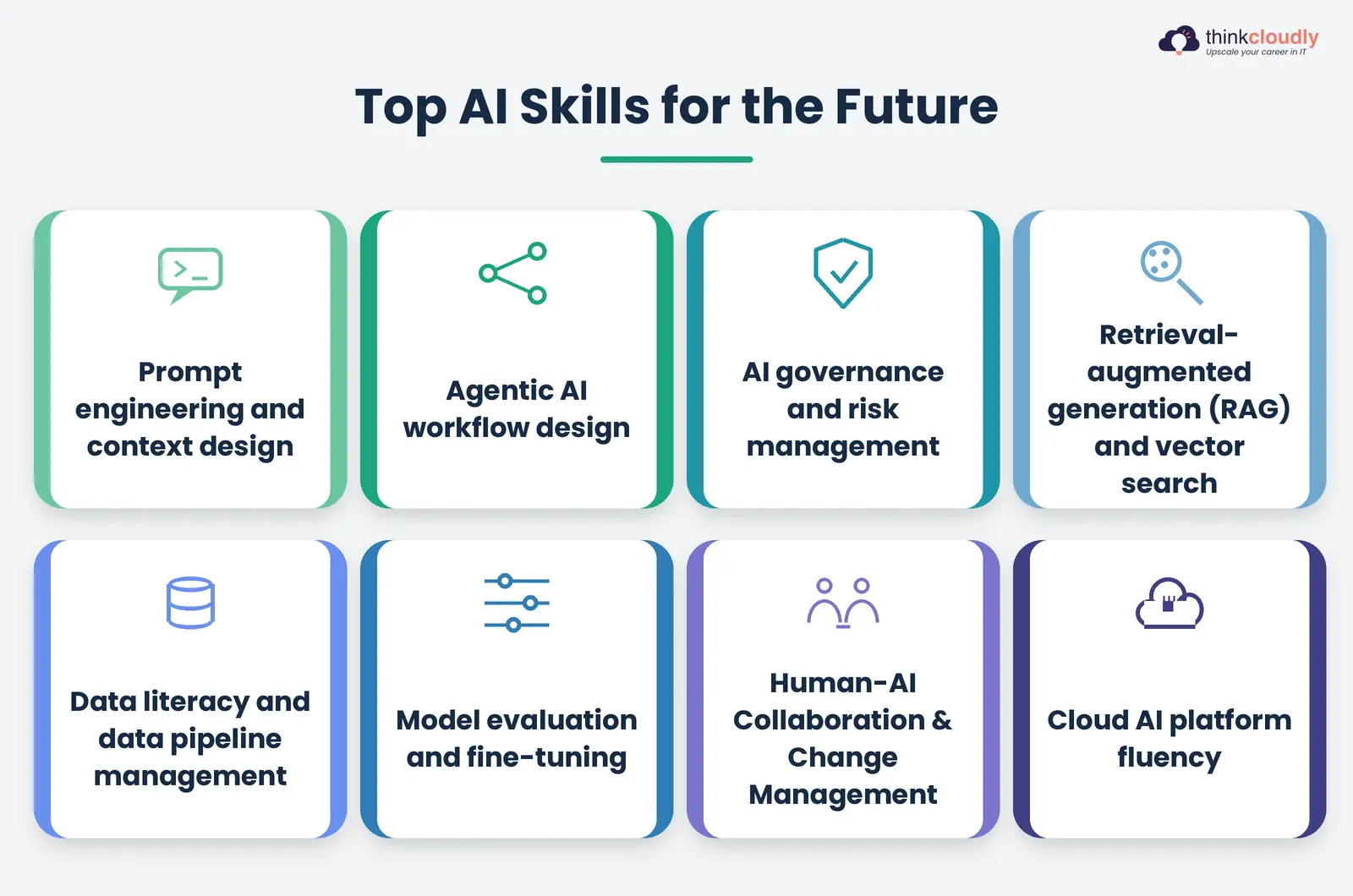
- Prompt engineering and context design—not just writing clever prompts, but designing the information an AI model needs to generate reliable output.
- Agentic AI workflow design—building systems where AI agents complete multi-step tasks with minimal supervision.
- AI governance and risk management—understanding compliance, bias auditing, and responsible deployment, especially as regulation stiffens.
- Retrieval-augmented generation (RAG) and vector search—securely connect large language models to a company’s own data.
- Data literacy and data pipeline management—AI is only as good as the data feeding it, and employers know this more than ever now.
- Model evaluation and fine-tuning—figuring out whether a model’s output is actually good and making changes when it’s not.
- Human-AI Collaboration & Change Management—helping teams adopt AI tools without resistance or misuse.
- Cloud AI platform fluency—hands-on comfort with AWS, Azure, or Google Cloud’s AI and machine learning services.
If you only have time to build two or three of these, prompt engineering, RAG, and governance tend to give you the broadest reach across industries, since they apply whether you’re in healthcare, retail, or finance.
Artificial Intelligence Career Skills vs. AI Technical Skills: Know the Difference
People often lump everything AI-related into one bucket, but employers draw a clear line between two categories, and the best artificial intelligence career skills training programs teach both.
These are the business-facing abilities: knowing which AI use case solves a real problem, communicating AI limitations to non-technical stakeholders, managing AI-related risk, and leading teams through adoption. They matter whether you’re an engineer or not, and they’re often the deciding factor in who gets promoted into AI leadership roles, regardless of which department you sit in.
AI technical skills, on the other hand, are the hands-on, build-it-yourself abilities: writing code that interacts with models, deploying and monitoring machine learning pipelines, and troubleshooting when a system behaves unpredictably.
According to SHL research cited in the same hiring reports mentioned earlier, nearly half of US employees have already been encouraged by their employers to use AI at work, mostly for data analysis and writing tasks, which tells you even non-technical staff are now expected to carry baseline AI literacy.
The smartest move for 2027 isn’t picking one lane. It’s building enough AI technical skills to understand how the systems actually work, paired with enough artificial intelligence career skills to apply that understanding where it matters to a business.
AI Technical Skills You’ll Need to Master This Year
If you’re aiming for a hands-on AI role, here’s where your learning hours should go, and this is squarely where AI skills in demand in 2027 get technical rather than conceptual. These core capabilities show up consistently in job postings for AI engineers, ML engineers, and data scientists across the US market:
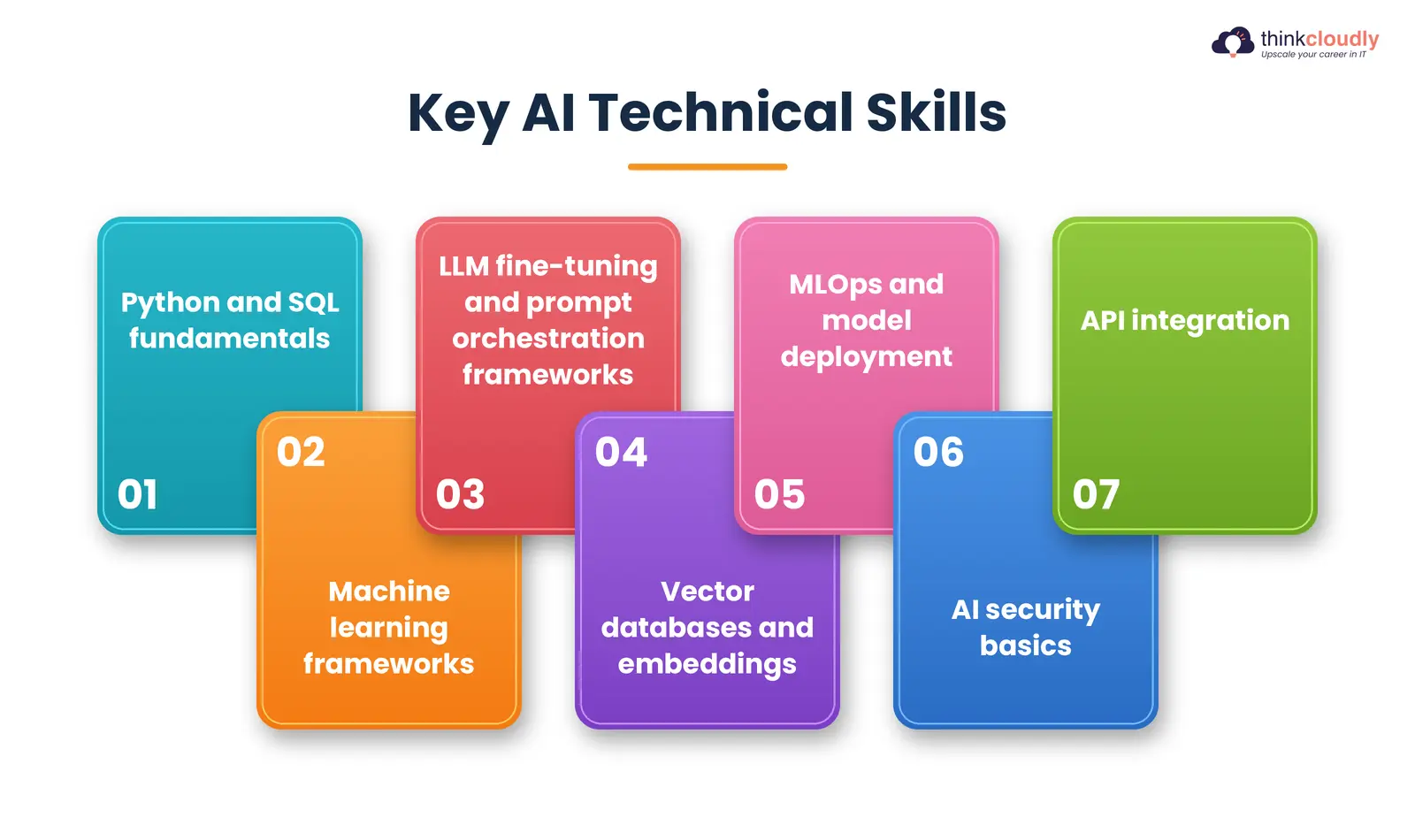
- Python and SQL fundamentals—still the backbone of almost every AI and data role, no shortcuts here.
- Machine learning frameworks—practical comfort with tools like scikit-learn, PyTorch, or TensorFlow, depending on the role.
- LLM fine-tuning and prompt orchestration frameworks—tools like LangChain or similar orchestration layers are increasingly expected knowledge.
- Vector databases and embeddings—essential for building search and retrieval systems that actually understand context.
- MLOps and model deployment—getting a model from a notebook into production and keeping it running reliably.
- AI security basics—recognizing prompt injection, data leakage, and other risks unique to AI systems.
- API integration—connecting AI models to the tools a business already uses, from CRMs to internal dashboards.
None of this requires a computer science degree. It requires structured practice, and that’s exactly what a good course provides.
Skills Required for AI Jobs, Role by Role
Not every AI job wants the same mix of abilities, which is one of the most overlooked parts of the AI skills in demand 2027 conversation. Here’s a quick breakdown of the skills required for AI jobs across a few common roles, along with where each skillset tends to be learned best:
|
AI Job Role |
Core Skills Required |
Where to Build the Skill |
|
AI/Prompt Engineer |
Prompt design, context structuring, model evaluation |
Google AI Essentials, Deep Learning. AI short courses |
|
Machine Learning Engineer |
Python, ML frameworks, MLOps, model deployment |
IBM AI Engineering Professional Certificate |
|
AI Product Manager |
Business case design, AI governance, stakeholder communication |
University extension AI strategy courses |
|
Data Analyst (AI-augmented) |
Data literacy, SQL, basic model interpretation |
Coursera Data Analytics certificates |
|
AI Governance Specialist |
Compliance, bias auditing, risk frameworks |
AI ethics and policy certificate programs |
This table alone should tell you something important: the skills required for AI jobs aren’t identical across roles, so chasing every trending skill at once usually backfires. Pick the lane that matches the role you actually want, then go deep.
Essential AI Skills to Learn: Best Courses to Learn in the USA
This is what most people actually came here for, so let’s get specific. Here are the essential AI skills to learn today if you want to position yourself correctly for AI skills in demand in 2027, matched with courses that are actually recognized by US employers.
- For beginners and non-technical folks: Start with Google AI Essentials, a short, practical course designed for people who use AI tools every day and want to use them well. It teaches prompt writing, workflow automation, and responsible AI use without needing any coding knowledge, making it one of the quickest ways for essential AI skills to learn.
- For budding machine learning engineers: The IBM AI Engineering Professional Certificate is still one of the most respected hands-on programs for acquiring real AI technical skills, teaching Python, deep learning, and model deployment via actual projects instead of just lecture videos.
- For career switchers looking for AI-adjacent roles: Short, stackable certificates from DeepLearning. Build a portfolio quickly with AI on prompt engineering, generative AI and RAG systems without committing to a full degree program. These courses are especially useful if you have transferable experience already and just need to prove artificial intelligence career skills on paper.
- For people chasing AI governance or leadership tracks: Look for university-extension certificate programs in AI ethics, policy, and risk management. Employers in finance and healthcare, in particular, are paying close attention to candidates who can speak fluently about compliance alongside capability.
No matter which path you pick, match the course to the exact skills required for AI jobs you’re actually targeting. Generic, one-size-fits-all bootcamps waste months precisely because they ignore this distinction, and understanding AI skills in demand 2027 means accepting that depth beats breadth almost every time.
A pattern worth noticing: employers consistently reward people who finish a project, not just a course. According to LinkedIn’s 2026 Skills on the Rise report, nearly half of recruiters now search explicitly by skills data rather than job titles or degrees when filling open roles. That means a finished project you can point to, even a small one, often beats a stack of unfinished certificates.
How to Build Future AI Skills Without a Tech Background?
You don’t need to quit your job and go back to school to catch up. Here’s a realistic, non-overwhelming path for building future AI skills while you’re still working, without trying to cram the entire list of essential AI skills to learn into one frantic weekend:
- Block two to three hours a week, consistently, rather than binging a course over one weekend and forgetting it a month later.
- Apply what you learn to something at your current job, even informally, since real use cases stick better than tutorial exercises.
- Choose one niche instead of trying to learn “all of AI.” Governance, prompt engineering, and data analysis are each deep enough fields on their own.
- Document what you build. A simple portfolio, even three small projects, does more for your credibility than a long list of completed courses.
- Revisit your skill list every few months. This field changes quickly enough that what counted as advanced a year ago is now considered a baseline expectation.
A Personal Note
I’ll be honest about something most career guides won’t admit: nobody fully knows what AI skills will matter five years from now, including the people writing hiring reports. What I do know, from watching this space closely, is that the people who stay calm, keep learning in small consistent steps, and actually finish what they start are the ones who end up ahead, regardless of which specific tool or framework happens to be trending next quarter.
If you take one thing from this guide, let it be that: don’t chase every headline, just pick a lane and go deep. That’s worked for nearly everyone I’ve seen make a real transition into this field, and I don’t see a reason it would stop working now. And if someone asks you a year from now what AI skills in demand 2027 actually meant in practice, I hope your answer is a finished project, not a browser tab full of courses you never got around to completing.