






Most people studying for CISM in 2027 are not short on knowledge. They’ve already spent years managing risk, running programs, or responding to incidents. What they’re usually short on is a plan that matches the exam’s own math—and that gap, more than any missing fact, is what sends candidates back for a second sitting.
Good CISM exam preparation isn’t about consuming more material. It’s about sequencing the material you already have access to, testing yourself the way the exam actually tests you, and knowing in advance what a passing result requires.
This guide walks through what changed in the CISM blueprint for 2027, how to build a CISM study plan around that change, and the specific habits behind how to pass the CISM first attempt rather than funding a retake. If your CISM exam preparation is still just “read a book and hope,” the rest of this article is built to replace that approach.
Why Does CISM Exam Preparation Need a Different Approach?
ISACA updated the CISM exam content outline for test windows opening in late 2026, and the change carries into every 2027 exam date. The four domains are unchanged in name, but the weight behind each one shifted, and new material on enterprise and information security architecture was folded directly into the existing domains.
That single change matters more than most candidates realize. A course, question bank, or prep guide written against the old percentages will quietly misdirect your hours—pushing you toward a domain that now matters less and away from one that now matters more. Before committing to any paid resource, confirm it was rebuilt for the current outline, not simply republished with a new cover date.
CISM Exam Outline
Here’s the structural detail every CISM exam preparation plan should be built around, laid out so it can double as a one-page reference or the basis for an infographic:
|
Exam Detail |
What It Means for You |
|
Format |
150 multiple-choice questions, 4-hour window, in-person or remote proctoring |
|
Domain 1 — Information Security Governance |
18% of total exam weight |
|
Domain 2 — Information Security Risk Management |
20% of total exam weight |
|
Domain 3 — Information Security Program |
33% of total exam weight—the single largest domain |
|
Domain 4 — Incident Management |
29% of total exam weight |
|
Scoring scale |
200 to 800, scaled (not raw percentage correct) |
|
CISM passing score |
450 on the scaled range |
|
Experience requirement |
5 years in information security, with 3 years in a management capacity |
|
Retake policy |
Up to 4 attempts in any 12-month period; a 30-day gap required between attempts. |
A CISM study plan that divides hours evenly across four domains is mathematically working against itself before a single question is answered—and the CISM passing score is earned on total scaled performance, not by excelling in whichever domain happens to feel most comfortable.
Your 12-Week CISM Study Plan
A CISM study plan is not a reading calendar. It’s a sequence that shifts effort to match domain weight, forces testing before you feel ready, and leaves time to fix whatever that testing exposes. Here’s a 12-week structure broken into phases simple enough to lift straight into a visual timeline:
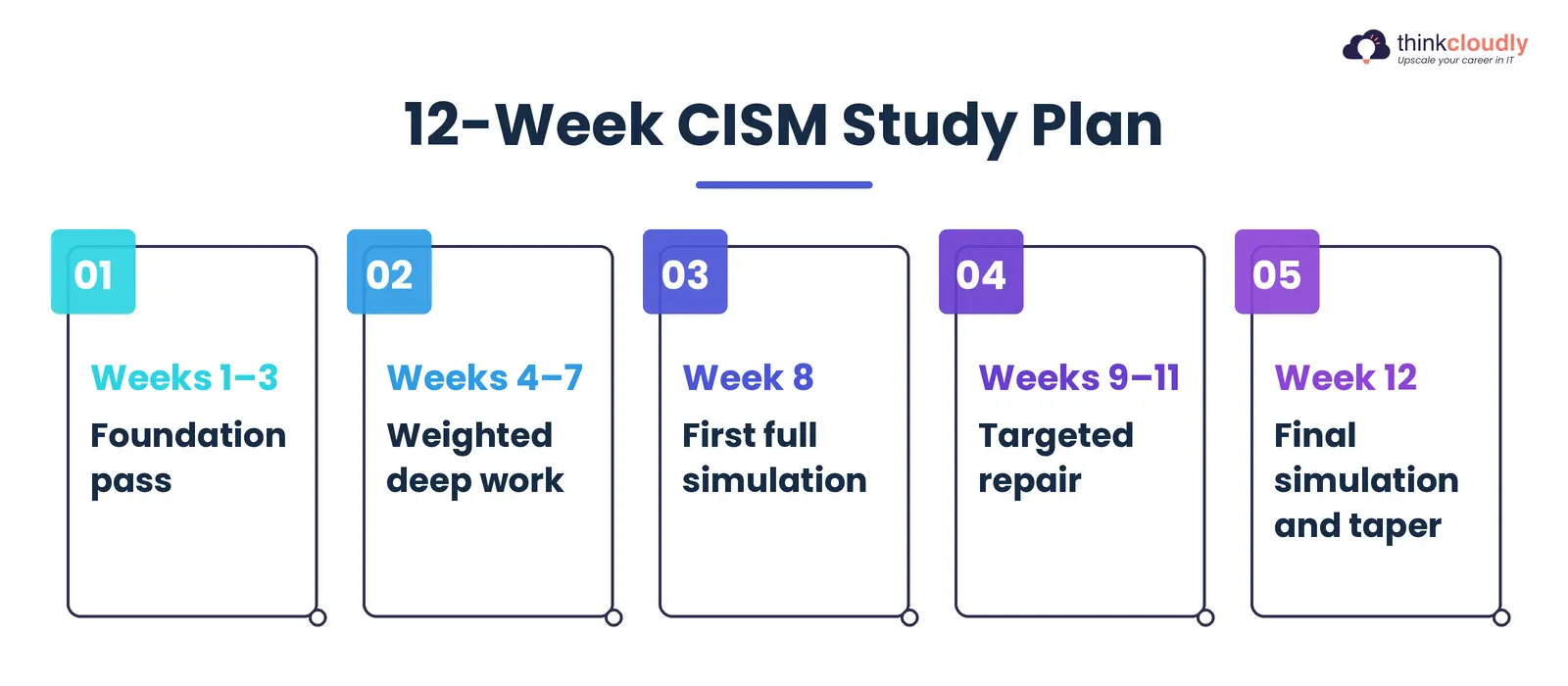
- Weeks 1–3—Foundation pass. Read the complete content outline once, domain by domain, without trying to memorize anything yet. Build a short reference sheet for each domain. Begin a light daily rotation of CISM practice questions purely to get comfortable with how scenarios are phrased.
- Weeks 4–7 — Weighted deep work. Redirect study hours to match the real exam weighting: the heaviest blocks go to the Information Security Program domain, the second-heaviest to Incident Management, and proportionally less time to Governance and Risk Management. Review the rationale behind every answer, correct or not.
- Week 8 — First full simulation. Sit one complete 150-question timed mock, no notes and no pausing, purely to establish an honest baseline rather than a confidence boost.
- Weeks 9–11 — Targeted repair. Rebuild your personal error log by domain. Spend the majority of remaining hours on your three weakest subtopics specifically, not on a general review of everything.
- Week 12 — Final simulation and taper. Run one or two more full-length mocks early in the week, then taper new material entirely in the final three to four days before the exam.
That structure treats the exam’s own weighting as an instruction rather than a footnote. Most first-attempt failures don’t come from a knowledge gap—they come from a CISM study plan that spent the same number of hours on an 18% domain and a 33% domain.
How to Pass CISM First Attempt: What Actually Separates the Two Outcomes?
Searching for how to pass CISM’s first attempt, rather than simply how to study for the exam, already puts you ahead, because passing on the first try is a measurably different goal than passing eventually, on some attempt. A small set of habits shows up again and again among people who get it done the first time:
- Set the exam date early, before you feel fully ready. A fixed deadline enforces a pace that an open-ended calendar never will.
- Take full-length mocks in one sitting, not broken into short sessions across a week—fatigue in hour four is part of what real sitting tests are.
- Default to the management-level answer, not the technically correct one. CISM consistently rewards the choice that protects the business objective over the control that is simply the most thorough.
- Review the rationale on questions answered correctly, not only the missed ones—a right answer reached for the wrong reason is a gap that resurfaces under exam pressure.
- Track accuracy domain by domain, not as one overall percentage, since a comfortable average can hide a dangerously weak score in Incident Management or the Program domain underneath it.
- Treat practice questions as diagnostic tools, not scorekeeping—the goal of each session is to find what you don’t know, not to confirm what you already do.
- Stop adding new material in the final three days. Consolidation beats cramming at that point in any CISM exam preparation timeline.
People who work out how to pass CISM first attempt almost always say the same thing afterward: the mocks taught them more than the course content did. A course builds knowledge. Full-length, timed mock exams build the exam-day judgment that CISM is actually graded on.
CISM Practice Questions: How Many Is Actually Enough
There’s no single magic number, but a reasonable floor is this: by exam day, you should have worked through enough CISM practice questions to see each domain’s question style repeated at least three times over, with full-length timed attempts mixed in rather than relying on short daily drills alone. Short sessions build pattern recognition. Full-length sets under timed conditions build the pacing and stamina that short sessions simply can’t simulate.
Volume matters less than how the questions are used. A bank of a thousand practice questions is wasted if the only output is a score. Read the rationale behind every question, right or wrong, and maintain a running log of which domain keeps producing the same category of mistake. By the final two weeks, that log becomes more useful to your CISM exam preparation than any single course video.
The Incident Management Process Every Candidate Must Internalize
Domain 4 carries 29% of the exam, and most of it tests one underlying idea from several different angles: a disciplined incident management process, applied consistently while under pressure and with incomplete information. The lifecycle CISM candidates are expected to know closely mirrors the structure described in NIST’s guidance and runs in four stages:
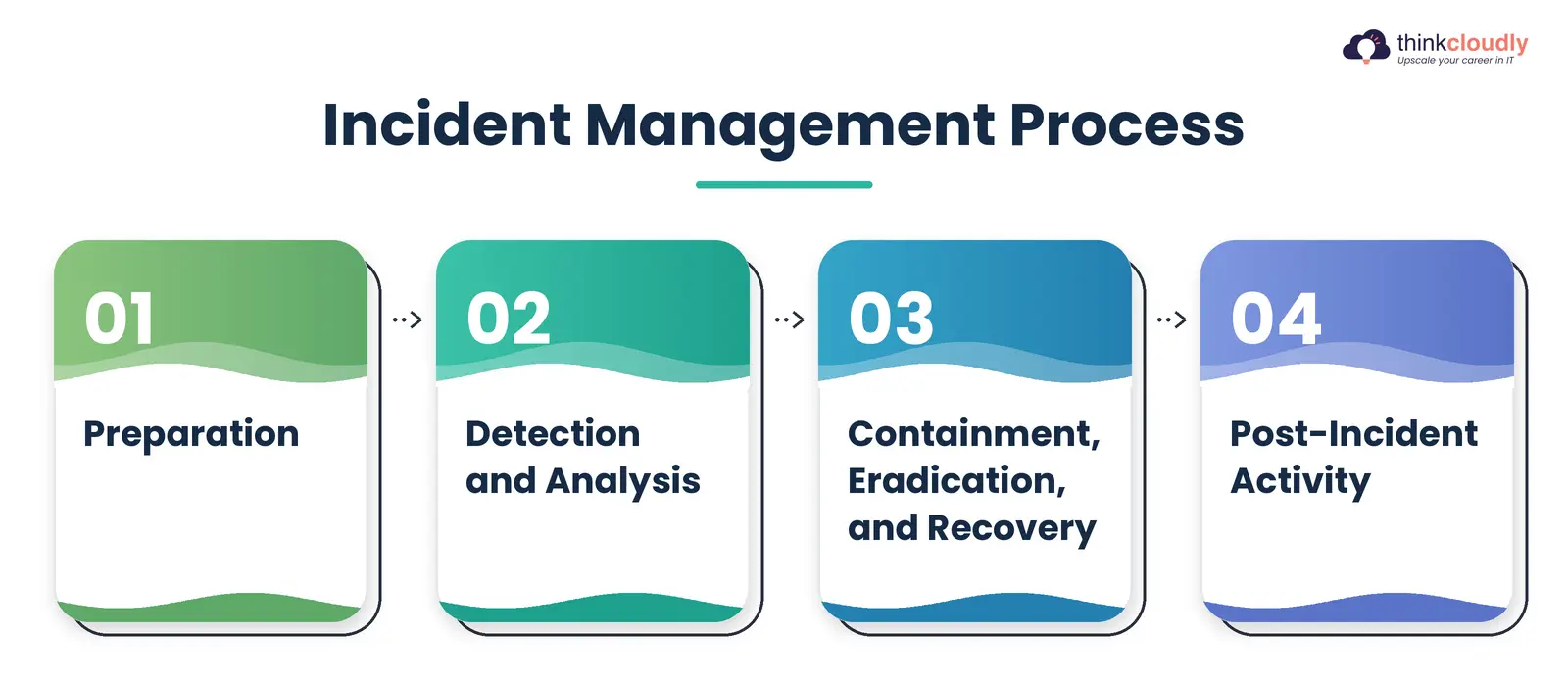
- Preparation—build the capability before anything happens: define what qualifies as an incident, deploy logging and detection tooling, keep escalation contact lists current, and maintain a response kit that’s ready to deploy without delay.
- Detection and Analysis—identify a possible event, confirm whether it’s genuine, scope which systems and data are affected, and prioritize by business impact rather than technical severity alone.
- Containment, Eradication, and Recovery—limit the damage first, remove the root cause second, and restore systems in stages, only once each stage is confirmed clean.
- Post-Incident Activity—run a structured lessons-learned review, measure time-to-detect and time-to-respond, and feed those findings back into the plan for next time.
CISM doesn’t test this incident management process as a list to memorize—it tests whether you can sequence these steps correctly inside a scenario where a business stakeholder is pushing for faster service restoration than safe containment allows. Nearly every Domain 4 question is really asking one thing: do you understand that disciplined sequencing protects the business, not just the network?
CISM Study Guide: Building a Resource Stack Instead of Relying on One Product
No single course is a complete CISM study guide by itself, no matter how it’s marketed. Candidates who pass on the first attempt tend to assemble their own stack rather than outsourcing the entire effort to one provider:
- The official content outline, read in full at least twice, used as the anchor for every other resource, gets checked against
- A structured course that maps directly to the current four-domain weighting rather than an older version of it
- A sizeable, current bank of practice questions that includes full rationales, not bare answer keys
- A personal, domain-by-domain error log, which by the final month typically outperforms anything a provider sells
- A study partner or small group to argue through scenario questions, since CISM’s management-style items often have more than one defensible-sounding answer
Treat that combination—not any single purchase—as your actual CISM study guide. A well-reviewed course such as those referenced in DestCert’s CISM preparation guide can anchor the content coverage, but the error log and the timed mocks are what convert that coverage into a passing score on the day that counts. Assembled deliberately, that stack is what separates a focused CISM exam preparation plan from a pile of unused subscriptions and good intentions.
Mistakes That Quietly Sink First-Attempt Candidates
Each item below is really the flip side of how to pass CISM first attempt — fix these, and you’ve addressed most of what separates a pass from a retake:
- Spending equal hours across all four domains instead of weighting study time the way the 2027 outline weights the exam itself
- Treating every round of practice questions as a scorekeeping exercise rather than a diagnostic one
- Delaying full-length timed mocks until the final week, which guarantees your first real experience of four-hour fatigue happens on the actual exam
- Assuming years of hands-on technical experience alone will carry a candidate through management-style, business-impact questions that reward a different instinct entirely
- Booking the exam before running even one full-length mock, which removes the only honest signal of whether your preparation is actually working or quietly failing
A Personal Note
I’ll be direct about something most exam-prep articles dance around: the people who pass CISM on the first attempt are rarely the most technically gifted people in the room. They’re the ones who respected the exam’s own weighting instead of studying by feel, and who were honest about which domain was genuinely their weakest rather than the one that merely felt weakest at the time.
I’ve watched candidates spend a month polishing a domain they already knew was cold simply because it felt good to be good at it, while their real weak spot sat untouched until the final week — and then ran out of runway to fix it. If your CISM exam preparation fails, it’s almost never because the underlying material was too hard.
It’s because the plan didn’t match where the exam actually puts its weight, and that is entirely within your control to correct before test day. Clear the CISM passing score once, on your own terms, and you never have to revisit this particular exam again.
Exam structure, domain weighting, and scoring details can change as ISACA updates its content outline. Always confirm the current version directly on ISACA’s CISM credentialing page before scheduling or paying for an exam date.