







Type “CISA salary in UK” into a search bar and you’ll get five different numbers that don’t agree with each other, and almost none of them say which experience band they’re actually quoting. That confusion matters more than usual here, because CISA isn’t built as an entry credential in the first place—ISACA requires five years of relevant experience before anyone can hold the title—yet thousands of UK professionals still search for CISA jobs for freshers every single year, hoping there’s a faster route in than the rulebook admits.
This guide pulls together live UK job-market data for late 2026 and early 2027 to lay out a realistic certified-level pay figure at every career stage, sets it against Compliance Officer salary UK numbers and the wider world of IT risk management careers, and gives a straight answer on where a true beginner should start if the five-year clock hasn’t run out yet.
Why CISA Still Commands Strong Pay in the UK Right Now?
Before the numbers, it’s worth understanding why employers keep paying a premium for this specific credential instead of hiring generalist auditors and training them up.
- UK financial services firms, under growing pressure from the FCA and PRA on operational resilience, need auditors who can independently test IT controls rather than take a vendor’s word for it.
- Boards are asking harder questions about third-party risk and data governance, and a CISA holder is one of the few titles that signals “can test this independently” rather than “can talk about this convincingly.”
- The talent pool is genuinely thin—the five-year experience requirement filters out a huge share of applicants before they even sit the exam, which keeps supply tight relative to demand.
- Regulatory reporting deadlines are shrinking across the UK and EU, and audit teams are being asked to do more verification work in less time, which pushes up what they’ll pay for proven capability.
- Large consultancies and the Big Four are still expanding their IT audit and assurance practices, and they compete directly with in-house teams for the same certified candidates.
- Hybrid and remote hiring has widened the market for CISA holders outside London, which has quietly pushed up regional pay rather than diluting it.
That backdrop is exactly why a CISA certification salary in the UK has kept climbing even while some neighboring compliance roles have gone flat or slipped slightly—which the numbers below show plainly.
CISA Salary in the UK by Experience
Here’s the part most articles skip: breaking the number down by how far along someone actually is, rather than quoting one blended average and calling it a day.
For true freshers—people with no prior audit or compliance role and no way to meet CISA’s five-year experience bar yet—the realistic entry point isn’t a certified-level pay band at all. It’s a junior IT audit associate or compliance analyst role, typically paying £28,000 to £36,000, while the exam and the experience clock run in parallel.
According to data for IT Audit roles, covering permanent vacancies in the six months to late November 2026, the 10th percentile for IT Audit sits at £40,350—already above most fresher offers, which tells you how quickly pay moves once someone has even a year or two of real audit exposure behind them.
By the two-to-four-year mark, with the exam passed and partial experience credit building (ISACA allows up to three years of substitution for related degrees or other certifications), earnings typically land between £40,000 and £60,000, tracking close to the 25th percentile of that same IT Audit dataset.
This is also the stage where a genuine CISA job for freshers search starts paying off in practice, even though the person isn’t technically “certified” yet in ISACA’s eyes—many employers will advance candidates on “exam passed, experience pending” status.
Once the full five-year experience requirement is met and the CISA designation is formally awarded, the picture changes sharply. IT Jobs Watch’s dedicated CISA tracker, covering the six months to 18 November 2026, puts the UK median CISA salary in UK terms at £77,500—up 10.71% year-on-year, with 154 live permanent vacancies specifically citing the credential. The middle half of the market runs from £65,000 (25th percentile) to £87,313 (75th percentile), and the top end reaches £105,000 at the 90th percentile.
|
Experience Stage |
Typical Role |
CISA Salary in the UK (2026–27) |
|
0–2 years (pre-certification) |
Junior IT Audit Associate / Compliance Analyst |
£28,000 – £38,000 |
|
2–4 years (exam passed, experience building) |
IT Auditor / Senior Compliance Analyst | £40,000 – £60,000 |
|
5+ years (fully certified) |
CISA-Certified IT Auditor |
£65,000 – £87,313 |
|
7–10+ years (senior/lead) |
Senior IT Auditor / Audit Manager | £90,000 – £105,000 |
Notice the jump between the “experience building” row and the fully certified row—that’s not a gentle slope; it’s closer to a step change, and it’s the single clearest reason professionals push through the eligibility requirement rather than treating CISA as optional once they’ve decided on audit as a career. That single step is the clearest proof that a CISA certification salary isn’t just a certificate premium—it’s an eligibility premium tied directly to verified, documented experience.
CISA Jobs for Freshers: What a Realistic Entry Path Actually Looks Like
Nobody chasing CISA jobs for freshers should expect to walk straight into a certified-level pay bracket on day one, and pretending otherwise just sets people up for a disappointing first offer. What a sensible entry path actually looks like:
- Start in a junior internal audit, IT risk, or compliance analyst role at a firm with a structured graduate or associate program—banks, insurers, and the Big Four all run these.
- Sit the CISA exam as early as the role allows, even before the five-year experience requirement is fully met, since the pass stays valid while experience accrues.
- Document every control test, audit finding, and system walkthrough in detail—this becomes the exact evidence ISACA and future employers ask for.
- Pursue a complementary entry-level credential (ISACA’s CDPSE or a foundational ISO 27001 course) to make a CV stand out before the CISA title is official.
- Target teams that explicitly mention risk management careers in their job description, since those teams are usually building a pipeline toward CISA rather than expecting it on arrival.
The honest version of this entry path, then, isn’t about finding an employer who’ll ignore ISACA’s rulebook. It’s about finding the right feeder role early, so the experience clock starts ticking as soon as possible rather than two years later than it needed to.
CISA Salary in the UK vs. Compliance Officer Salary in the UK vs. IT Risk Management Careers
People weighing a CISA career scope often compare it against two adjacent paths, and the honest comparison matters more than a generic “compliance pays well” headline.
Compliance officer salary UK figures currently sit well below certified CISA pay. The data covering the six months to 15 November 2026 shows a UK median of £45,000—and that figure actually fell 5.26% year-on-year, down from £47,500 the previous period.
The 10th to 75th percentile range runs from £35,500 to £50,000, a noticeably tighter band than CISA’s. In plain terms, a compliance-officer pay ceiling often sits close to where a CISA salary in the UK range begins.
IT risk management careers tell a slightly different story. IT Jobs Watch’s Risk Management data puts the UK median at £74,500, close to CISA’s £77,500, with a wide spread from £45,490 at the 10th percentile up to £115,000 at the 90th.
The overlap here is real—plenty of professionals move fluidly between risk management roles and CISA-aligned audit work, because the two disciplines examine the same risks from different angles: one decides what to do about a weakness, the other independently verifies whether the fix actually worked.
The practical takeaway: a compliance-officer path is the gentlest entry point but caps out lower; risk-focused roles offer a comparable ceiling to CISA with a slightly different skill set (ownership versus verification); and a fully certified CISA salary in the the UK figure sits at or above both once the experience requirement clears. None of this means one path is objectively better—it means the choice should track what the day-to-day work actually involves, not just which line looks best on a comparison chart.
What Actually Moves a CISA Certification Salary Higher?
Passing the exam and meeting the experience bar gets someone onto the certified pay ladder. It doesn’t, by itself, explain why two certified auditors with the same letters after their name can sit £20,000 apart. A handful of factors do most of that work:
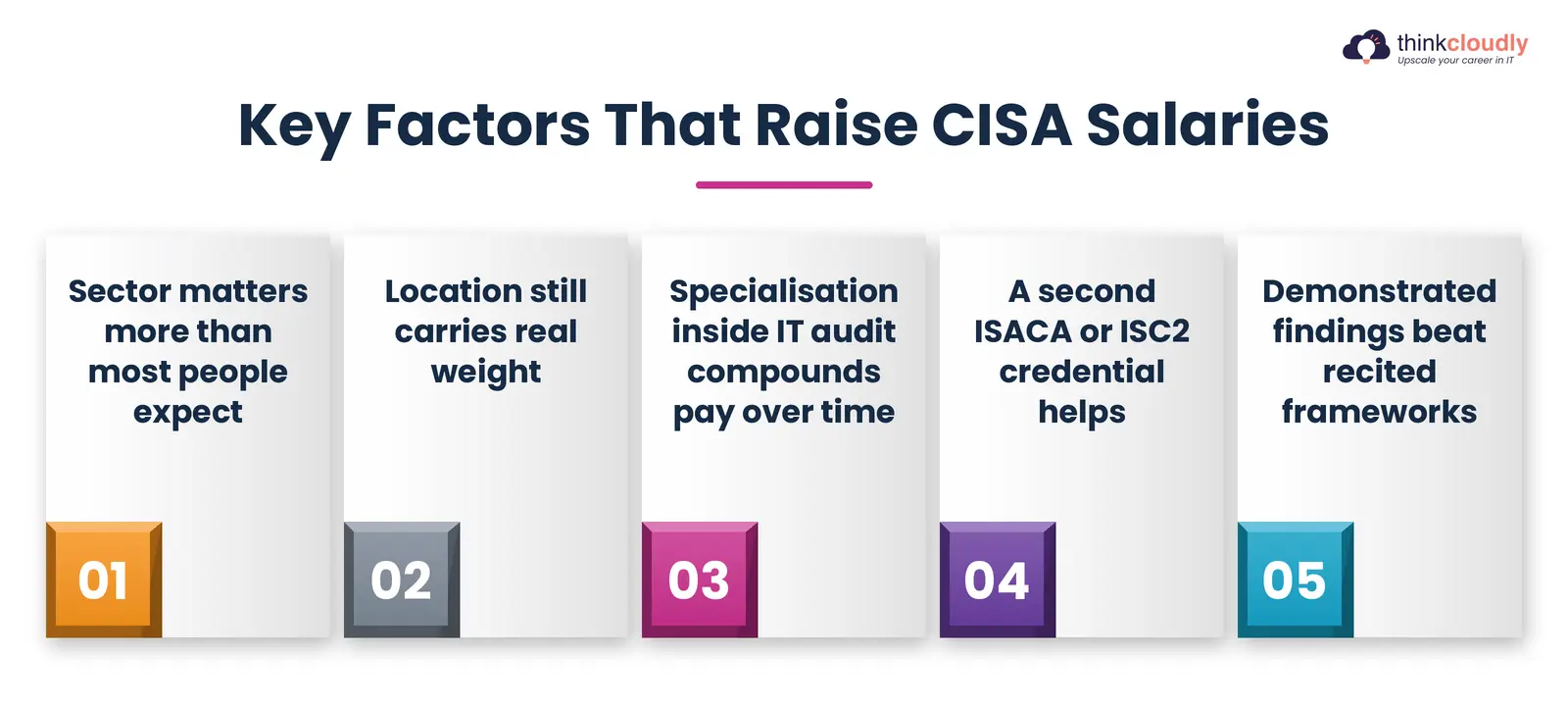
- Sector matters more than most people expect. Financial services, insurance, and public-sector contracts in the UK consistently pay toward the top of the CISA certification salary range, largely because regulatory pressure forces them to keep dedicated, certified audit capacity rather than sharing one generalist across departments.
- Location still carries real weight. London and the South East sit meaningfully above the rest of the UK for the same title, even with hybrid work narrowing some of that gap.
- Specialization inside IT audit compounds pay over time. Someone who pairs CISA with cloud-specific audit experience (AWS, Azure, or GCP control frameworks) or data privacy knowledge tends to clear the next pay band faster than someone who stops at the baseline exam.
- A second ISACA or ISC2 credential helps. Pairing CISA with CRISC or a security-focused badge regularly pushes a CISA certification salary figure toward the 75th percentile and beyond, rather than hovering near the median.
- Demonstrated findings beat recited frameworks. Hiring panels increasingly ask scenario-based questions about an actual control failure someone caught, not textbook definitions of COBIT—and the ability to answer that well shows up directly in the offer.
CISA Career Scope: Where the Certification Actually Leads
A fair question behind every CISA career scope search is simple: does this credential open doors beyond “IT auditor,” or is it a one-track ticket? The honest answer is that it opens more doors than most people assume, provided the early years are spent building breadth rather than just clocking hours.
- The most direct CISA career scope runs from IT audit associate through senior IT auditor, audit manager, and eventually director of internal audit (technology) or chief audit executive — a track that typically reports into an audit committee rather than a security or operations leader.
- A second branch of that same path moves sideways into governance, risk, and compliance leadership, since the control-testing discipline CISA teaches transfers directly into GRC program ownership.
- A third branch, less talked about, leads into consulting — the Big Four and major advisory firms hire CISA holders specifically to run external audit and assurance engagements across multiple clients, which tends to accelerate both pay and exposure compared with staying in a single in-house team.
Whichever branch someone ends up on, this certification rarely dead-ends at “auditor forever” the way some entry-level IT certifications do; it’s closer to a foundation that several different senior tracks build on top of.
A Personal Note
I spent the better part of two years assuming my compliance analyst job was a dead end because it didn’t have “auditor” in the title, and I nearly gave up on the idea of CISA altogether because the five-year requirement felt like a wall I’d never get past. What actually changed things wasn’t a shortcut — there wasn’t one — it was realising that every control test I was already running at my compliance desk counted toward that experience clock, I just hadn’t been documenting it properly.
The year I started keeping a plain log of every finding, every walkthrough, every exception I raised, is the year my eventual CISA application practically wrote itself. If you’re early in this and the CISA salary in UK numbers above feel miles away from where you’re sitting right now, they’re not as far as they look.
Start documenting the work you’re already doing, sit the exam the moment your employer allows it, and let the experience requirement run in the background while you build the evidence it’s asking for anyway. You can also connect with Thinkcloudly to get better jobs in futures.