






If you’ve spent any time scrolling ISACA’s credential list, you’ve probably landed on the same fork in the road a lot of IT and security professionals hit around year four or five: CRISC vs. CISA. Both come from the same issuing body, both sit on a resume under “governance, risk, and compliance,” and both get recommended to anyone who so much as mentions wanting to “move into risk.” That advice is lazy. The split isn’t a coin flip, and treating it like one is how people end up with a certification that doesn’t match the work they’re actually doing.
Heading into 2027, this decision carries more weight than before. Risk and audit functions are no longer back-office afterthoughts—boards ask pointed questions about third-party risk, AI governance, and cyber exposure, and expect the people answering to hold a credential that maps to the seat they occupy.
So before you book an exam slot, it’s worth understanding what CRISC and CISA each certify, because the honest answer to CRISC vs. CISA depends entirely on whether your job is to manage risk or to independently verify it.
What Is CRISC?
CRISC—Certified in Risk and Information Systems Control—is ISACA’s credential for professionals who identify, assess, and manage IT and business risk as part of an enterprise risk management program. It’s built for people who sit inside a risk function and help the organization decide what to tolerate, what to mitigate, and what to escalate.
The exam covers four domains: governance, IT risk assessment, risk response and reporting, and information technology and security. Governance anchors the whole credential—CRISC assumes risk decisions can’t be made in a vacuum, and every risk register ties back to board-level appetite and policy.
ISACA requires three years of cumulative, hands-on experience across at least two of those domains, earned within the ten years before applying or the five years after passing (ISACA’s CRISC page has the current eligibility language). That bar is noticeably lower than most ISACA credentials, which is part of why CRISC attracts people earlier in their careers than you’d expect for a risk-focused certification.
What Is CISA?
CISA—Certified Information Systems Auditor—is ISACA’s credential for professionals who audit, test, and independently assess information systems and controls. Where CRISC asks, “How do we manage this risk?” CISA asks, “Did the control actually work the way it was supposed to?”
The exam spans five domains: the audit process, IT governance and management, systems acquisition and implementation, operations and business resilience, and protection of information assets.
ISACA requires five years of professional experience in IT auditing, control, assurance, or security, though up to three years can be waived through qualifying education or other certifications—at least two years can never be waived, no matter how many degrees you stack against it. That stricter bar signals CISA was designed as a mid-career credential, not an entry point.
CRISC vs CISA: Core Differences
The table below lays out the CRISC vs. CISA comparison side by side, so you can see the structural differences before reading through the reasoning behind them.
|
Factor |
CRISC |
CISA |
|
Full name |
Certified in Risk and Information Systems Control |
Certified Information Systems Auditor |
|
Issuing body |
ISACA |
ISACA |
|
Core focus |
Enterprise IT risk identification and management |
Independent audit and control assurance |
|
Typical mindset |
Risk owner and advisor |
Independent evaluator |
|
Domains |
Governance; IT Risk Assessment; Risk Response and Reporting; IT and Security |
Audit Process; Governance and Management of IT; Acquisition and Implementation; Operations and Resilience; Protection of Information Assets |
|
Experience required |
3 years across 2+ domains, no waivers |
5 years in audit/control/security, up to 3 years waivable |
|
Exam length |
150 questions, 4 hours |
150 questions, 4 hours |
|
Passing score |
450 on a 200–800 scale |
450 on a 200–800 scale |
|
Typical job titles |
IT risk manager, risk and compliance analyst, GRC manager |
IT auditor, audit manager, IT risk and assurance manager |
|
Reports to |
Risk committee, CRO, or CIO |
Audit committee or chief audit executive |
|
Best suited for |
Risk-management-track professionals |
Assurance-track professionals |
A table is a useful shortcut, but it can’t tell you how either role feels day to day, which is what the rest of this piece digs into.
CRISC vs CISA: Exam and Requirements
Here’s the exam and eligibility picture broken into quick-reference points—useful if you’re building a comparison slide or deciding which exam to register for first:
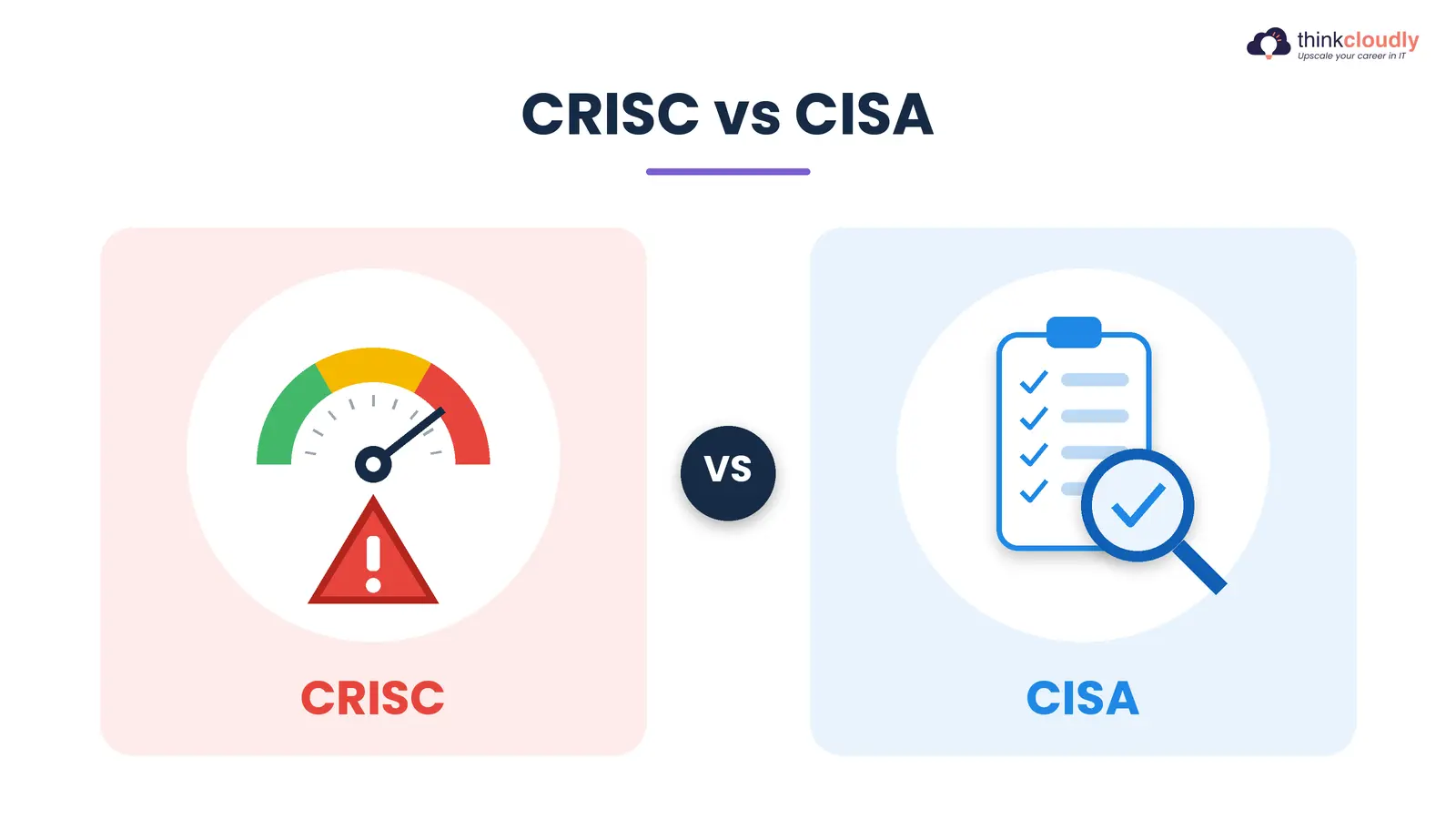
- Format: Both exams run 150 multiple-choice questions across four hours, scored on the same 200–800 scale with 450 as the passing mark.
- Domain weighting: CRISC leans heavily toward Risk Response and Reporting (32%) and Governance (26%); CISA leans toward Operations and Business Resilience (26%) and Protection of Information Assets (26%).
- Experience bar: CRISC asks for three years across at least two of its own domains with no waivers permitted; CISA asks for five years, with up to three years waivable through approved education or other certifications.
- Who gets in faster: Professionals three years into a risk, compliance, or GRC role can sit for CRISC sooner than an equally experienced auditor can clear CISA’s stricter, partly non-waivable requirement.
- Cost: Exam fees sit in the same band for both—roughly $575 for ISACA members and $760 for non-members—plus separate registration and annual maintenance fees.
- Retake policy: Both allow up to four attempts within any 12-month period.
- Maintenance: Both require 20 CPE hours annually and 120 hours across a rolling three-year cycle to keep the certification active.
None of that settles which exam is harder—both are serious mid-career credentials. What it makes clear is that this isn’t about difficulty at all; it’s about which discipline your actual job already resembles.
Is CRISC Certification Worth It?
The question people actually want answered is whether CRISC certification is worth it and whether it holds up once you look past the marketing on ISACA’s own site. The honest answer: for the right role, yes, and the compensation data backs that up more clearly than it does for a lot of comparable credentials.
- A breakdown of compensation data from DestCert’s CRISC salary guide puts average CRISC-holder base pay around $147,000, with IT risk managers clearing $160,000 and senior GRC and risk-consultant roles landing in the 95,000–126,000 range depending on scope.
- CISA compensation tracks lower on average for individual-contributor audit roles—commonly cited in the 86,000–118,000 band—but audit leadership and director-level roles close the gap quickly, and a CISA holder running an audit for a large enterprise can out-earn a mid-level CRISC holder without much trouble.
- Broader labor-market data supports the direction of travel for both: the U.S. information security analyst category, the closest general proxy for risk and audit-adjacent IT roles, shows an average salary north of $129,000 with faster-than-average projected growth, per DataUSA’s occupational profile built on U.S. Bureau of Labor Statistics projections.
- Is CRISC certification worth it if you’re already doing risk work without it? Usually yes, because the credential tends to unlock title changes and salary bands faster than tenure alone does, especially at organizations that use ISACA certifications as a gate for promotion.
- The honest caveat: nobody should chase CRISC certification worth it headlines purely for the dollar figure. Pay follows the scope of the role you’re hired into far more than it follows which four letters sit after your name.
CRISC Career Path vs. CISA Career Path: Role by Role
Mapping both credentials onto an actual CRISC career path and an actual audit career path makes the decision far less abstract than reading domain descriptions.
- Entry point (years 2–4): CRISC candidates are often risk analysts, GRC coordinators, or junior compliance staff; CISA candidates are typically IT audit associates or junior internal auditors.
- Early specialization (years 4–7): CRISC holders move into risk and compliance analyst or GRC analyst roles; CISA holders move into senior IT auditor or audit team lead positions.
- Mid-career (years 7–10): A typical CRISC career path continues into IT risk manager or information security risk consultant; the CISA-aligned track continues into audit manager or IT risk-and-assurance manager.
- Senior and leadership (10+ years): CRISC holders often land director of risk management, VP of information security, or chief risk officer tracks; CISA holders land director of internal audit (technology) or chief audit executive roles.
- Lateral movement: It’s common to see a mid-career auditor pivot onto a CRISC career path once they move from testing controls to owning risk decisions—the reverse pivot, from risk owner back into pure audit, happens far less often.
Neither track outranks the other. A resume built around risk registers, control self-assessments, and mitigation planning reads as “risk management” even before a hiring manager notices the letters; one built around testing evidence, audit findings, and control walkthroughs reads as “assurance” just as fast. The certification confirms the pattern a recruiter already sees in the work history—it rarely creates that pattern out of nothing.
Enterprise Risk Management and Governance and Compliance: Where the Overlap Really Sits
It’s tempting to treat CRISC and CISA as opposite ends of a spectrum, but both credentials actually share a governance backbone. CRISC builds its entire structure around enterprise risk management, treating governance as the domain that ties every risk decision back to business objectives.
CISA, meanwhile, dedicates a full domain to IT governance and management, because an auditor can’t test a control meaningfully without understanding the governance and compliance framework the control is supposed to serve.
That shared ground explains why governance and compliance knowledge transfers so well between the two paths. A risk professional who understands enterprise risk management frameworks like COBIT or ISO 31000 will recognize most of CISA’s governance domain on sight, and an auditor fluent in governance and compliance testing will find CRISC’s governance domain familiar territory rather than foreign material.
The real axis of CRISC vs CISA isn’t the subject matter — it’s the stance you take toward it. CRISC asks you to own the risk decision; CISA asks you to independently check whether someone else’s risk decision actually held up in practice. Where governance and compliance work sits in your current job — advisory or verification — is usually the single clearest signal for which exam to sit first.
Cyber Risk Management in 2027: Why This Choice Matters More Now
Cyber risk management has moved from a specialist sub-function to a standing board agenda item, and that shift is part of why this decision carries more weight heading into 2027 than it did five years ago. Regulators in the US, UK, and EU are tightening disclosure timelines for security incidents, and boards want someone in the room who can speak fluently about both risk exposure and control effectiveness.
Organizations building out cyber risk management programs for 2027 are hiring CRISC holders specifically to own the risk register, quantify exposure, and recommend where the budget should go. CISA holders, by contrast, are being pulled into the same conversations to independently validate that the controls funded by those budget decisions are actually operating as designed.
Neither role replaces the other — a mature cyber risk management function genuinely needs both the person deciding what to do about a risk and the person checking whether that decision produced a working control. If your 2027 career plan involves sitting closer to that board-level conversation, it’s worth being honest about which side of the table — deciding or verifying — you actually want to sit on.
Can You Reasonably Pursue Both?
Yes, and a fair number of GRC professionals end up on both sides of CRISC vs CISA over a ten-year span. There’s no ISACA rule blocking dual certification, and overlapping governance material means study time for one reinforces the other. Worth being upfront about: pursuing both is a multi-year commitment, not a single busy quarter, given separate experience documentation and CPE cycles for each.
Most dual-certified professionals didn’t plan the combination from day one — they earned CRISC early in a risk or compliance role, then added CISA once an audit leadership opportunity came up, or vice versa.
A Personal Note
I’ve seen too many people pick between CRISC and CISA based on which exam their study group happened to be taking that quarter, rather than which one actually matched their job description. That’s an expensive way to find out you guessed wrong eighteen months later.
If there’s one thing worth taking from this piece, it’s this: read your own day-to-day work honestly before you read either exam’s blueprint. Are you deciding what the organization should do about risk, or are you checking whether someone else’s decision actually worked? That answer matters more than any salary chart. You can also check thinkcloudly courses for improvement your skills and knowledge.
I’ll add the thing most certification guides won’t say out loud: nobody outside your own department is impressed by which exam you passed. They care whether you can do the job the credential claims to prove you can do. Treat CRISC or CISA as evidence you collect on the way to the role you actually want, not as the destination, and the CRISC vs CISA debate mostly resolves itself.