







If you work anywhere near IT governance, risk, or security, you have probably typed “CISA vs CISM” into a search bar at least once this year. Both credentials come from ISACA, both show up in the same job postings, and both get thrown around as if they’re interchangeable.
They aren’t. The real question behind CISA vs. CISM isn’t which one is “better” in the abstract—it’s which one matches the work you actually do and the work you want to be doing in three to five years.
This matters more going into 2027 than it did a few years ago. Audit and security budgets have become one line item in a lot of organizations, hiring managers are more literal about matching certifications to role titles, and the gap between an “assurance” career and a “leadership” career has gotten wider, not narrower.
So before you register for either exam, it’s worth understanding what each certification actually signals—and the honest answer to the “CISA or CISM, which is better?” question, which is, “It depends entirely on where you’re standing.”
What Is CISA?
CISA—Certified Information Systems Auditor—is ISACA’s credential for professionals who audit, control, and assess information systems. It’s the closest thing the profession has to a universal IT audit certification. If your work involves reviewing controls, testing compliance, or signing off on whether a system meets a standard, the CISA training program was built with your job description in mind.
The exam covers five domains: the audit process itself, IT governance, systems acquisition and implementation, systems operations and resilience, and protection of information assets. Passing requires understanding information systems auditing as a discipline—not just running checklists, but being able to form and defend an independent opinion about risk and control effectiveness. ISACA requires five years of relevant professional experience to earn the full certification, though you can sit the exam first (ISACA’s CISA page has the current experience-substitution rules).
What Is CISM?
CISM—Certified Information Security Manager—is built for people who run security programs, not just evaluate them. It assumes you’re making decisions about risk appetite, incident response, and security strategy, and that you’re accountable for outcomes, not just findings. Where CISA asks, “Does this control work?” CISM asks, “Is this the right control given our risk posture and business goals?”
ISACA’s experience bar is steeper here: five years of information security work, with at least three of those years in a management capacity across the job’s core domains. That management requirement is the real dividing line in any cybersecurity career path conversation—CISM is explicitly not an entry credential, and ISACA doesn’t pretend otherwise.
It’s worth noting that CISM training program doesn’t test information systems auditing skills at all—it assumes you already understand controls and risk and spends its four domains on security program development, risk management, incident response, and governance instead. That’s the clearest proof that these two certifications are built for different muscles, not two difficulty levels of the same muscle.
CISA vs CISM: Core Differences at a Glance
The table below is the fastest way to see the CISA vs CISM split without reading five more paragraphs.
|
Factor |
CISA |
CISM |
|
Full name |
Certified Information Systems Auditor |
Certified Information Security Manager |
|
Issuing body |
ISACA |
ISACA |
|
Core focus |
Auditing, controls, compliance assessment |
Security governance, risk and program leadership |
|
Typical mindset |
Independent evaluator |
Accountable decision-maker |
|
Experience required |
5 years in audit/assurance/control (some substitutions allowed) |
5 years in infosec, 3 of which in management |
|
Exam length |
150 questions, 4 hours |
150 questions, 4 hours |
|
Passing score |
450 on a 200–800 scale |
450 on a 200–800 scale |
|
Typical job titles |
IT auditor, compliance analyst, risk & assurance manager |
Security manager, CISO, security governance lead |
|
Reports to |
Often audit committee / board |
Often CIO or executive leadership |
|
Best suited for |
Assurance-track professionals |
Management-track professionals |
That comparison is useful, but a table can’t tell you how the roles feel day to day, so the sections below go deeper into the parts that actually drive a decision.
CISA vs CISM: Exam and Requirements
Here is the exam and eligibility picture broken down for quick reference—useful if you’re mapping this out for a team or turning it into a one-page cheat sheet:
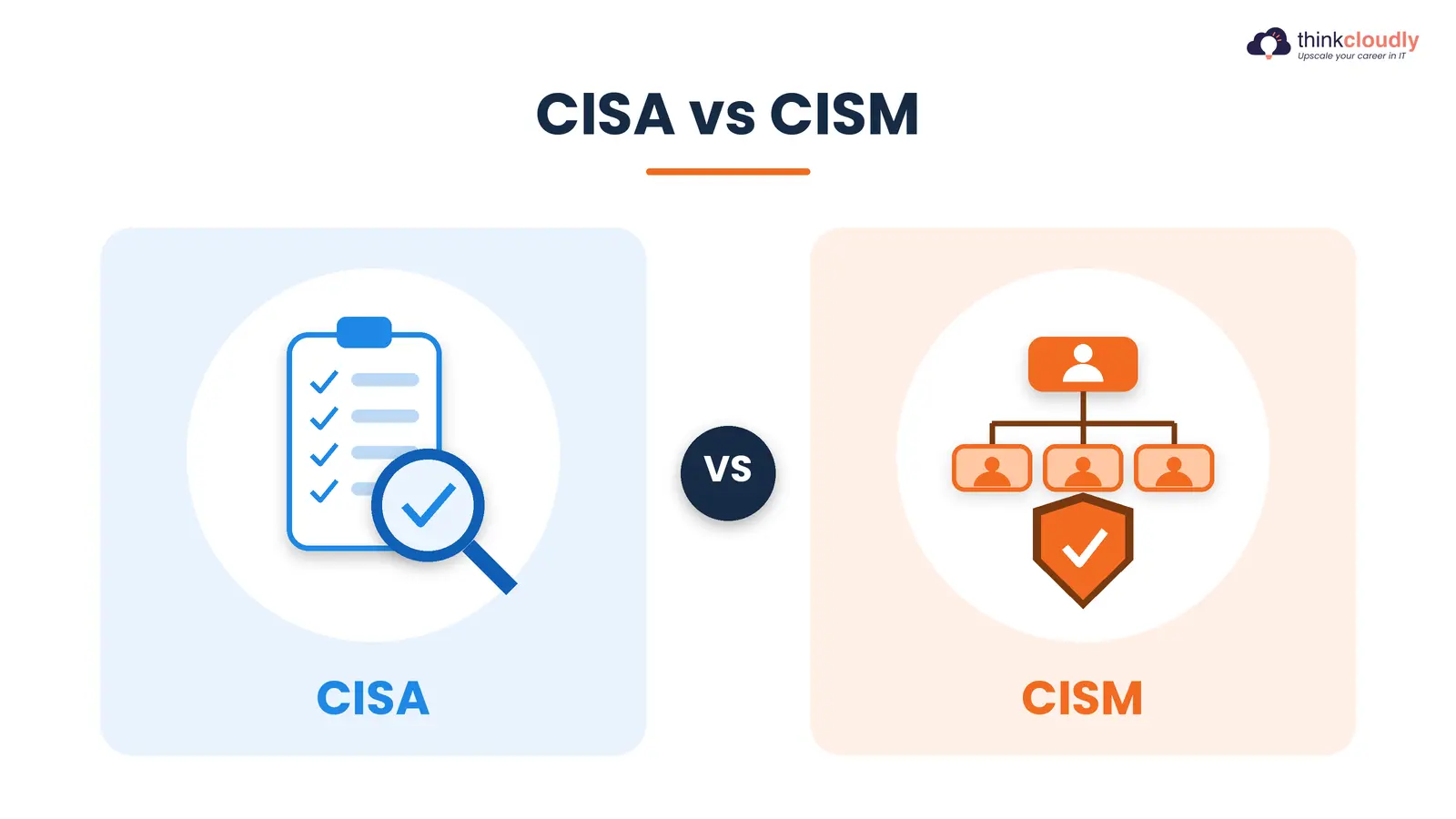
- Format: Both exams run 150 multiple-choice questions over four hours, scored on a 200–800 scale with 450 as the passing mark.
- Domains: CISA has five domains weighted toward operations/resilience and asset protection (26% each); CISM has four domains weighted toward program development and incident management.
- Experience window: Both require five years of relevant experience within the ten years before applying, though waivers exist for related degrees or lower-tier certifications.
- Management requirement: CISM uniquely requires three years in an information-security management role—CISA has no equivalent management clause.
- Cost: Exam fees sit in the same band for both (roughly $575 for ISACA members, $760 for non-members), plus separate application and annual maintenance fees.
- Retake policy: Both allow up to four attempts per 12-month period if you don’t pass on the first try.
- Maintenance: Both require 120 CPE hours across a three-year cycle, with a minimum per-year contribution, to keep the credential active.
None of this tells you which is harder in any objective sense—both are considered rigorous mid-to-senior credentials. What it does tell you is that CISA vs CISM isn’t a difficult contest; it’s a specialization choice with different entry bars attached.
CISM vs CISA Salary: What the Numbers Actually Say
Compensation is usually the first question people ask, and the honest answer is that CISM vs CISA salary comparisons tend to favor CISM—but not because CISA is undervalued. It’s because CISM sits closer to management and executive pay bands by design.
- Industry salary surveys put CISA vs CISM compensation at roughly 86,000–118,000 for CISA-aligned audit and assurance roles, against roughly 150,000–248,000 for CISM-aligned security management and CISO-track roles, according to a 2026 breakdown from DestCert’s CISA vs CISM comparison.
- That same CISM vs. CISA salary gap narrows once you factor in company size and region—a CISA holder running an audit for a large multinational can out-earn a CISM holder managing security at a small firm.
- Broader market data backs the direction of travel: the U.S. information security analyst role (the closest general category to both certifications) carries an average salary north of $129,000 and a projected employment growth rate well above the national average built on U.S. Bureau of Labor Statistics projections.
- Neither number is a guarantee. Title, region, industry regulation, and whether you’re in a public or private company all move the figure more than the letters after your name do.
- The practical takeaway: don’t choose a certification purely to chase the higher end of a CISM vs CISA salary chart. Choose the one that matches the role you’re actually doing, because pay follows role fit faster than it follows acronyms.
CISA or CISM: Which Is Better for Your Career Stage?
This is where most comparison articles dodge the question. Here’s a direct answer: CISA or CISM, which is better, depends on exactly one thing—whether your next career move is toward independent assurance or toward security leadership.
If you’re three to five years into IT audit, risk, compliance, or controls testing, and you want external validation of that track, CISA is the fit. It’s also the more natural first certification if you’re not yet in a formal management role, since CISM’s three-year management requirement can lock out otherwise qualified candidates.
If you’re already leading a security function, or a CISO role is a realistic five-year target, CISM is built for exactly that trajectory. It signals to hiring committees that you can run a program, not just inspect one.
A fair number of professionals eventually hold both, usually starting with CISA while building audit or technical credibility, then adding CISM once they step into management. That sequencing answers the CISA or CISM, which is better debated more honestly than either certification’s marketing copy does: it’s rarely either/or once you’re five-plus years into the field.
Cybersecurity Career Path: Mapping Roles to Each Certification
Thinking about this as two different tracks on the same cybersecurity career path makes the decision less abstract.
The CISA-aligned track typically runs IT audit associate → senior IT auditor → audit manager → director of internal audit (technology) or head of IT risk and assurance. People on this track usually report to an audit committee or a chief audit executive, and their core deliverable is an independent opinion, not a security program.
The CISM-aligned track typically runs: security analyst → security operations manager → security governance or program manager → director of information security → CISO. This track is explicitly a cybersecurity career path toward executive accountability, and the CISM credential exists to mark the transition from “does the work” to “owns the outcome.”
Neither path is objectively more prestigious, and neither is a dead end—it’s genuinely common to pivot between them, especially around the 7–10 year mark when people reassess whether they want to keep evaluating risk or start owning it. The CISA-to-CISM pivot is far more common than the reverse, mostly because management experience is a prerequisite for CISM but not for CISA.
Hiring managers tend to read these two tracks differently, too. A resume heavy on audit findings, control testing, and regulatory frameworks reads as “assurance,” even without the CISA letters attached. A resume built around incident response ownership, security budget decisions, and team leadership reads as “management” just as quickly. Certifications confirm the pattern recruiters already see; they rarely create it from nothing.
IT Audit Certification vs Information Systems Auditing: Where CISA Really Fits
It helps to separate two ideas that get blurred constantly: an IT audit certification (the credential itself) and information systems auditing (the discipline the credential certifies). CISA is the certification; the discipline is the actual job of independently testing whether controls, processes and systems do what they’re supposed to do, day after day, across audit cycles that rarely look identical twice.
This distinction matters because some professionals chase the IT audit certification without having done much of that hands-on testing work, and they struggle with the exam’s scenario-based questions, which assume real exposure to audit planning, evidence gathering, and reporting. ISACA designed CISA this way on purpose — it wants the credential to reflect genuine field experience, not just exam-prep memorization, which is also why the experience waiver process is strict about documentation.
If your actual day job is closer to “building and running defenses” than “independently testing them,” CISM is the better match even if your title technically includes the word “audit.” Titles lag reality more often than certifications do.
Can You Reasonably Pursue Both?
Yes, and plenty of people do, which is itself a quiet answer to the CISA or CISM which is better framing — for a lot of careers, the real answer is “both, in sequence,” not “pick one forever.” There’s no ISACA rule against holding both, and the overlapping subject matter (governance, risk, controls) means a lot of CISA study material is useful background for CISM, and vice versa.
The honest caveat on CISA vs CISM dual-certification: it’s a multi-year commitment, not a weekend project, given the separate experience requirements and separate CPE cycles for each. Most people who hold both didn’t plan it as a combo from day one — they earned CISA early, grew into management, and added CISM when the job actually called for it.
A Personal Note
I’ve watched enough people in this field pick a certification because a job ad listed it, rather than because it matched what they wanted to be doing in five years. That’s a slower, more expensive way to get where you’re going. If you take nothing else from this piece, take this: read your own job description honestly before you read ISACA’s exam blueprint. The letters after your name should describe work you already recognize, not work you’re hoping a certification will somehow talk you into.
I’ll also say this plainly, because most career blogs won’t: nobody outside your own team actually cares which exam you passed. They care whether you can do the job the exam was supposed to prove you could do. Treat the certification as evidence you collect along the way, not as the destination itself, and the CISA or CISM, which is a better question, mostly answers itself.