






I get asked some version of the same question every time someone finds out I work in IT audit: is CISA hard to pass? Usually it’s phrased a little differently—”How bad is it really?” or “Is it worse than the PMP?”—but underneath, “Is CISA hard to pass?” is exactly what people want answered before they spend $575 on an exam fee.
My honest take hasn’t changed in years: yes, it’s genuinely difficult, but not for the reasons most people assume. The exam doesn’t punish you for not knowing enough facts. It punishes you for studying the wrong things in the wrong order.
This isn’t a marketing page for a boot camp, and I’m not going to invent a tidy pass-rate table that ISACA itself has never published. What I can give you is the real structure of the exam, what the available data—and the notable lack of it—actually tells you, and a 90-day plan built
lt directly around CISA exam difficulty, domain by domain, for test windows running through 2027.
What Makes People Ask “Is CISA Hard to Pass?” in the First Place?
Nobody asks if CISA is hard to pass because they’re bored on a Sunday. They ask after skimming the exam content outline ISACA updated to reflect current technology and evolving audit practice and realizing it isn’t a memorization exercise. CISA exam difficulty comes from three places, and almost nobody warns you about the second one:
- Breadth, not depth. You’re tested across five domains spanning audit methodology, IT governance, systems development, operations, and asset protection. No single domain is brutally deep, but you can’t skip any of them.
- Judgment-based questions. ISACA writes scenario questions with more than one “correct-sounding” answer. You’re picking the best auditor response, not the only true statement, and that trips up people used to fact-recall exams.
- A scaled scoring system most candidates misread, which feeds directly into the passing score requirements confusion covered below.
That combination of breadth and judgment is responsible for most of the real CISA exam difficulty, and it’s worth untangling the scoring piece properly before anything else.
Passing Score Requirements Explained
Here are the mechanics, confirmed against the current exam structure. Understanding these passing score requirements changes how you’ll plan every study session that follows.
|
Exam Detail |
Figure |
|
Total questions |
150, multiple choice |
|
Time allowed |
4 hours |
|
Score range |
200–800 (scaled) |
|
Passing score |
450 |
|
Domain 1 — Information Systems Auditing Process |
18% |
|
Domain 2 — Governance and Management of IT |
18% |
|
Domain 3—Information Systems Acquisition, Development & Implementation |
12% |
|
Domain 4 — Information Systems Operations and Business Resilience |
26% |
|
Domain 5 — Protection of Information Assets |
26% |
|
Exam fee (member / non-member) |
$575 / $760 |
Passing is only the entry point, too. Once you clear the 450 mark, keeping the credential active means logging at least 20 continuing-education hours a year and 120 over a rolling three-year cycle, under ISACA’s updated 2027 CPE policy. It’s worth knowing that now, before exam day, because the discipline that gets you past that 450 mark is the same discipline that keeps you compliant afterward.
The passing score requirements use a weighted scale, not raw correct answers. A question in Domain 4 or Domain 5 — the two heaviest domains at 26% each — carries more statistical pull on your final score than a question from Domain 3 at 12%. That’s not a trick ISACA hides; it’s just rarely explained clearly.
Knowing this scoring structure in advance changes how you allocate hours: you stop treating all five domains as equal and start weighing your study the way the exam weighs its questions. Skipping this step is one of the quieter reasons CISA exam difficulty feels worse than it needs to for otherwise well-prepared candidates.
Is There an Official CISA Pass Rate?
This is where I have to disappoint the content mills that confidently quote a precise CISA pass rate. ISACA does not publish one officially, the way some other certifying bodies release year-by-year statistics.
What exists instead is a scatter of unverified estimates from training vendors—figures in the 40% to 50% range show up repeatedly across prep sites and reports a self-selected 92% pass rate among its own paying students, which says more about who buys boot camps than about the exam itself.
So if you came here hoping for a single authoritative CISA pass rate number, I’d rather give you the truth: it doesn’t exist publicly, and anyone citing one without a source is guessing. What we do know reliably is who tends to struggle—candidates sitting the exam with fewer than two years of real audit or IT-control exposure and candidates who prepared only by reading rather than testing themselves against timed conditions. That pattern matters more than any invented pass-rate figure, because it’s the one variable you can actually control before test day.
How Many CISA Study Hours Do You Actually Need?
There’s no single official figure here either, so treat every number you read—including mine—as a range, not gospel. Based on guidance from exam-prep providers like Surgent, which recommends roughly two to three hours a day for about two months, most candidates land somewhere between 120 and 180 total CISA study hours before they’re genuinely exam-ready.
People with a background in internal audit or security operations usually sit at the lower end of that range; career-changers coming from outside IT or audit tend to need the higher end of CISA study hours, sometimes more.
The total number of CISA study hours matters less than how those hours are spent. Twenty hours of passively watching videos is not equivalent to twenty hours of answering scenario questions and reviewing why the “almost right” answers were wrong. Track the mix of activity, not just the clock, or you’ll hit your hour target and still walk in underprepared.
The Role of Practice Test Questions in Passing CISA
If I had to compress everything I know about this exam into one piece of advice, it would be this: practice test questions aren’t a way to check your knowledge—they’re the actual method by which you build the judgment of the exam tests.
Reading a manual teaches you facts. Working through scenario-based questions teaches you how ISACA phrases a problem, how it hides the correct auditor behavior inside two plausible-sounding distractors, and how to read a dense question without losing track of what’s actually being asked.
A few rules worth holding to:
- Don’t just check whether you got the answer right—read the rationale for every wrong option too, every single time
- Time yourself. At four hours for 150 questions, you have roughly 96 seconds per question, and an untimed review builds a false sense of pace
- Retake the same question bank a second time after a two-week gap; if your score barely moves, you memorized answer positions instead of reasoning
- Log every miss by domain. After working through several hundred practice test questions, a pattern in your weak domain becomes obvious, and that pattern should reshape whatever study time remains
The 90-Day CISA Study Plan for 2027
Here’s the structure I’d follow if I were sitting this exam again for a 2027 test date, broken into three clean phases rather than one long, undifferentiated grind. The point of splitting it this way is that your last 30 days should look nothing like your first 30—different intensity, different materials, different goal:
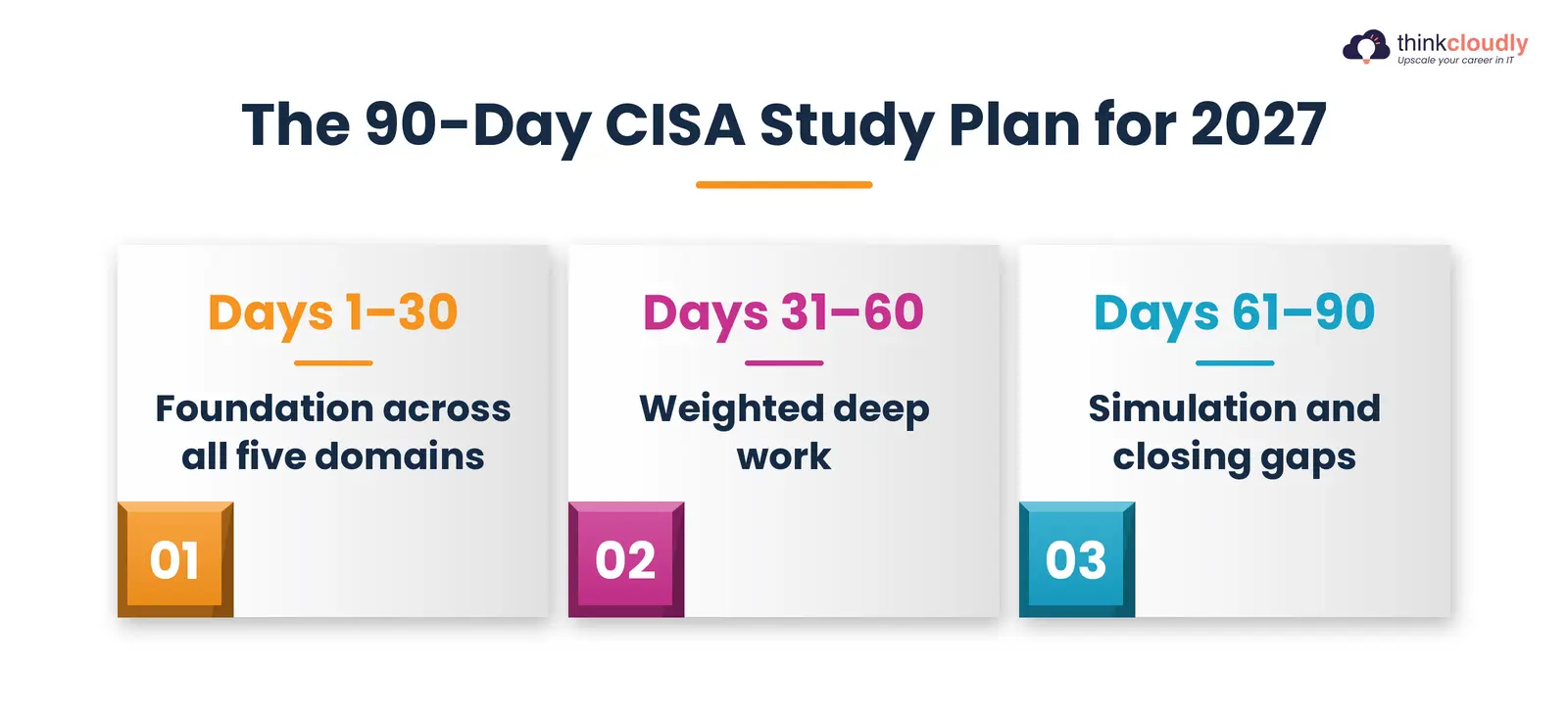
Days 1–30—Foundation across all five domains
- Read through the full content outline once, domain by domain, without trying to memorize details yet
- Build a single reference sheet per domain, no more than two pages each
- Start a light rotation of scenario questions, purely to get used to ISACA’s phrasing style
- Flag your weakest domain early—most people discover it’s Domain 3 or Domain 4
Days 31–60 — Weighted deep work
- Shift study time to match domain weighting: more hours on Domains 4 and 5 (26% each), proportionally less on Domain 3 (12%)
- Increase daily question volume, reviewing every rationale rather than just the final score
- Take one full 150-question timed mock exam at the end of this phase to establish a real baseline
Days 61–90 — Simulation and closing gaps
- Run two to three additional full-length timed mock exams under real conditions, no notes, no pausing
- Rebuild your domain-by-domain error log and spend the final two weeks almost entirely on your three weakest sub-topics
- Taper new material in the final 3–4 days and focus on review so you walk in with confidence rather than fatigue
Common Mistakes That Make the Exam Harder Than It Needs to Be
None of these require more raw intelligence to fix—just a different sequence of habits over the 90 days before test day:
- Studying all five domains equally instead of weighting hours the way the exam weights questions
- Treating mock questions as a scorekeeping exercise instead of a learning tool and skipping the rationale on answers you got right
- Underestimating the pacing problem—running out of time on the last 20–30 questions because the first 100 took too long
- Assuming years of audit experience alone will carry you through Domain 3’s systems-development content, which rewards specific exam knowledge more than general experience
- Booking the exam date before a single full-length timed mock, which guarantees your first real brush with CISA exam difficulty happens on exam day instead of weeks earlier, when you can still fix it
Is CISA Hard to Pass? My Honest Take
I’ll end where I started. Is CISA hard to pass? For most people, yes—not because the material is exotic, but because it’s wide, scenario-based, and graded on a scaled system that punishes guesswork more than it rewards raw memorization.
I’ve watched sharp, experienced auditors stumble because they trusted job experience over a structured plan built around the real passing score requirements, and I’ve watched people newer to the field pass comfortably because they respected the format and trained for it directly. Is CISA hard to pass for someone willing to match their prep to the exam’s actual shape? Much less so.
If there’s one thing I’d want you to walk away with, it’s this: stop hunting for a magic pass-rate number that will tell you your odds, because no official version of it exists. Build your own odds instead — study hours weighted to domain percentages, enough timed repetition to make ISACA’s phrasing feel familiar instead of adversarial, and at least three full mock exams before the real one. That’s the entire difference between candidates who find out the hard way and candidates who walk out already knowing they passed.
A Personal Note
I wrote this because most of what’s online about this exam is either recycled boot-camp copy or a syllabus with no lived texture to it. I’ve sat across from people who crammed for two weeks and passed, and people who studied for six months and missed it by a handful of points — and the difference was never raw intelligence.
It was whether their hours matched the way the exam is actually weighted, and whether they trusted a timed mock’s feedback over their own gut feeling about how ready they were. I still remember how certain I felt walking into my own attempt, and how little that certainty had to do with the actual result. If you take one thing from this post, let it be that: build your plan around the exam’s real structure with Thinkcloudly, not around how confident you happen to feel on any given evening.