
When I talk to people who are just stepping into the world of business analysis, they almost always ask me the same question:
“Which certification should I actually go for?”
It’s a fair question because the certification landscape looks confusing from the outside—a pile of acronyms, exam fees, and eligibility rules that don’t seem to explain themselves. I’ve spent enough time inside this field and around people preparing for these exams to know that most of the confusion clears up once you see the roadmap laid out properly.
That’s exactly what this blog is going to do. If you’re chasing this credential, this guide walks you through every stage — from the entry-level exam to the senior credential — along with the skills that actually matter on the job, like number-crunching, working with people, and mapping out how a business runs. No fluff, no recycled checklists. Just a clear path.
Why Does This Certification Actually Matter?
Let’s get the obvious question out of the way first: Is a professional business analyst certification worth the time and money?
Business analysis sits at the crossroads of business strategy and technology delivery. Companies need people who can translate a vague business problem into a workable solution, and certification is how the industry proves you can do that reliably, not just by accident.
According to IIBA’s own certification research, professionals holding the CBAP credential earn 13 per cent more on average than uncertified professionals. That’s not a marketing number — it comes directly from IIBA’s Annual Business Analysis Survey.
Beyond the pay bump, this credential does three things for you:
- It forces you to learn the discipline properly instead of picking up habits by trial and error.
- It gives recruiters and hiring managers an external, standardised signal that you know what you’re doing.
- It opens the door to specialised tracks like data analytics reporting, agile analysis, and business data analytics.
If you’re serious about a long-term career in this field, a professional business analyst certification isn’t a nice-to-have. It’s the backbone of your professional credibility.
The Certification Bodies You Should Know
Most global recognition in this space comes from the International Institute of Business Analysis (IIBA), whose credentials are built around the BABOK Guide (Business Analysis Body of Knowledge). You’ll also come across PMI’s PMI-PBA and technical add-ons like Microsoft’s Power BI certifications for reporting and analytics work, but for a structured professional business analyst certification journey, IIBA remains the most widely recognized path across industries. You can see the full breakdown of IIBA’s credential family on IIBA official page.
Let’s walk through the roadmap step by step.
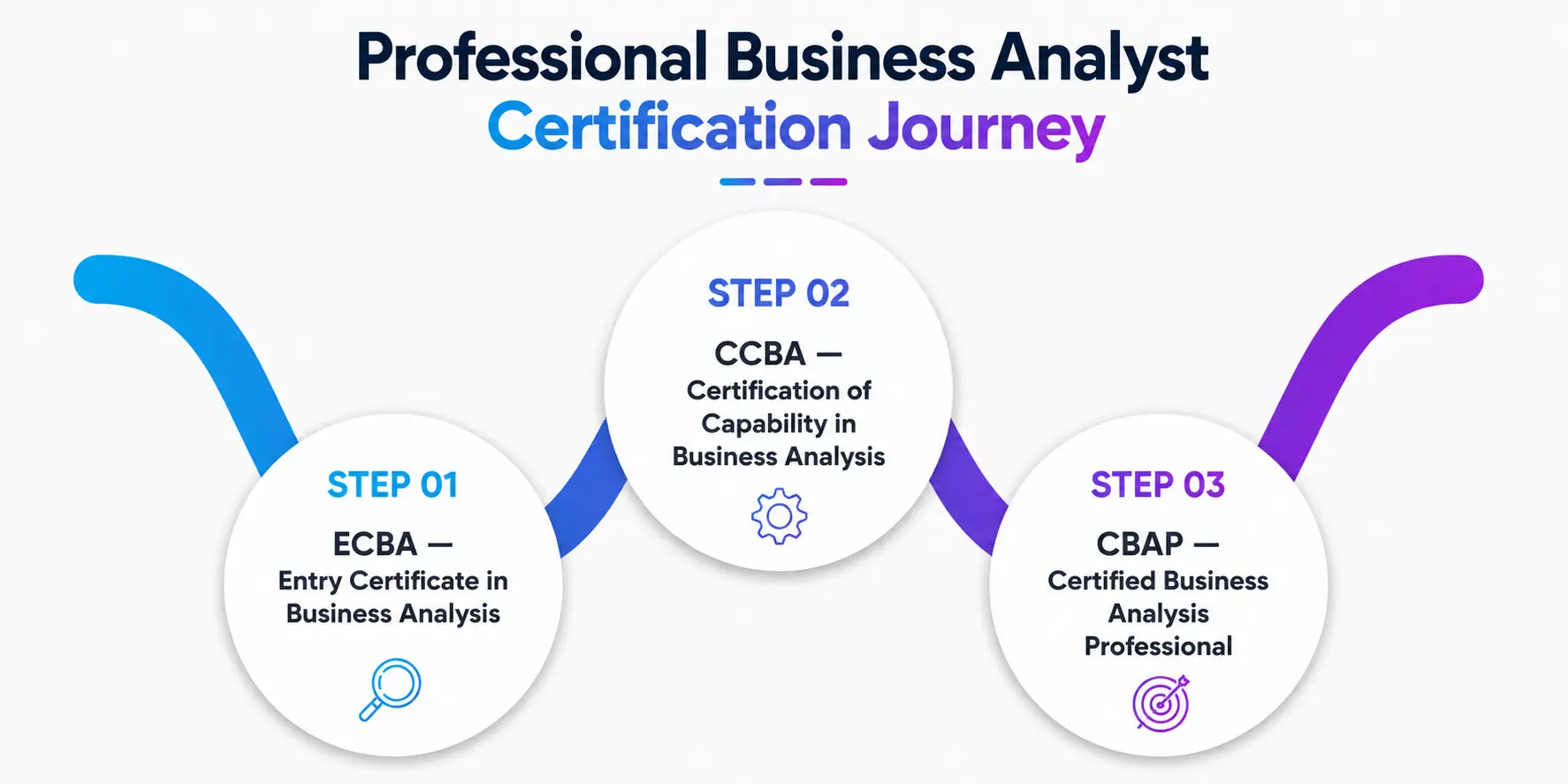
Step 1: ECBA — Entry Certificate in Business Analysis
This is where almost everyone starts, and honestly, it’s the right place to start even if you already have some experience.
The ECBA has no mandatory work experience requirement. It’s built for people who want to formally validate their understanding of business analysis before they’ve built a long résumé. According to PM Study Circle’s ECBA guide, there are no mandatory work experience or educational prerequisites, though candidates are encouraged to invest in at least 21 hours of professional development before attempting the exam.
Here’s what the exam actually looks like: 50 multiple-choice questions, completed in 1.25 hours, based entirely on the BABOK Guide’s. Cost-wise, expect to pay somewhere in the $300–$395 range depending on your region and IIBA membership status.
If you’re a student, don’t skip this: IIBA offers discounted student pricing at this level, which makes it an accessible first move even before you land your first BA job.
What you’ll actually learn here: the fundamentals of requirements elicitation, basic techniques for interpreting numbers, and an introduction to stakeholder management—all of which become the foundation for everything that comes after.
Step 2: CCBA — Certification of Capability in Business Analysis
Once you’ve got two to three years of hands-on experience under your belt, the CCBA becomes your next logical stop on this credentialing path.
The CCBA exam includes 130 scenario-based questions over 3.5 hours, and candidates need at least 70% to pass. Experience requirements are substantial: 3,750 hours of business analysis work within the last seven years, distributed across at least two of the six BABOK knowledge areas. IIBA’s own CCBA certification page confirms this is designed for practitioners with two to three years’ experience who are ready to take on larger and more complex project responsibility.
This is usually the stage where identifying gaps and business modeling stop being theory and start being daily work. You’re no longer just gathering requirements—you’re identifying the difference between the current state and desired future state, mapping processes with standard notation tools, and presenting findings to leadership.
Step 3: CBAP — Certified Business Analysis Professional
This is the flagship, senior-level professional business analyst certification, and it’s not for beginners. IIBA describes it plainly on the CBAP certification page as the credential for professionals with over five years of practical business analysis experience.
The numbers are steep by design. As detailed in the CBAP handbook by IIBA, candidates need a minimum of 7,500 hours of business analysis work experience within the last 10 years. You’ll also need 35 hours of professional development completed in the last four years, two professional references, and formal agreement to the IIBA’s Code of Ethical Conduct.
According to Adaptive US’s CBAP guide, with fewer than 21,000 CBAPs globally, the certification is highly prestigious, and it demonstrates mastery of business analysis across complex, real-world scenarios, making it the benchmark for senior BA professionals worldwide. The exam itself is case-based and scenario-driven—120 questions built to test how you apply concepts, not just recall them.
At this level, your daily toolkit typically includes system-modelling diagrams, advanced work with senior leadership across multiple business units, and executive-level reporting that feeds directly into strategic decision-making.
The Certification Comparison Table
Here’s a quick side-by-side so you can see exactly where you stand on this journey.
|
Certification |
Best For | Experience Needed | Exam Format |
Approx. Cost |
|
ECBA |
Beginners, students, career switchers | None required | 50 MCQs, 1.25 hours |
$300–$395 |
|
CCBA |
Mid-level analysts | 3,750 hrs in last 7 years | 130 scenario-based MCQs, 3.5 hours |
~$325+ |
|
CBAP |
Senior BA professionals | 7,500 hrs in last 10 years | 120 case-based MCQs |
~$325–$450 |
|
IIBA-CBDA |
Analysts moving into business intelligence and data analytics | Varies | Scenario-based |
Varies by region |
|
IIBA-AAC |
BAs working in agile teams | Varies | Scenario-based |
Varies by region |
The Core Skills Behind Every Level of Certification
Passing an exam is one thing. Actually being good at the job is another. Here’s what you need to genuinely master alongside your certification prep, and why each one matters.
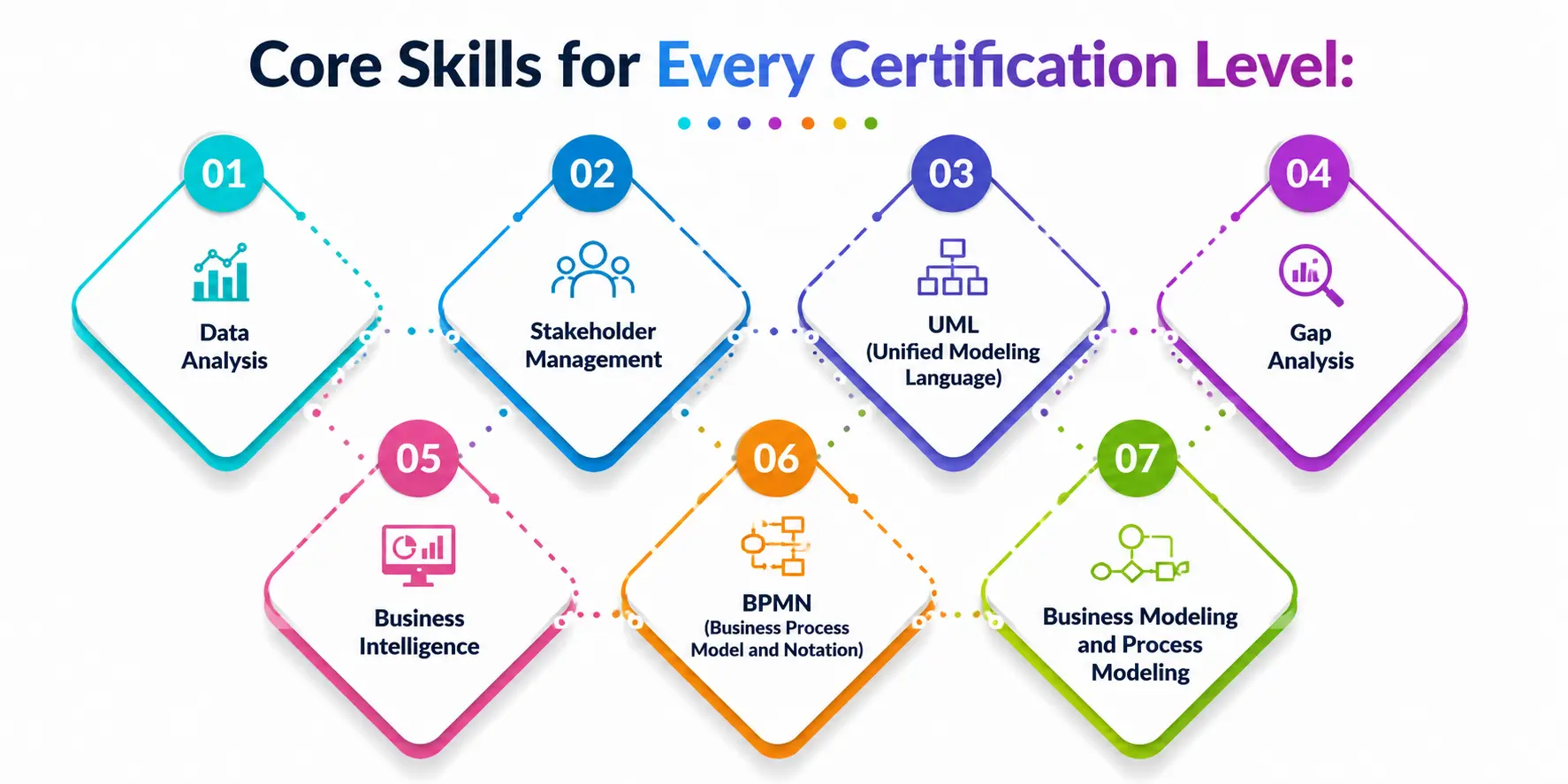
1. Data Analysis
Every BABOK knowledge area eventually touches data analysis. You’re expected to interpret trends, validate assumptions with evidence, and support recommendations with numbers rather than gut feeling. Weak analytical skills are one of the most common reasons candidates struggle with CCBA and CBAP scenario questions, because those exams test your ability to apply logic to messy business situations.
2. Stakeholder Management
This is less about spreadsheets and more about people. Strong stakeholder management means knowing how to identify who’s affected by a change, how to keep conflicting interests aligned, and how to communicate technical outcomes to non-technical leadership. Every level of IIBA’s credentialing track tests this because, frankly, most BA projects fail from mishandling the people’s side, not the technical work.
3. UML (Unified Modeling Language)
UML gives you a shared visual language for describing systems—use case diagrams, activity diagrams, and class diagrams. If you’re working anywhere near software development teams, UML is how you communicate requirements without ambiguity. It shows up heavily in CCBA and CBAP-level scenario questions.
4. Gap Analysis
Gap analysis is the structured comparison between where a business is today and where it needs to be. It’s one of the most practical tools you’ll use, and it directly informs solution recommendations. Almost every certification exam beyond ECBA tests your ability to identify and document a gap correctly.
5. Business Intelligence
As organizations lean harder into data-driven decisions, business intelligence skills—dashboards, reporting tools, and performance metrics—have become part of a modern BA’s toolkit. IIBA even offers a standalone credential, the CBDA, specifically for analysts who want to specialize here.
6. BPMN (Business Process Model and Notation)
BPMN is the industry-standard notation for mapping out business processes visually. If gap analysis tells you what needs to change, BPMN is how you document the process before and after that change. It’s a core technique inside the “process modeling” knowledge area of the BABOK.
7. Business Modeling and Process Modeling
Business modeling looks at the bigger picture—how an organization creates value, how departments interact, and how strategy translates into operations. Process modeling zooms into the specifics — the step-by-step flow of a single business process. Both skills are tested across every certification level, and both are things you’ll use in real projects almost every week.
How to Build Your Study Plan?
A realistic roadmap looks something like this:
- Months 1–2: Read the BABOK Guide cover to cover at least once. Don’t try to memorize it—understand how the six knowledge areas connect.
- Months 2–3: Take a structured training course from an IIBA Endorsed Education Provider if your budget allows it. It shortens the learning curve significantly.
- Month 3: Start practice exams. Candidates should take at least 3 to 5 full-length practice exams before sitting the real test, because these exams are heavily scenario-based rather than definition-based.
- Month 4: Schedule your exam through IIBA’s PSI-managed testing partner and go in confident.
This timeline shifts depending on which certification level you’re targeting—ECBA candidates can usually move faster since there’s no experience gate, while CBAP candidates often spend 150–200 hours in dedicated preparation.
Common Mistakes Candidates Make
I’ve seen the same mistakes repeat themselves across almost every batch of aspiring analysts:
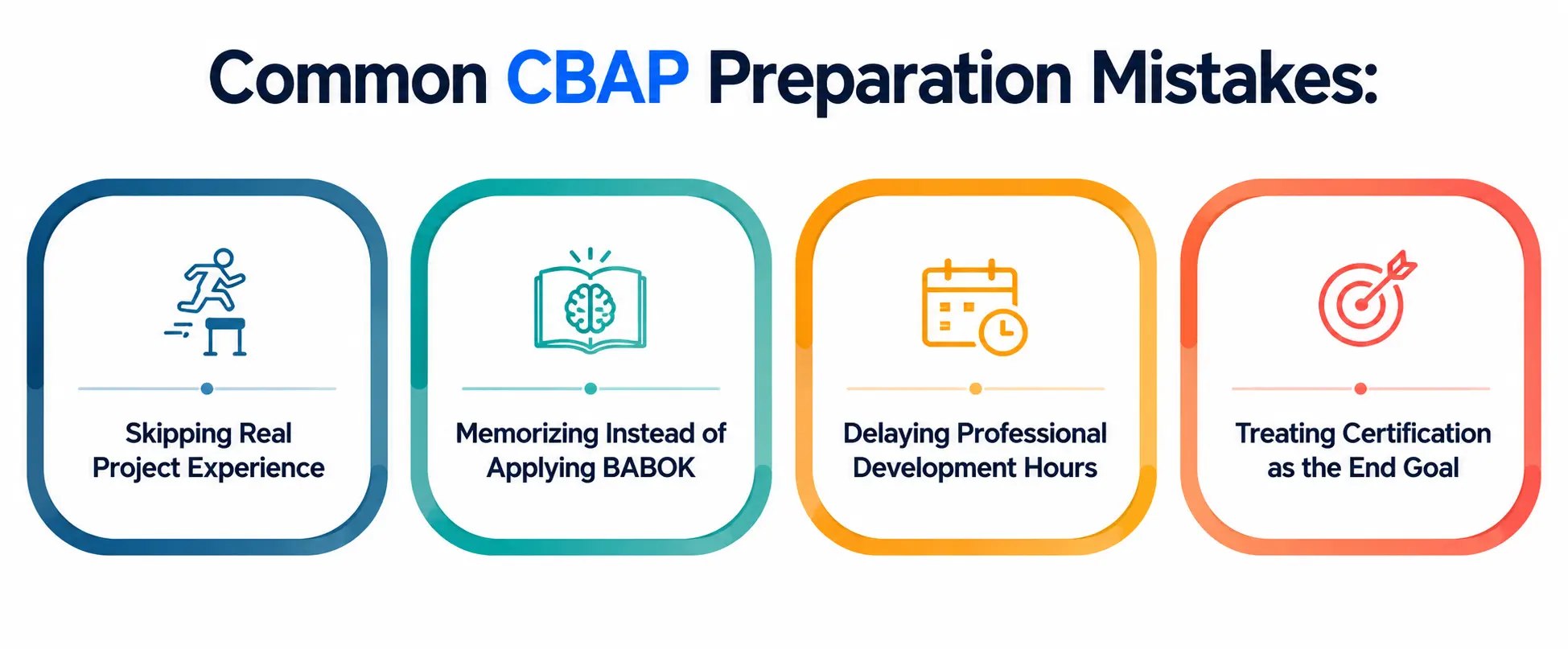
- Jumping straight to CBAP without building real project experience in people-facing skills and process mapping first.
- Memorising BABOK definitions instead of practicing how to apply them to scenario questions.
- Ignoring the professional development hour requirements until the last minute, which delays applications.
- Treating the exam as the finish line instead of the starting point of actual BA competence.
A professional business analyst certification only pays off if you treat the learning process as seriously as the exam itself.
A Personal Note
I’ll be honest with you — when I first started paying attention to this field, the certification maze felt intimidating. Too many acronyms, too many conflicting opinions on forums about “which one is really worth it.” What changed things for me was realizing that a professional business analyst certification isn’t really about the letters after your name.
It’s about forcing yourself to learn a structured way of thinking — one that respects data, respects the people affected by change, and respects the process of getting from a problem to a solution. If you’re just starting out, don’t rush to the top tier. Start with ECBA, get your hands dirty on real projects, and let your certification path grow alongside your actual competence. That’s the version of this journey that actually sticks.