

Every time someone posts a six-figure DevOps offer on a forum, three people in the comments say it doesn’t match what they’re seeing in their own job search—and both sides are usually telling the truth.
The DevOps engineer salary conversation in the US is confusing because people compare a ten-year platform lead’s total compensation against a first-year offer and call the gap “unrealistic.” It isn’t unrealistic. It’s just two different rungs on a ladder that moves faster than almost any other role in tech right now.
Most of the confusion disappears once you separate salary by experience from salary by location and once you know which states actually pay a premium versus which ones only look like they do on a quick search.
This guide breaks that number down by real experience bands for 2026 heading into 2027, shows where in the country the number actually moves, names the states candidates keep asking about, and separates the skills that pad an offer from the ones that just sound good on a resume.
If you want to build a career in DevOps, join the DevOps training program by ThinkCloudly
Why the DevOps Engineer Salary Keeps Climbing in the US?
A few structural reasons explain why this role has outpaced general software hiring on pay, even in a cautious market:
- Cloud spend in the US has not slowed down even as hiring budgets tightened, and someone has to keep that infrastructure running without errors.
- Companies that rushed cloud migrations in 2020–2023 are now paying to fix what was built badly, and that remediation work sits squarely with DevOps teams.
- Security and compliance requirements (SOC 2, HIPAA, FedRAMP) have pushed automation from a nice-to-have into a contractual obligation for vendors selling to enterprise and government clients.
- Layoffs hit product and marketing teams harder than infrastructure teams, because a company can pause a feature launch, but it cannot pause its production environment.
- AI workloads need GPU orchestration, model-serving pipelines, and cost controls that didn’t exist three years ago, and DevOps teams are absorbing that work by default.
- The talent pool for people who can actually write infrastructure code, not just click through a console, is still thin relative to demand.
- Even companies doing layoffs in other departments are, in several documented cases, still backfilling infrastructure roles within the same quarter, because an unstaffed production environment costs more than the headcount it would take to run it properly.
That scarcity is the real reason this role has held up better than most tech roles through a bumpy hiring year, and it’s also why the gap between the bottom and top of the pay scale keeps growing rather than settling down.
DevOps Engineer Salary by Experience Level
This is the number you’re here for, so let’s not bury it. According to Dice’s 2027 Tech Salary Report, DevOps roles continue to rank among the highest-paid specialties in US tech, with the national average sitting well above general software engineering pay once experience is factored in. The current US DevOps Engineer salary data breaks this down further, and the pattern lines up with what recruiters are actually quoting candidates right now.
Here is the salary by experience breakdown that matters most for anyone trying to figure out where they fall:
|
Experience Level |
Typical Base Salary (USD, 2027) |
Total Comp (Base + Bonus/Equity) |
|
Entry-level (0–2 yrs) |
$75,000 – $95,000 |
$80,000 – $105,000 |
|
Mid-level (3–5 yrs) |
$105,000 – $130,000 |
$115,000 – $150,000 |
|
Senior (6–9 yrs) |
$135,000 – $165,000 |
$150,000 – $190,000 |
|
Staff / Lead (10+ yrs) |
$165,000 – $200,000+ |
$190,000 – $260,000+ |
Notice how wide the gap is between the entry-level band and the staff-level band. This isn’t a gradual slope—the DevOps pay range roughly doubles between someone’s first role and their tenth year, and most of that growth happens between year three and year seven, exactly when someone starts owning real infrastructure-automation projects instead of just maintaining ones built by someone else. That same jump is also where someone’s physical location starts to matter more in raw dollar terms than it did at entry level—a gap we’ll get into next.
Salary by experience also shows up in how offers are structured, not just the number. Entry-level offers are almost entirely base salary. By the time someone reaches senior level, equity and performance bonuses start making up a real share of total comp, which is why two “senior DevOps engineer” titles can show base salaries $20,000 apart and still be roughly equal once total comp is counted.
Which US States Actually Pay the Most?
Location still moves the DevOps engineer salary more than most candidates expect, even with remote work normalized. The state-level salary data for this role consistently shows the same cluster of states at the top, and it isn’t a surprise once you look at where the employers actually are.
The highest-paying states for this role in 2026 include:
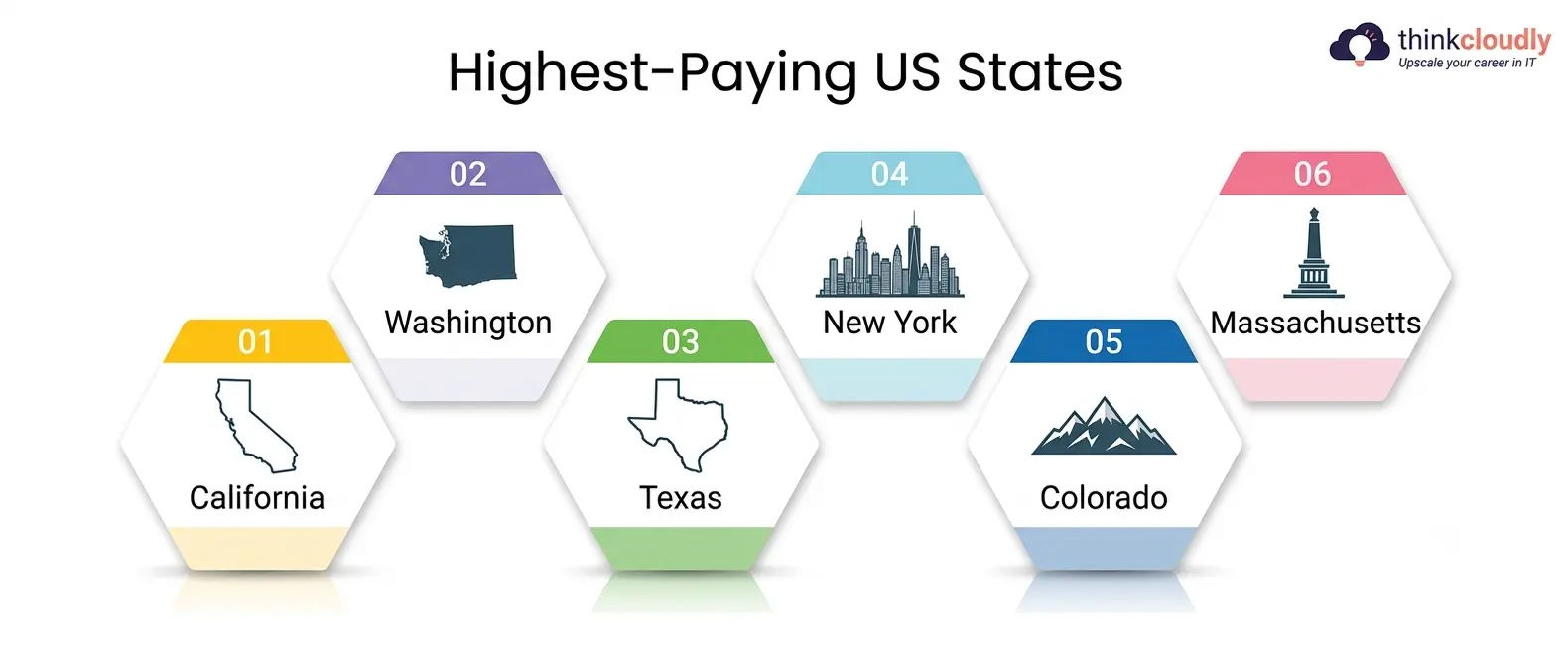
- California—still the ceiling, driven by Bay Area and Los Angeles tech employers; expect a 15–25% premium over the national median.
- Washington—Seattle’s cloud-provider density (Amazon, Microsoft) keeps local pay close to California’s without California’s cost-of-living tax.
- New York—Fintech and enterprise SaaS companies compete hard for infrastructure talent, pushing pay above the national average in both the city and its surrounding tech corridor.
- Massachusetts—Boston’s biotech and enterprise software base pays a real premium for anyone who can automate compliance-heavy environments.
- Texas—Austin specifically has absorbed enough relocated tech headcount that its offers now sit closer to the coasts than most of the rest of the state.
- Colorado — Denver and Boulder have quietly built a dense enough cluster of SaaS and fintech employers that local offers now sit noticeably above the national median, even though the state rarely makes the shortlist when people guess at this out loud.
Outside these highest-paying states, the national median still holds up reasonably well because remote-first hiring has flattened some of the old geographic gap. A company based in Austin will often quote the same number to a remote hire in Ohio that it quotes a local candidate, which wasn’t true five years ago.
That said, candidates physically based in one of these highest-paying states, even in a remote role, tend to get better initial offers simply because recruiters anchor to local comp bands by default.
The ranking itself has stayed fairly stable for the past three years, which makes it one of the more reliable planning tools in this whole conversation—if you’re weighing a relocation purely for pay, these states are still where the math works best.
The Skills That Actually Change the Number on Your Offer
Not every skill on a DevOps resume carries equal weight with a hiring manager. These are the ones that consistently move an offer up, based on what’s showing in current job postings:
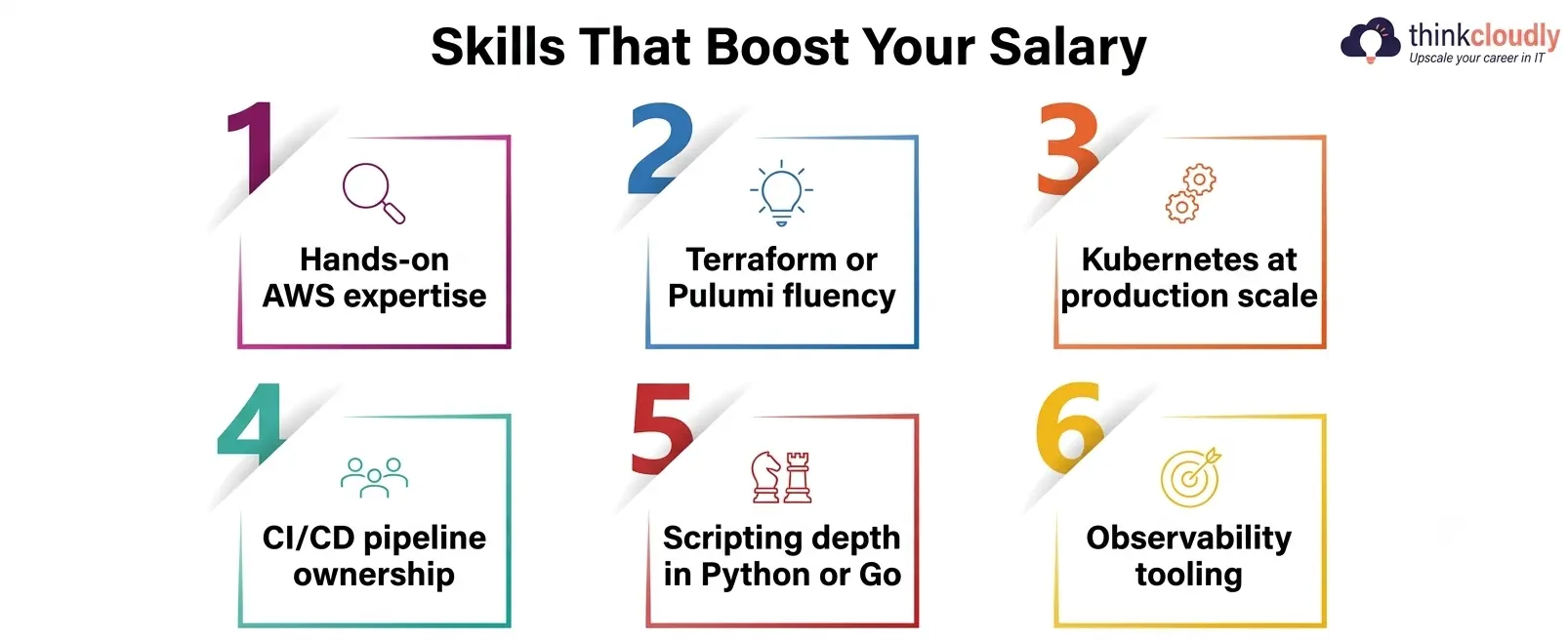
- Hands-on AWS expertise—this is still the single biggest lever. A candidate who can speak fluently about IAM policy design, VPC architecture, and cost optimization, not just “I’ve used EC2,” commands a noticeably higher offer than one who lists AWS as a bullet point.
- Terraform or Pulumi fluency—provisioning infrastructure from code rather than clicking through a console separates a mid-level candidate from a senior one almost instantly in interviews.
- Kubernetes at production scale—not a weekend tutorial cluster, but real experience with scaling policies, node pools, and incident response under load.
- CI/CD pipeline ownership—GitHub Actions, Jenkins, or GitLab CI experience where you built the pipeline, not just used one someone else configured.
- Scripting depth in Python or Go—good automation lives or dies on scripting quality, and interviewers test this directly rather than taking a resume’s word for it.
- Observability tooling—Datadog, Prometheus, or Grafana experience signals you can diagnose problems, not just deploy code and hope.
AWS expertise specifically deserves its own callout because of how many job postings name it explicitly rather than listing “cloud experience” generically. The salary data by role and skill shows candidates with a named AWS certification and real hands-on cloud depth clearing offers 8–12% above peers with comparable years of experience but no cloud certification attached.
That gap tends to be largest for candidates moving from a general sysadmin background into DevOps, since employers weigh provable cloud skills more heavily when the rest of the resume doesn’t already signal it.
How Automation Engineering Changes the Trajectory?
Automation engineering is the quiet differentiator in almost every DevOps engineer salary negotiation, and it’s worth separating from general DevOps work because the two get conflated constantly. A DevOps engineer who maintains existing pipelines is doing valuable, necessary work.
A DevOps engineer who builds self-healing infrastructure, writes scripts that eliminate entire categories of manual tickets, or designs systems that scale without a human approving every change is doing something a company will pay noticeably more to keep.
The difference rarely shows up on a job title, which is exactly why so many candidates with the same “DevOps Engineer” label end up in very different pay bands once an offer is actually on the table.
This shows up concretely in interviews. Hiring managers now routinely ask candidates to walk through a specific automation engineering project—what broke, what you built to fix it permanently, and what the measurable result was (fewer incidents, faster deployments, lower cloud spend).
Candidates who can answer that with a real story, rather than a tool list, are the ones landing offers at the top of each band in the table above. The Bureau of Labor Statistics’ occupational data for software and infrastructure roles confirms this broader trend: roles tied to measurable efficiency gains are growing faster and paying better than roles defined purely by tool familiarity.
It’s also why the DevOps pay range at senior and staff levels is so much wider than at entry level. A senior engineer who can prove measurable automation wins to a VP has genuine negotiating leverage; one who can’t is stuck negotiating inside a narrower band regardless of title, no matter how many years of tenure sits on the resume next to it.
Where the DevOps Engineer Salary Is Headed Into 2027?
A few forces will likely keep pulling this number up rather than flattening it out. AI infrastructure work is expanding the job description for DevOps teams without expanding headcount at the same pace, which keeps demand per-person high. Companies that already automated the easy 80% of their infrastructure are now paying more for the harder 20%, which rewards senior-level problem solvers disproportionately.
And the gap between candidates with real AWS expertise plus a documented automation engineering track record, versus candidates with tool familiarity alone, looks set to widen rather than close.
Salary by experience will likely keep spreading wider at the top rather than compressing, and the ranking of highest-paying states has been stable enough for long enough that it’s a reasonable input for anyone weighing a relocation purely on pay. None of that guarantees any individual offer, but it’s the direction every current data source points.
A Personal Note
I spent my first year in this field assuming the DevOps pay range I kept reading online applied to me the moment I landed a job with “DevOps” in the title. It didn’t. My first offer sat at the very bottom of the entry-level band, and I remember feeling like the number online had been exaggerated just to get clicks. It hadn’t been.
What I was missing wasn’t effort — it was that I’d learned tools without learning to talk about the problems those tools solved. The jump that actually mattered for me came two years in, when a senior engineer made me rebuild a deployment process I’d been quietly complaining about for months instead of just tolerating it.
That project became the thing I talked about in every interview after, and it’s the reason my own DevOps engineer salary moved out of that entry band faster than I expected. If you’re early in this and the numbers above feel out of reach, they’re not a ceiling — they’re just further down the ladder than year one.