
There are currently 4.8 million unfilled cybersecurity jobs sitting open around the world right now, and that gap grew, not shrank, over the past year. That single number is the reason so many people are suddenly asking the same question: which network security certification actually moves the needle in 2026?
I’ve spent enough time around hiring managers, bootcamp graduates, and career changers to know the honest answer isn’t “just get CISSP” or “just get CCNA.” It depends on where someone is standing right now.
This roadmap walks through that decision step by step, using real 2026 numbers rather than recycled advice from three years ago, so anyone reading it can figure out exactly where they fit and what to study next.
Why Does a Network Security Certification Matter More in 2026 Than Ever?
The workforce math here is not subtle. According to StationX article “2026 Cybersecurity Job Market Analysis,” the global talent gap now sits at 4.8 million unfilled positions, a 19% year-over-year increase even as the active workforce grew to 5.5 million professionals.

In the United States alone, the same data points to information security analyst salaries with a median around $120,000, and the Bureau of Labor Statistics projects growth for that occupation far above the average for all jobs.
What used to be a “nice to have” line on a resume has quietly become the fastest, cheapest way to prove real competence to a hiring manager who has hundreds of open roles and not enough qualified applicants to fill them.
This is exactly why a network security certification carries so much weight right now. It is not a substitute for hands-on skill, but it is the fastest signal an employer can use to shortlist someone out of a stack of hundreds of resumes.
Recruiters scanning applicant tracking systems in 2026 are quite literally searching for certification keywords before a human ever reads a cover letter, which means the credential someone chooses to pursue can be the difference between an interview and silence.
Building Blocks: Network Fundamentals Before You Certify
Nobody should walk straight into an advanced exam without first locking down network fundamentals. That means understanding how IP addressing, subnetting, VLANs, routing tables, and the OSI model actually work in a live environment, not just on a practice test.
Just as important is a working grasp of common network protocols, since almost every security scenario on an exam or in a real incident traces back to how TCP/IP, DNS, DHCP, HTTP/HTTPS, and SSH actually behave under normal and abnormal conditions.
Skipping this stage is the single most common reason candidates fail their first attempt at any serious credential. A person who can recite firewall rules but cannot explain why a three-way handshake matters will struggle the moment an exam scenario gets specific. CompTIA’s own Network+ exam, and free resources like Cisco’s Networking Academy, exist precisely to build this base layer before anyone spends real money on a harder exam.
This groundwork is also exactly what most network security certification exams assume candidates already know before the harder, scenario-based questions even begin, so investing two or three focused weeks here before moving on saves far more time later.
The 2026 Certification Roadmap by Career Stage
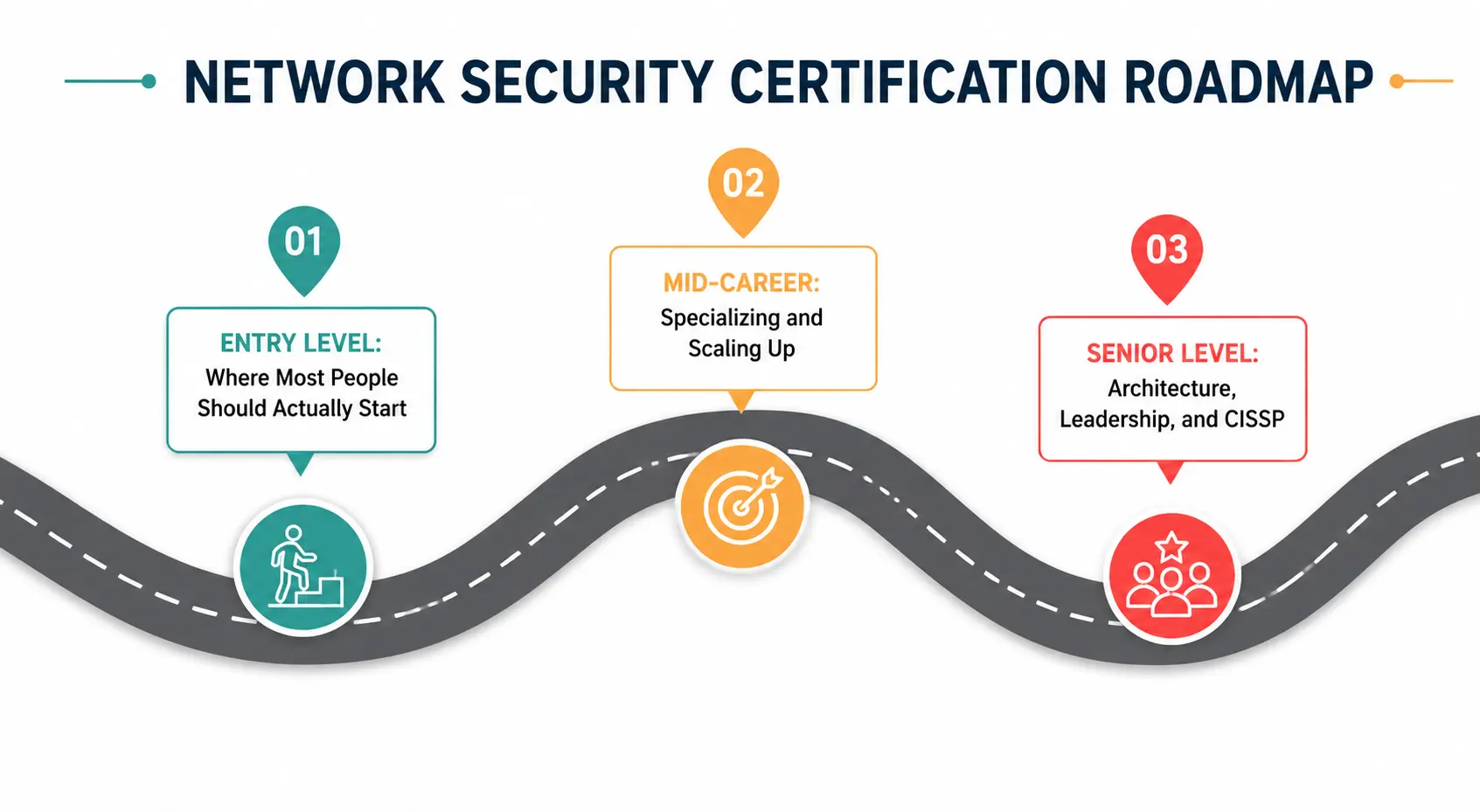
1. Entry Level: Where Most People Should Actually Start
At the entry level, the goal is proving foundational competence, not chasing a big title. CompTIA Security+ remains the most requested entry-to-mid credential in the US, and CompTIA confirmed a significant 2026 objective refresh to the SY0-701 exam, adding deeper coverage of zero trust architecture, cloud security controls, and AI-augmented threats, according to Network World’s article.
Alongside Security+, the Cisco Certified Network Associate, especially when paired with CCNA security topics like access control, VPNs, and device hardening, gives candidates a genuinely practical foundation for their first network engineer or network administrator role.
The CCNA exam itself costs $300 in 2026, though most candidates budget between $450 and $3,000 total once study materials, practice labs, and possible retakes are factored in.
That is a modest investment against the payoff: entry-level networking roles in the US typically start between $60,000 and $80,000, with help-desk positions slightly lower and hands-on technical roles moving quickly past $75,000 once real experience is added on top of the certification.
2. Mid-Career: Specializing and Scaling Up
Once someone has 2-4 years of hands-on experience, the roadmap shifts toward specialization. CCNP Security is the natural next step after CCNA, and current 2026 data shows CCNP holders averaging between $110,000 and $118,000, compared to roughly $85,000-$95,000 for CCNA-only professionals, a gap that widens further for anyone specializing directly in security or data center tracks.
This is also the stage where a mid-career professional typically decides whether to go deeper into pure networking, pivot toward cloud security certifications like AWS or Azure networking tracks, or move toward governance-focused paths like CompTIA CySA+.
It’s also worth noting that a network administrator with 3-5 years of experience who adds a security-focused credential on top of their CCNA is one of the fastest-moving salary jumps in the entire industry right now, often 20-30% higher than peers without it, simply because so few candidates combine strong fundamentals with a recognized security-specific badge.
3. Senior Level: Architecture, Leadership, and CISSP
At the senior end of the roadmap, certifications shift from proving technical skill to proving strategic judgment. CISSP remains the benchmark here. It requires five years of paid experience across at least two of its eight security domains, and certified professionals report an average salary around $131,000, representing roughly a 37% pay advantage over non-certified peers in similar roles, according to Research.com‘s 2026 CISSP analysis.
This is the stage where someone stops being just a network engineer executing tickets and starts owning network architecture decisions for an entire organization, weighing zero trust rollouts, cloud migration risk, and compliance frameworks like CMMC 2.0 all at once.
Below is a quick comparison to make the roadmap easier to scan at a glance.
|
Certification |
Best For | Typical 2026 Exam Cost |
Average US Salary Range |
| Absolute beginners, DoD-aligned roles | ~$404 |
$75,000 – $103,000 |
|
| Aspiring network engineer or network administrator | ~$300 |
$85,000 – $113,000 |
|
|
CCNP Security |
Mid-career specialists | ~$400 |
$110,000 – $118,000 |
| Senior architects, security leadership | $749 |
$130,000 – $160,000 |
|
|
CompTIA SecAI+ |
AI-security specialists layered on existing certs | Varies by region |
Premium of 15–30% over peers |
What Actually Changed in 2026?
The biggest shift this year isn’t a new exam number; it’s a new topic area. CompTIA officially introduced SecAI+ in February 2026, a certification built specifically around defending and responsibly using AI systems inside a security operation.
Network World’s launch reported that CompTIA positioned the credential as addressing an urgent need for professionals who can both defend against and responsibly apply AI technologies in modern security environments.
At the same time, CMMC 2.0 Phase 3 enforcement is expanding to cover a broader base of federal contractors later in 2026, which means Security+ and other DoD-aligned credentials are becoming less optional for anyone touching government-adjacent networks.
None of this replaces the fundamentals. A network security certification built around AI threats still assumes the holder already understands baseline network architecture, protocols, and access control.
Think of SecAI+ or similar emerging credentials as a specialty layer sitting on top of a foundation that hasn’t actually changed that much, just gotten more consequential to get right the first time.
Renewal Costs: The Part of Every Network Security Certification Nobody Budgets For
A certification isn’t a one-time purchase; it’s closer to a subscription for staying current. CompTIA credentials like Security+ carry a three-year validity period, renewable through 50 continuing education units, which typically runs around $150 in CE fees for the full cycle.
CISSP is steeper: ISC2 charges a $135 annual maintenance fee on top of 120 continuing professional education credits required across every three-year cycle, though many of those credits can be earned free through ISC2 webinars.
Anyone building a career around network protocols, access control, and evolving network architecture standards should treat these renewal costs as part of the real total, not a surprise bill three years later.
Skipping renewal doesn’t just cost money either; it quietly signals to employers that a credential has gone stale in a field where the underlying technology changes every year.
How to Choose the Right Path for Your Goals?
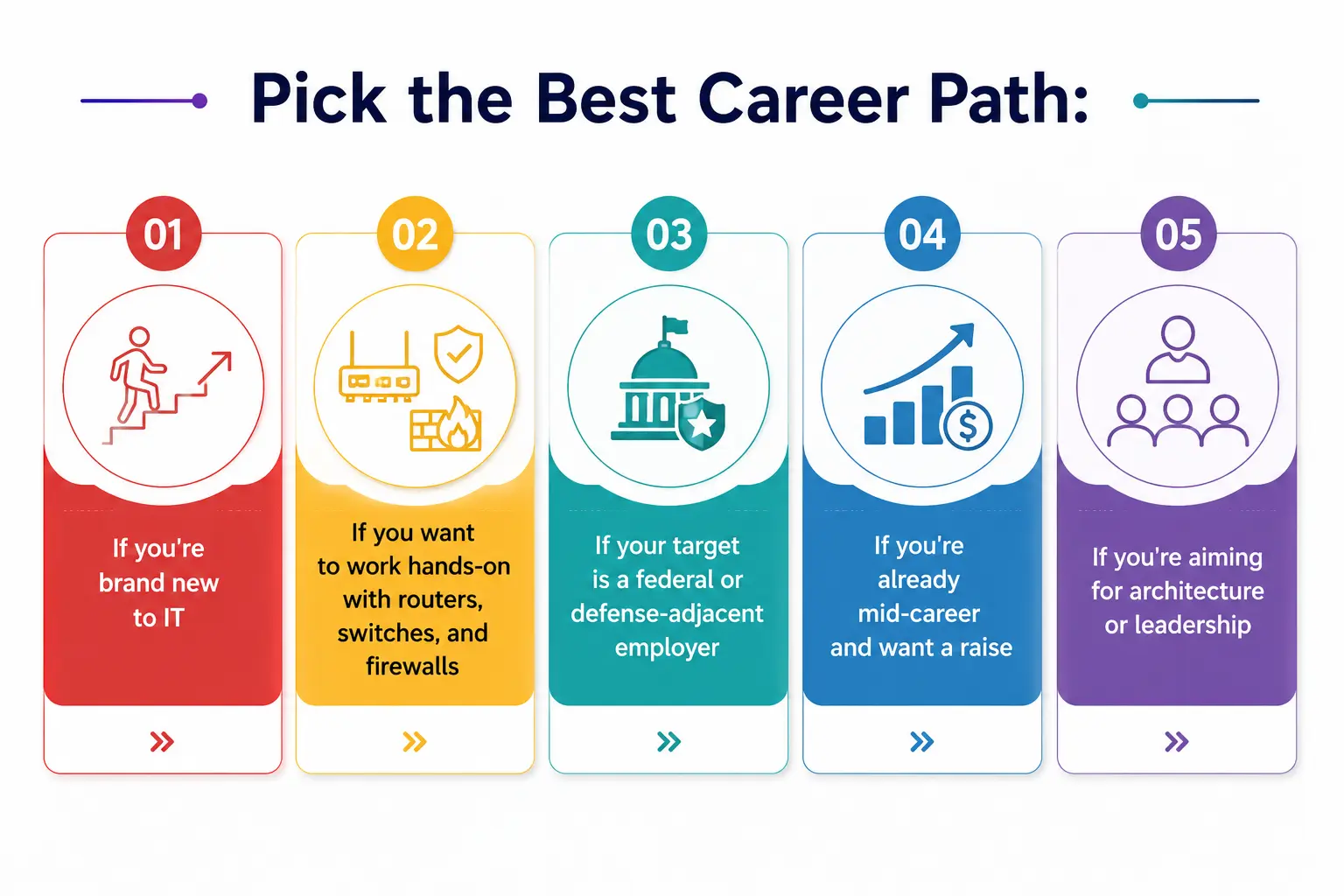
- If you’re brand new to IT, start by mastering the OSI model, IP addressing, and subnetting through a free resource like Cisco Networking Academy, then sit for CompTIA Network+ before anything security-specific.
- If you want to work hands-on with routers, switches, and firewalls, CCNA with a security focus is the most direct path into a hands-on networking career, whether that starts as a support technician role or something more specialized down the line.
- If your target is a federal or defense-adjacent employer, CompTIA Security+ is close to mandatory given DoD 8140 alignment.
- If you’re already mid-career and want a raise, CCNP Security or a cloud-networking specialty will usually move the needle faster than a second entry-level badge.
- If you’re aiming for architecture or leadership, CISSP is still the credential that opens those doors, though it requires real years of experience first, not just study time.
Conclusion
Choosing a network security certification in 2026 isn’t about picking the most famous acronym; it’s about matching the credential to exactly where a person stands and where they actually want to go next. The data is clear that demand for qualified people has outpaced supply for years running, and that gap isn’t closing anytime soon, which means the return on a well-chosen certification is higher right now than it has been in a long time.
Start with fundamentals, be honest about current experience level, and pick the next step deliberately rather than chasing whatever certification trends on social media that week.
A Personal Note
I’ll be honest about something most guides like this skip over: I’ve watched too many smart, capable people burn six months chasing CISSP before they had the hands-on hours to actually pass it, and I’ve watched just as many stall out re-taking CCNA three times because they skipped the fundamentals to save a week.
The people who move fastest aren’t the ones with the most exams listed on LinkedIn. They’re the ones who picked one credential that matched where they actually stood, finished it, and let the next step reveal itself from there. If you take one thing from this roadmap, let it be patience with the order, not the pace.