
Every few months, someone messages me asking the same question in slightly different wording: “Can I really switch into tech without a four-year degree?” The honest answer is yes, and the fastest, most structured route most people take to do it is a career in IT with bootcamp training. That’s not a sales pitch. It’s what the enrollment numbers, the hiring data, and the students I’ve talked to over the past year actually show.
This guide walks through what this route actually looks like in practice—not the marketing version, the real one. We’ll cover how bootcamps compare to traditional degrees and certifications, what you’ll actually learn, how to pick a program that won’t waste your money, and what jobs are realistically waiting on the other side.
If you’re weighing whether to enroll in a bootcamp this year, this is meant to be the article that answers your actual questions, not the one that just tries to sell you a seat in a cohort.
Why Does the Career in IT with Bootcamp Path Exist in the First Place?
Traditional computer science degrees are excellent, but they’re built for a four-year timeline and a theory-first curriculum. Most people who need income in six months, or who are switching careers in their thirties or forties, can’t wait that long. Bootcamps grew out of that exact gap—compressed, job-focused programs that teach practical, employable IT skills instead of a full academic sequence.
The scale of this industry by 2026 tells its own story. According to Course Report’s ongoing bootcamp market research, roughly 25,000 students graduate from bootcamp programs annually across more than 600 schools worldwide, generating around $350 million in tuition revenue. That’s not a niche experiment anymore; it’s a parallel pipeline into the industry that employers have grown used to hiring from.
Graduates report an average starting salary of about $69,079, with a typical pay increase of 56% compared to whatever they were earning before enrolling—which is a big part of why this path keeps showing up as a serious option rather than a shortcut nobody trusts.
None of that means bootcamps are magic. They’re intense and compressed, and they demand real focus. But for someone with the discipline to finish one, the return on time invested is hard to beat compared to a multi-year degree, especially if your goal is simply to get hired and start building experience.
It’s also why more employers now list recognized IT certification programs alongside bootcamp project work as equally valid proof that someone is ready to contribute.
Reference Blog: Thinkcloudly Free Bootcamp Review: Is It Worth Joining in 2026?
What You Actually Learn: Technology Skills vs. Theory
A good bootcamp doesn’t try to replicate a computer science degree in miniature. It focuses on the technology skills that get someone hired for a specific job family—help desk and support, web development, data analytics, cybersecurity, or cloud infrastructure—and skips most of the abstract theory a four-year program spends a semester on.
That distinction matters more than people expect. Employers hiring for junior roles usually care less about whether you can explain Big-O notation from memory and more about whether you can troubleshoot a broken deployment, write a working SQL query, or configure a basic firewall rule under time pressure.
Bootcamps are built around that reality. A typical curriculum stacks hands-on IT skills—Git version control, cloud platform basics, scripting, ticketing systems, and basic networking—on top of a handful of real projects you can show in an interview instead of just describing.
The IT skills gap this closes is real. A lot of self-taught learners pick up scattered IT skills from tutorials and YouTube videos but never build the kind of structured, project-based portfolio that a hiring manager can actually evaluate in fifteen minutes.
A bootcamp forces that structure on you, on a deadline, with instructors checking your work—which is exactly what most self-directed learners struggle to enforce on themselves.
Bootcamp vs. Degree vs. Certification: A Side-by-Side Look
Here’s a table format explanation to make the comparison concrete, since most people weighing a career in IT with bootcamp training are also weighing it against a degree or a stack of standalone certifications.
|
Factor |
IT Bootcamp | Four-Year Degree |
Self-Paced Certifications |
|
Typical length |
8 to 20 weeks | 4 years |
Weeks to months, self-directed |
|
Typical cost |
3,500–30,000 (avg. ~$14,142) | 40,000–120,000+ |
100–3,000 per exam/course |
|
Focus |
Applied technology skills, job-ready projects | Theory plus breadth |
Narrow, vendor-specific IT skills |
|
Structure |
Cohort-based, instructor-led, deadlines | Semester-based, broad electives |
Entirely self-paced |
|
Best for |
Career changers who need speed and accountability | Students wanting depth, research, or grad school later |
People adding a credential to existing experience |
|
Outcome data |
~79% of alumni employed in programming/tech roles | Varies widely by school and major |
Varies widely; often supplements a resume rather than replacing experience |
None of these three paths is universally “better.” The bootcamp route tends to win on speed and job-readiness. A degree wins if you want deep theoretical grounding or plan to go into research or a highly regulated specialty later. Standalone IT certification programs work best as an addition to something you already have, not as a replacement for hands-on project experience.
Step by Step: How to Actually Start a Career in IT with Bootcamp Training
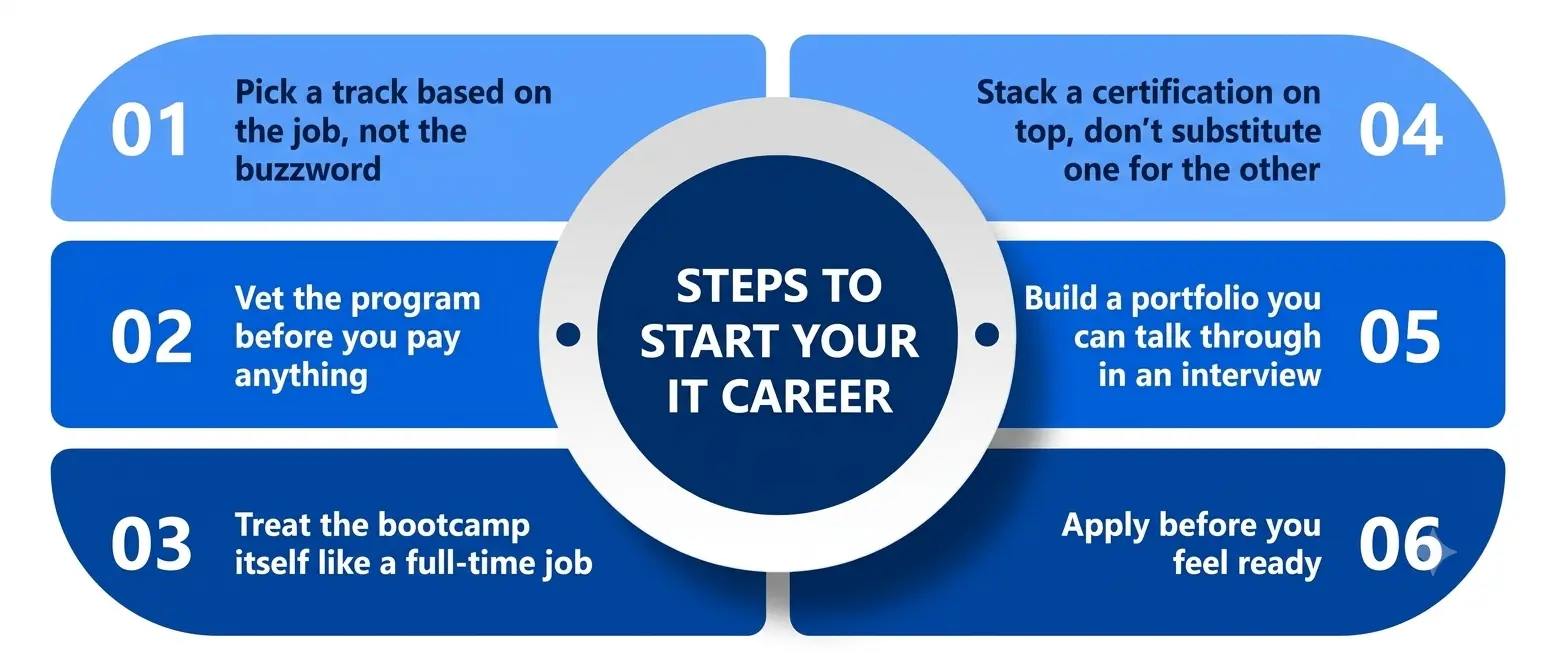
1. Pick a track based on the job, not the buzzword. Don’t choose “cybersecurity” because it sounds impressive. Look at actual entry-level job postings in your target city or remote-friendly companies, see which skills repeat across listings, and pick the track that matches. Help desk, QA testing, web development, data analytics, and cloud support are the most common entry points in 2026. If you’re unsure which track fits, spend a week previewing free information technology courses online before committing to a specific specialization.
2. Vet the program before you pay anything. Ask for verified outcomes data, not marketing claims—job placement rate within six months, median starting salary, and how many graduates are still employed a year later. A legitimate school will hand this over without hesitation.
3. Treat the bootcamp itself like a full-time job. The programs that produce hired graduates are the ones people show up for daily, not the ones squeezed in around a full-time schedule. If you can’t clear the hours, look at part-time or extended-format information technology courses instead of the accelerated version.
4. Stack a certification on top; don’t substitute one for the other. Once you’ve got applied project experience, layering in one of the well-known IT certification programs—CompTIA A+, Security+, or an AWS/Azure associate credential—adds a resume signal that a bootcamp alone doesn’t always provide. Employers read certifications as proof you can pass a standardized bar; they read bootcamp projects as proof you can actually build something.
5. Build a portfolio you can talk through in an interview. Three to five solid projects, each with a clear problem, your specific contribution, and a measurable outcome, beat a long list of tutorials completed. Hiring managers ask “walk me through this” far more often than “list what you know.”
6. Apply before you feel ready. Most graduates land their first offer weeks or months after finishing, not the day the program ends. Start applying to entry-level technology jobs during your final few weeks of the program rather than waiting for a diploma to arrive.
What Jobs Are Actually Waiting on the Other Side?
This is the part people worry about most, understandably. Here’s where this path realistically leads, based on what employers are actually posting for in 2026.
According to Robert Half’s guide to entry-level IT hiring, the most accessible entry-level technology jobs right now include Help Desk Tier 1 support, QA analyst roles, junior web developer positions, NOC technician roles, and junior data analyst seats—all roles that reward hands-on skills over a specific degree.
Robert Half also notes that many employers are actively willing to hire and develop early-career candidates who show real potential, even without a long résumé, which is precisely the population bootcamp graduates fall into.
Realistically, most bootcamp graduates don’t walk straight into a senior engineering role, and no honest advisor should tell you otherwise. What they do land, consistently, are entry-level technology jobs that put them inside a company, working on real systems, with a manager who can vouch for them the next time they apply somewhere bigger.
From there, the second and third moves tend to come faster—bootcamp alumni surveys show average earnings climbing toward roughly $80,000 by a second role and around $95,000 by a third, as real production experience starts to outweigh where someone originally learned to code or configure a network.
Costs, Timeframes, and Whether the ROI Actually Holds Up
Cost is usually the first objection, and it’s a fair one. Programs run anywhere from $3,500 to $30,000, with the typical student paying somewhere around $14,000 for a full-time, instructor-led format. Compare that to $40,000 or more for a single year of many four-year degree programs, and the math starts to look different fast—especially if the bootcamp shortens your time out of the workforce from four years to fourteen or twenty weeks.
That shorter runway matters most for entry-level technology jobs, where employers care far more about current, demonstrable skills than about how long you spent acquiring them. Length matters more than people initially assume, too.
Programs stretching 16 weeks or longer tend to produce graduates with meaningfully higher starting salaries than the shortest 8-week formats, because there’s simply more room to build real technology skills instead of racing through a syllabus. If a program promises job-readiness in two weeks, that’s a red flag worth taking seriously, not a shortcut worth celebrating.
The CompTIA IT Industry Outlook for 2026 points to workforce pipeline development as one of the industry’s five defining trends this year, with employers increasingly building skills-based hiring paths rather than defaulting to degree requirements for every open role.
Many of those hiring paths lean on recognized IT certification programs to validate a candidate quickly, which is exactly why pairing one with a bootcamp pays off. That shift is exactly what makes a career in IT with bootcamp training a more defensible bet in 2026 than it might have looked a decade ago, when degree requirements were far more rigid across the industry.
Common Mistakes That Derail This Path
The biggest one is picking a program based on the flashiest marketing page instead of verified outcomes data. Ask for a breakdown by cohort, not a single aggregated success number pulled from the school’s best year.
The second is treating information technology courses as a substitute for networking. Most bootcamp graduates land their first role through a referral, an alumni connection, or a hiring partner the school works with directly — not a cold application into a job board black hole. Show up to the program’s career services sessions even when they feel optional.
The third is stopping at the certificate. A career in IT with bootcamp training is a starting point, not a finish line. The data continues to project faster-than-average growth across most computer and information technology occupations through the rest of this decade, and staying current — through continued information technology courses, on-the-job learning, or an added certification — is what keeps that growth working in your favor rather than someone else’s.
A Personal Note
I’ve sat across the table from a lot of career changers who assumed a bootcamp was a gamble reserved for twenty-two-year-olds with nothing to lose. Almost none of the people I’ve actually watched succeed fit that description. The ones who made it work were closer to thirty-five, coming out of retail management, teaching, or hospitality, with a mortgage and genuine fear about whether this would pay off.
What got them through wasn’t talent nobody else had — it was that they treated the bootcamp like the job it was training them for: full attention, daily consistency, and a refusal to quit in week six when the material got hard, and the confidence dipped.
If you’re on the fence about whether a career in IT with bootcamp training is realistic at your age or your stage of life, I’d tell you what I tell them: the industry cares far more about what you can build and troubleshoot than about how you got there. Show up for the unglamorous middle weeks, and the rest tends to sort itself out.