Every year, a fresh batch of “top AWS courses” roundups gets published, and most of them recycle the same handful of 2019-era course links without checking whether the content still matches what AWS actually tests.
That’s a problem right now, because AWS is mid-refresh: three certifications are being rebuilt around AI-assisted workflows and agentic tooling, with new versions rolling out between October 2026 and January 2027.
Picking a course that hasn’t caught up with that shift means studying for an exam that no longer exists by the time you sit for it, which wastes months you probably don’t have to spare if you’re trying to move roles or break into the field this year.
This guide skips the recycled lists. It walks through the training genuinely worth your time heading into 2027, organized around the career path each one sets you up for—system design, networking, automation, or container orchestration—rather than which platform paid for the placement. Along the way, it points to the official exam changes actually driving this refresh, so you’re not just taking someone’s word for it.
Why the Timing Matters Heading Into 2027?
Cloud hiring hasn’t slowed down, but it has gotten pickier. Companies aren’t hiring generalists who “know AWS” in the abstract; they’re hiring people who can point to a specific, current skill set and back it up with something they’ve actually built.
According to AWS’s own announcements, the Solutions Architect – Professional, Developer – Associate, and Machine Learning Engineer – Associate exams are all being updated to test AI-assisted development, agentic AI workflows, and resilience-as-a-service patterns. That’s a meaningful shift from the exam’s most existing course material that was built to prepare people for even a year ago.
This matters for anyone weighing an AWS career move in the next twelve months. An outdated course teaches outdated architecture habits, and those habits show up in interviews long before they show up on an exam score.
The safest move is choosing course material that’s explicitly updated for the current exam guides rather than something with a big enrollment count and a stale syllabus.
It’s also worth budgeting for the exam fees themselves—associate-level exams generally run $150 and professional-level exams closer to $300, so factor that into your timeline alongside whatever a course itself costs.
Reference Blog: The Complete AWS Certification Journey: From Beginner to Pro
How to Choose the Right AWS Courses in 2026 and 2027?
Not every course labeled “2026 edition” actually is one. A few filters make the decision easier:
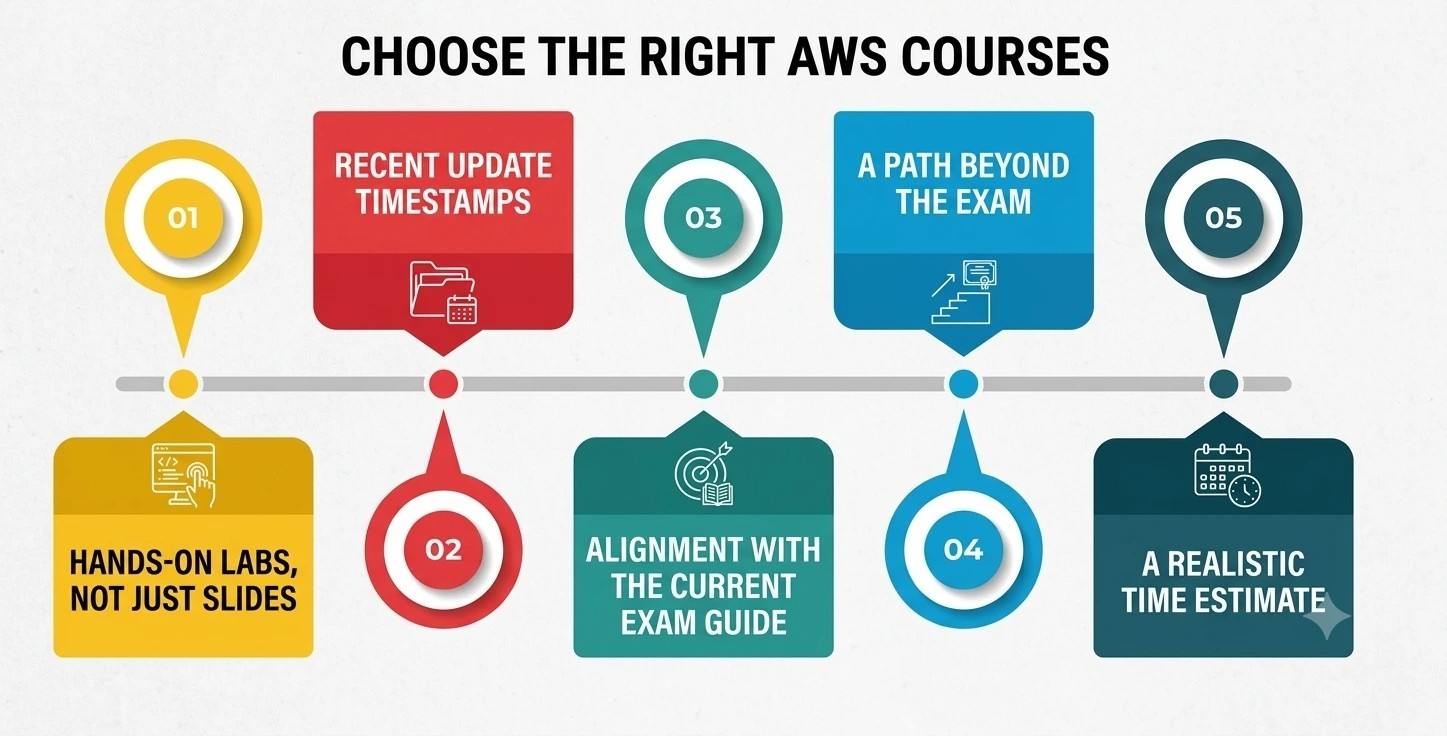
- Hands-on labs, not just slides. Courses that include a real AWS sandbox—where you provision resources and tear them down yourself—build muscle memory that a video lecture never will.
- Recent update timestamps. Check when the course content was last revised, not just when it was published. AWS services change fast enough that a three-year-old walkthrough can be actively wrong.
- Alignment with the current exam guide. AWS publishes an exam guide for every certification; a good course maps its modules directly to that document.
- A path beyond the exam. The best programs teach you to actually run a workload, not just answer multiple-choice questions about one.
- A realistic time estimate. Look for a course that tells you upfront how many hours it actually takes, so you can plan around a job search or a current role instead of guessing.
Keeping these filters in mind saves a lot of wasted evenings on outdated material, and it’s a habit worth carrying into every certification you chase after this one.
AWS Courses Mapped to Career Tracks for 2027
Here’s a quick reference for how the major certification paths map onto the career direction you’re aiming for.
|
Career Track |
Where to Start | What It Covers |
Best Suited For |
|
Cloud Architecture |
AWS Certified Solutions Architect – Associate, plus a hands-on design-pattern course | End-to-end system design, cost optimization, high availability |
People who want to plan systems, not just operate them |
|
AWS Networking |
VPC and hybrid-connectivity deep-dive courses | Subnetting, Transit Gateway, Direct Connect, security groups |
Engineers who enjoy troubleshooting connectivity issues |
|
AWS DevOps |
AWS Certified DevOps Engineer – Professional prep course | CI/CD pipelines, infrastructure-as-code, automated rollback |
Engineers who like automation more than manual configuration |
|
AWS Containers |
EKS and Kubernetes-on-AWS labs | Container orchestration, service mesh basics, scaling policies |
Developers moving from monolithic apps to microservices |
|
General Career Starter |
AWS Certified Cloud Practitioner, then Solutions Architect – Associate | Core services, billing, shared responsibility model |
Career switchers with little or no cloud background |
That table is a starting point, not a finish line. Each track below goes deeper into what actually matters once you commit to it, including which skills tend to show up most in interviews for that specific direction.
Best Picks for a Cloud Architecture Career
Cloud architecture is the track most people picture when they imagine an AWS career, and for good reason—it pays well and touches nearly every part of a modern tech stack. The foundational move here is still the AWS Certified Solutions Architect – Associate exam, a 130-minute, 65-question test that costs $150 and recommends at least a year of hands-on AWS experience going in. Candidates without prior IT experience are usually better off starting with the Cloud Practitioner exam first, then circling back once the fundamentals feel solid.
The strongest AWS courses for this track pair exam prep with real design exercises: sketch a three-tier web application, then rebuild it for multi-region failover, then redo it again on a tighter budget. That repetition teaches cloud architecture the way it’s actually practiced, where trade-offs matter more than memorized service limits.
AWS’s own Skill Builder platform offers free and subscription-tier learning paths built directly around this exam, which makes it a reasonable first stop before paying for a third-party course. Once the associate-level exam is behind you, the professional-level cloud architecture certification—refreshed in November 2026 to include AI/ML integration and resilience-as-a-service patterns—is the next real milestone for anyone serious about senior architecture roles, and it’s a noticeably harder, more scenario-based exam than the associate version.
Best Picks for an AWS Networking Role
AWS networking rarely gets the spotlight, but almost every production incident, security gap, or runaway cost eventually traces back to a networking decision made early on. That makes it one of the more durable specializations inside a broader cloud career—foundational enough that demand for it doesn’t really dip, even as other specialties trend up and down with whatever the industry is excited about that year.
Good AWS courses in this track spend real time on VPC design, subnetting strategy, Transit Gateway peering, and the practical difference between a NAT gateway and a NAT instance—the kind of detail that only sinks in once you’ve broken a test environment and had to figure out why two subnets suddenly can’t talk to each other.
Beyond the associate-level material, dedicated AWS networking specialty courses go deeper into hybrid connectivity: Direct Connect, Site-to-Site VPN, and DNS routing with Route 53. Anyone aiming at a senior AWS networking role should also spend time with the U.S. Bureau of Labor Statistics occupational data, which projects computer network architect roles to grow 8% between 2025 and 2035—well above the average for all occupations and driven largely by continued cloud migration and infrastructure modernization work.
Best Picks for an AWS DevOps Career
AWS DevOps is where automation-minded engineers tend to land, and it’s one of the more hands-on tracks on this list. The certification target here is the AWS Certified DevOps Engineer – Professional exam, which assumes real experience with continuous integration, continuous deployment, and infrastructure-as-code tooling like CloudFormation or the AWS CDK, plus a working familiarity with monitoring and logging services.
The AWS courses that hold up best for this track treat the exam as a byproduct of practice rather than the goal itself—building an actual pipeline that deploys on every commit, then intentionally breaking it to practice rollback procedures until the recovery steps become second nature.
That approach builds AWS DevOps instincts that a slide deck alone can’t. Course quality here varies more than in other tracks, so it’s worth checking whether a course covers blue-green deployments and canary releases specifically, since those patterns show up constantly in both the exam and real production environments.
A strong course in this specialty also treats monitoring and incident response as core material, not an afterthought tacked onto the final module.
Best Picks for AWS Containers and Kubernetes
AWS containers have quietly become one of the fastest-growing corners of cloud hiring, mostly because so many companies are migrating monolithic applications into microservices running on Elastic Kubernetes Service (EKS) or Elastic Container Service (ECS).
Anyone building a career around modern application deployment should expect this specialization to come up in nearly every technical interview at this point, often as a whiteboard exercise rather than a multiple-choice question.
The best AWS courses for this track don’t just explain what a container is—most candidates already know that—they focus on orchestration at scale: how EKS handles node scaling, how service mesh tools manage traffic between microservices, and how to keep a container registry secure without slowing down deployments. Vendor-neutral credentials matter here too.
The Certified Kubernetes Administrator from the Cloud Native Computing Foundation pairs well with AWS-specific container training, since Kubernetes skills transfer across cloud providers in a way that most AWS-only credentials don’t. For engineers who want their AWS containers knowledge to stay valuable even if they eventually switch employers or cloud platforms, that portability is worth the extra study time, and it tends to make interviews at non-AWS shops go noticeably smoother too.
Building an AWS Career Roadmap for 2027
None of these tracks are mutually exclusive, and most experienced professionals end up touching all four at different points in an AWS career. A common, low-risk sequence looks like this: start with the Cloud Practitioner exam to lock in the fundamentals, move into Solutions Architect – Associate to understand how services fit together, then branch into whichever specialty—networking, DevOps, or containers—matches the kind of work that actually interests you day to day.
The mistake to avoid is stacking certifications without ever building anything real. AWS courses are only as valuable as the projects you build alongside them; a resume with five badges and zero deployed projects tends to raise more questions in an interview than it answers.
Recruiters and hiring managers increasingly ask candidates to walk through something they built rather than recite exam trivia, so treat every course as an excuse to ship a small, real project—a personal portfolio site on S3 and CloudFront, a CI/CD pipeline for a side project, or a containerized app running on EKS.
Budget your time honestly, too: most people underestimate how many hours a professional-level exam actually needs, and rushing it tends to cost more in retake fees than it saves in calendar time. That combination of certification plus visible, working proof is what actually moves an AWS career forward in a hiring market that’s grown more selective about who it calls back.
A Personal Note
I’ve watched enough students chase certifications like they’re collecting stamps, and the ones who actually land good roles are rarely the ones with the most badges. They’re the ones who got stuck debugging something at 11 p.m., swore at their laptop, and figured it out anyway, then went back the next day and did it again on a slightly harder version of the same problem.
If you take one thing from this guide, let it be this: pick the AWS courses that make you build something real, even something small and slightly broken, over the ones that just hand you a certificate. The certificate opens the door. The thing you built is what you’ll actually talk about once you’re through it, and it’s usually the part of the interview you end up enjoying instead of dreading.