





If you’re searching for a way into security operations without spending money you don’t have yet, you’re not alone, and you’re not out of options. Cybersecurity SOC training doesn’t have to start with a $3,000 bootcamp invoice.
Canada’s security teams are stretched thin enough right now that free, structured material—the kind built by the same vendors that run production security operations centers—carries genuine weight on an entry-level application, as long as you can show you actually finished it rather than just enrolled.
This guide walks through what this kind of free SOC training actually covers, what a hiring manager expects you to know before becoming a SOC analyst, and where the free material realistically stops.
Why Cybersecurity SOC Training Matters in Canada Heading Into 2027?
The shortage behind this isn’t a vague talking point. ISC2’s Cybersecurity Workforce Study puts the global workforce gap at several million unfilled roles, and Canada’s slice of that gap keeps showing up in the same places—entry-level monitoring and triage positions that sit open for months because employers can’t find candidates with even basic, demonstrable SOC analyst skills.
The Canadian Centre for Cyber Security’s own threat reporting has flagged the same pattern for several years running: organizations are buying detection tools faster than they can staff people to actually watch them.
That gap is exactly why cybersecurity SOC training aimed at beginners matters more in Canada right now than it did five years ago. A mid-sized firm in Toronto or Calgary doesn’t need another architect; it needs someone reliable on the overnight shift who can tell a real alert from noise.
Free training that gets you to that baseline—not expert level, just dependable Tier 1 competence—is now a realistic route into a career that used to require a computer science degree and years of unpaid internships to even get noticed.
It’s also worth saying plainly: Cybersecurity SOC training through free material works best for people who treat it like a job, not a hobby. Canadian job postings for SOC analyst roles consistently ask for hands-on familiarity with specific tools, not just a certificate name, which is the single biggest reason self-taught candidates either break through quickly or stall for a year.
SOC Analyst Roles and Responsibilities Inside a Real Security Operations Center
Before picking a course, it helps to know exactly what you’d be doing on shift. SOC analyst roles and responsibilities vary slightly by employer, but a Tier 1 position in almost any Canadian security operations center breaks down into the same core duties:
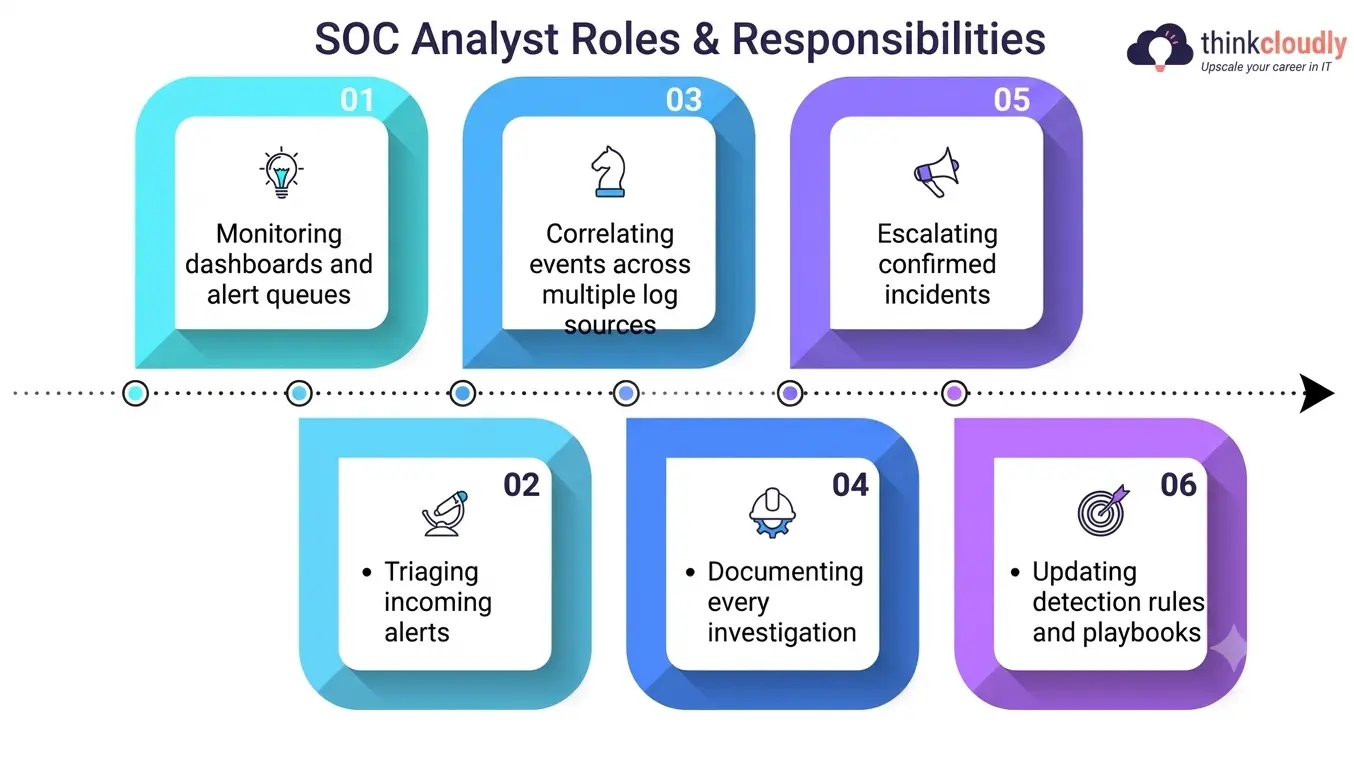
- Monitoring dashboards and alert queues continuously across a shift, watching for anything that deviates from normal traffic patterns.
- Triaging incoming alerts, deciding within minutes whether something is a false positive, a low-priority anomaly, or a genuine incident needing escalation.
- Correlating events across multiple log sources—firewalls, endpoints, identity systems, cloud platforms—to confirm whether an alert reflects a single blip or a wider pattern.
- Documenting every investigation in enough detail that a Tier 2 analyst picking up the case doesn’t have to redo the first twenty minutes of work.
- Escalating confirmed incidents through the right internal channel, with a clear, non-technical summary a manager can act on immediately.
- Updating detection rules and playbooks when a new attack pattern slips past existing alerts, so the same gap doesn’t repeat on the next shift.
Understanding SOC analyst roles and responsibilities specifically—rather than in the abstract, “I’ll watch for threats” sense—changes how you approach free training. You stop collecting badges and start practicing the exact motions a real shift demands: look, decide, document, escalate, repeat.
Core SOC Analyst Skills Employers Actually Screen For
Free Cybersecurity SOC training is only useful if it builds skills a hiring manager can verify in an interview. These are the SOC analyst skills that come up again and again in screening calls across Canadian employers, regardless of sector:
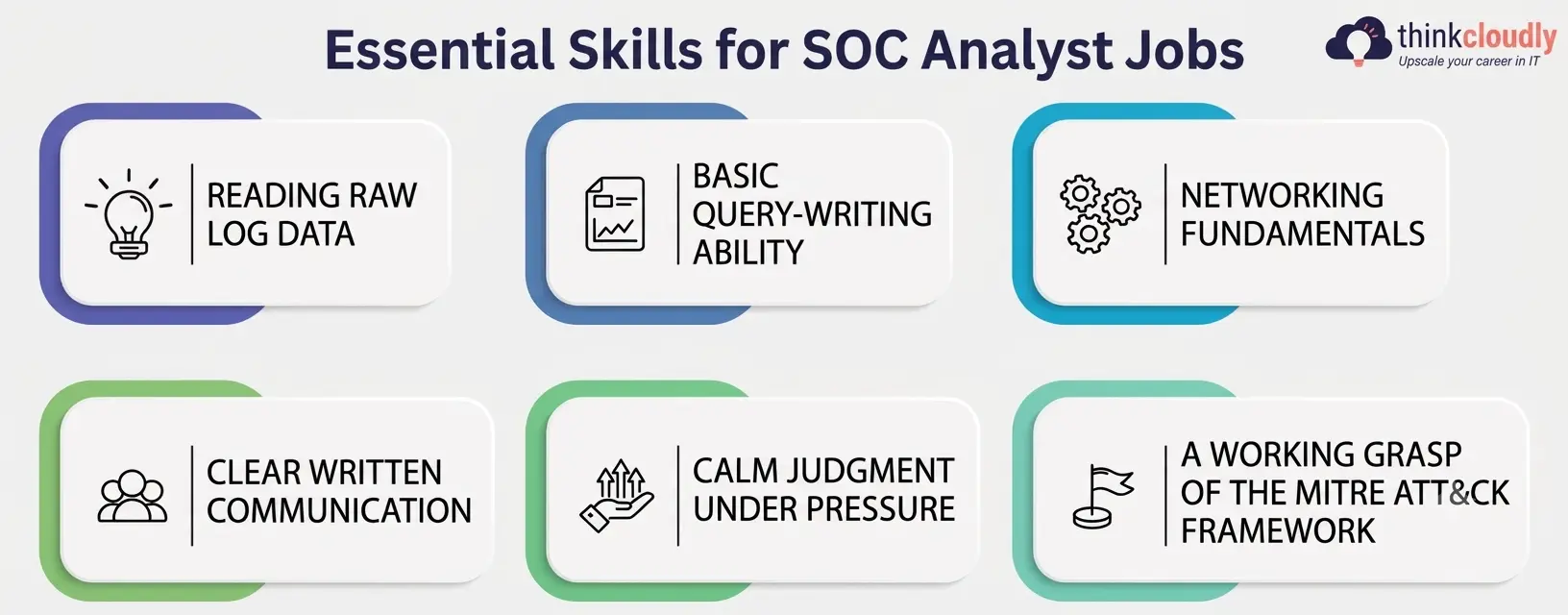
- Reading raw log data without needing it pre-summarized, across at least one SIEM platform (Splunk and Microsoft Sentinel both show up constantly in Canadian job listings).
- Basic query-writing ability, whether that’s SPL, KQL, or simple regular expressions, to pull a specific event out of a large dataset quickly.
- Networking fundamentals—ports, protocols, how a packet actually moves—because you can’t judge “abnormal” traffic without knowing what normal looks like first.
- Clear written communication, since a confusing incident report costs a team far more time than a slow one written carefully.
- Calm judgment under pressure, the kind that shows up when an interviewer asks you to walk through a messy, ambiguous alert rather than a clean textbook example.
- A working grasp of the MITRE ATT&CK framework, enough to describe what stage of an attack a given alert might represent.
Most free material teaches the first two SOC analyst skills reasonably well and barely touches the last four. Closing that gap yourself—by narrating your reasoning out loud while you practice, or writing a short incident summary after every lab exercise—is what separates a finished free course from an actual hire. Knowing SOC analyst roles and responsibilities could also make each of these skills easier to practice with intention, rather than clicking through a lab on autopilot.
Free Cybersecurity SOC Training Resources Worth Your Time in Canada
None of the following require a Canadian billing address or a corporate email to access, and each one puts you inside real tools rather than static slides. Consistency with one path beats sampling five of them halfheartedly.
- Cisco’s Introduction to Cybersecurity and Cybersecurity Essentials—free, self-paced, and widely recognized by employers as a legitimate first step, covering the networking and threat fundamentals that most SOC-specific courses assume you already have.
- IBM’s Cybersecurity Analyst Professional Certificate on Coursera—audit the lecture content for free without paying for the certificate itself; the coursework is built directly around the daily workflow of a real security operations center rather than generic theory.
- TryHackMe’s SOC Level 1 learning path—guided, hands-on rooms using real log data and alert simulations, widely regarded as one of the most direct free routes toward functioning as a capable Tier 1 analyst on day one.
- LetsDefend’s free-tier simulated SOC environment, which drops you into a mock shift with live-looking alerts closer to a real workday than most paid bootcamps manage.
- (ISC)² and CompTIA’s free study guides and webinars, useful for building vocabulary and exam familiarity ahead of any paid certification exam you decide to pursue later.
Pair whichever platform you choose with a plain-text journal where you log what each lab taught you. That habit alone makes this kind of SOC training stick far better than passively clicking through modules.
Becoming a SOC Analyst: A Realistic Free Learning Timeline
Trying to absorb networking fundamentals, a SIEM platform, and three lab environments at once is how most self-taught learners quit around week three. A sequenced plan holds up far better for anyone serious about becoming a SOC analyst without paying for a bootcamp:
- Weeks 1–3: Cover networking and log fundamentals through Cisco’s free Introduction to Cybersecurity before touching a SIEM dashboard at all.
- Weeks 4–6: Work through IBM’s Cybersecurity Analyst Professional Certificate modules on Coursera’s audit track, focused on real workflow rather than theory.
- Weeks 7–9: Move into TryHackMe’s SOC Level 1 path, treating every room as a mock shift rather than a puzzle to solve quickly.
- Weeks 10–11: Run LetsDefend’s simulated alerts under a timer, documenting each decision the way a real Tier 2 analyst would expect.
- Week 12 onward: Write up three detailed incident scenarios from your practice and start applying to Tier 1 SOC roles, even before you feel fully ready.
This pacing assumes five to seven hours a week, which is realistic alongside a full-time job or studies. Rushing it tends to produce a stack of certificates with very little retained judgment, and judgment is exactly what a shift lead is testing for in an interview.
Free Training vs. Paid SOC Analyst Certification: Where the Line Actually Sits
Free material gets you to a demonstrable baseline. A paid SOC analyst certification, pursued afterward, gives a hiring manager a third-party-verified signal that doesn’t rely on them trusting your self-reported lab notes. Here’s how the two typically compare for someone starting from zero in Canada.
|
Factor |
Free Self-Paced Training |
Paid SOC Analyst Certification |
|
Cost |
$0, aside from time |
Roughly 370–750 USD per exam, depending on the credential |
|
Best for |
Building hands-on skill and vocabulary |
Proving that skill to employers who screen by credential |
|
Typical starting point |
Cisco Introduction to Cybersecurity, TryHackMe SOC Level 1 |
CompTIA Security+, (ISC)² Certified in Cybersecurity |
|
Time to complete |
8–12 weeks of consistent effort |
Varies; often layered on top of free prep material |
|
Employer recognition |
Growing, especially with documented lab work |
Well-established and widely listed in job postings |
|
Best sequencing |
Finish first to confirm the field actually suits you. |
Pursue once free material feels comfortable, not before. |
Treat the free stage as the filter that tells you whether to spend money on a certification at all. Plenty of people discover during free SOC training that daily alert triage isn’t for them, and that’s a far cheaper discovery to make before an exam fee than after one.
Mistakes That Slow Down Becoming a SOC Analyst Through Free Resources
- The most common failure isn’t choosing the wrong platform—it’s switching platforms every time motivation dips, which leaves a learner with four half-finished accounts and no real depth anywhere.
- A second mistake is rushing past networking fundamentals to reach the more exciting alert-triage labs, which falls apart the moment an interviewer asks why a specific log pattern actually matters.
- A third is assuming every free resource carries equal weight; some genuinely teach the underlying fundamentals from the ground up, and some are thin marketing funnels dressed up as courses, so it pays to skim a syllabus before committing real hours to it.
- A fourth, quieter mistake is skipping documentation practice because writing up a lab feels less exciting than solving it — yet clear write-ups are usually the first thing a screening call probes for.
- A fifth mistake, more specific to Canada, is assuming the job market looks identical from coast to coast; a candidate in a smaller regional market may need to widen their search toward remote-friendly SOC postings sooner than someone based in Toronto or Vancouver.
Final Thoughts
Cybersecurity SOC training through free material won’t hand you a job by itself, and no legitimate provider — Cisco, IBM, or otherwise — claims that it will. What it can do is get you close enough to real SOC analyst roles and responsibilities that you can talk credibly about alert triage, log analysis, and escalation judgment in an interview, which is the actual bar most Tier 1 postings in Canada are testing against.
Pick one sequenced path, finish it properly, document what you built, and consider a SOC analyst certification only once the free stage feels comfortable rather than overwhelming. That order, worked through with free material, consistently beats a half-finished paid program sitting quietly in a browser tab.
A Personal Note
The part nobody mentions when you’re starting out is that the free material was never really the obstacle — Cisco, IBM, and the free-tier lab platforms all put out content that’s genuinely good enough to learn from. The obstacle is sitting with one path long enough to stop feeling like you’re just visiting someone else’s dashboard.
I’ve watched people bounce between three free courses in a single month and come out knowing less than someone who stuck with one slightly tedious module for three straight weeks. If you’re in Canada weighing where to begin, pick the path that matches what local postings are actually asking for, and give it longer than feels comfortable before deciding whether it’s working for you.