

In this blog, I have shared the top advanced GRC interview questions and answers that are frequently asked in risk, compliance, IT audit, and GRC analyst roles. I have explained each question using real-life scenarios so you can understand how organizations handle real-world risk and compliance challenges.
The GRC job market remains strong, and to secure a role in governance, risk, and compliance, you must be well-prepared for challenging interview questions. Whether you are preparing for GRC analyst interview questions, a compliance analyst role, or an IT auditor position, stay with me till the end—this guide will help you perform better during your interview.
Advanced GRC Interview Questions and Answers
Q1. What is risk appetite in GRC?
Risk appetite is one of the core GRC fundamentals and refers to the level of risk a business is willing to accept to achieve its goals. It includes both the minimum limit (taking too little risk) and the maximum limit (taking too much risk).
Put simply, risk appetite is defined when a business sets clear and measurable limits on how much risk it is prepared to take. In a governance, risk, and compliance (GRC) framework, risk appetite is implemented by aligning business goals with risk thresholds, policies, and control measures. Several factors influence an organization’s risk appetite, such as industry regulations, risk maturity, and overall risk management capability.
Risk appetite vs risk tolerance: risk appetite is the broad amount of risk the organization accepts; risk tolerance is the acceptable variation around a specific objective. Interviewers often ask this as a follow-up.
For example, an IT company that handles large amounts of sensitive data—client information, intellectual assets, and internal systems—usually has a low risk appetite for cybersecurity risks. To avoid financial losses, legal penalties, and loss of client trust, it implements strong security controls such as multi-factor authentication, regular vulnerability assessments, data encryption, and continuous system monitoring.
However, the same IT company may have a higher risk appetite when adopting new technologies such as AI tools or cloud platforms. These introduce operational risks, but the organization accepts them because innovation is critical for growth. These risks are managed through pilot programs and phased rollouts.
Q2. How do you align GRC with business strategy?
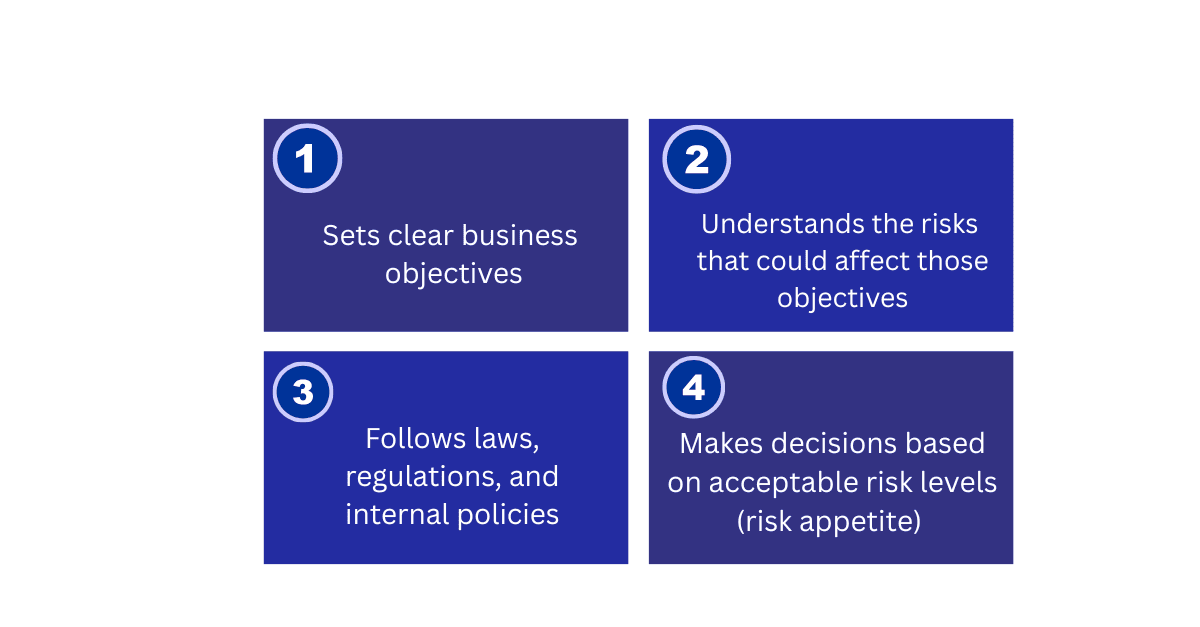
Aligning GRC with business strategy means ensuring that business goals, risks, and rules all work together.
In simple words, GRC aligns with business strategy when an organization:
- Sets clear business objectives: The organization defines what it wants to achieve, such as expansion, growth, or cost reduction. Clear objectives help teams understand priorities and align their efforts.
- Understands the risks that could affect those objectives: The organization identifies and analyses risks that may prevent it from achieving its goals, so controls and action plans are ready in advance.
- Follows laws, regulations, and internal policies: Compliance with internal rules and external regulations reduces legal penalties and reputational damage.
- Makes decisions based on acceptable risk levels (risk appetite): Decisions balance growth opportunities with compliance and safety.
This approach allows leaders to take informed risks while staying compliant, which is essential for IT audit and GRC roles.
Q3. How does the COSO ERM framework support enterprise-wide risk management?
COSO ERM (Enterprise Risk Management) is a framework created by the Committee of Sponsoring Organizations of the Treadway Commission. It is one of the most important topics in GRC interview questions and answers. Think of it as a guidebook that helps organizations manage risks across the entire company, not just in one department.
COSO ERM provides a structured, comprehensive approach that integrates risk management into strategy, operations, and daily decision-making:
- Integrated approach: Instead of managing risks in silos, COSO ERM connects all risks, giving a complete picture of how they interact.
- Links risk to strategy: Risks are considered when making strategic decisions, not as an afterthought.
- Improves decision-making: With clear risk information, leaders decide better where to invest resources and which opportunities to pursue.
- Enhances performance: Managing risks proactively helps avoid surprises, reduce losses, and achieve objectives more reliably.
- Creates a risk-aware culture: Everyone understands their role in identifying and managing risks—it is not just the risk manager’s job.
Overall, COSO ERM breaks down silos and creates a unified approach, which makes it highly relevant for IT audit and GRC professionals. (Internal link: COSO vs COBIT)
Q4. What is the difference between inherent risk and residual risk?
In risk analysis, understanding inherent risk vs residual risk is a key part of GRC fundamentals.
Inherent risk is the level of risk that exists before any controls or actions are taken to reduce it. For instance, a company stores customer data on servers without any protection. Hackers could easily steal that data—this is the inherent risk.
Residual risk is the risk that still exists after controls are applied. For example, you install a firewall and encrypt your data, but some chance of a breach still remains—that is the residual risk.
In simple words, inherent risk is the danger before protection; residual risk is the danger that remains after protection. This concept is frequently tested in GRC interview questions, especially for compliance analyst and risk analyst roles.
|
Aspect |
Inherent Risk |
Residual Risk |
|---|---|---|
|
Meaning |
Risk that exists before any controls are applied |
Risk that remains after controls are implemented |
|
Role of controls |
Assessed before controls; reduced by applying controls |
What remains after controls is managed through further treatment or acceptance |
|
Timing |
Before mitigation strategies are applied |
After mitigation strategies or controls are applied |
|
Risk level |
Higher |
Lower, but never zero |
|
Example |
Data breach risk without encryption or firewall |
Data breach risk even after firewalls and encryption |
Q5. How does the COBIT framework support IT governance and compliance?
COBIT is an IT governance framework developed by ISACA and is a major topic in IT audit interview questions. It provides structured guidance on aligning IT processes with business objectives, helping organizations meet compliance requirements, mitigate risks, and manage enterprise IT.
How COBIT supports IT governance: it gives organizations a defined set of governance and management objectives, so IT decisions, roles, and processes are clear and consistently applied.
How COBIT supports compliance: it provides documented practices that make it easy to show regulators and auditors that controls exist and work. This evidence helps the organization pass both internal and external audits.
For example, COBIT includes guidance on security and privacy, helping the organization protect personal data and prove that its controls meet regulatory requirements.
COBIT also lets organizations measure IT performance using KPIs and capability/maturity models—essential knowledge for candidates pursuing governance risk and compliance certifications.
Q6. How do you ensure continuous improvement in a GRC program?
Continuous improvement in a GRC program means regularly reviewing, updating, and strengthening processes so they stay effective as the business, risks, and regulations change. Organizations achieve this by:
- Performing regular risk assessments: As operations expand or technology changes, new risks appear and existing ones change. Regular assessments keep the risk register up to date.
- Conducting control testing and audits: Ongoing testing verifies whether controls are properly designed and working. Audit findings, incidents, and control failures reveal gaps. (Internal link: types of security controls)
- Monitoring KPIs and KRIs: Metrics measure the program’s effectiveness. A rise in security incidents or compliance violations signals that controls need strengthening.
- Tracking regulatory changes: Monitoring new laws and standards and updating policies, procedures, and controls keeps the organization compliant.
- Applying lessons learned: Feedback from incidents, audits, and near misses improves processes, updates training, and clarifies responsibilities to prevent repeat issues.
- Using GRC tools and automation: GRC platforms centralize data, improve reporting, and enable continuous monitoring, making improvement more efficient and consistent.
Q7. What role does compliance play in enterprise risk management (ERM)?
Compliance plays a critical role in ERM by helping organizations identify, manage, and reduce risks related to laws, regulations, and internal policies. Since regulatory violations can lead to heavy fines, legal action, and reputational damage, compliance is a key component of overall risk management—and a common theme in risk and compliance interview questions.
Compliance supports ERM by:
- Identifying regulatory risks: for example, failure to meet data protection laws, financial reporting standards, or industry regulations. These risks are assessed on impact and likelihood and added to the enterprise risk register.
- Designing compliance controls: policies, procedures, audits, and monitoring activities that keep the organization within its risk appetite.
- Monitoring and reporting issues: tracking regulatory changes, conducting assessments, and reporting issues so leadership can take timely corrective action.
Overall, compliance ensures regulatory risks are identified, controlled, monitored, and reported—especially important for IT audit and GRC roles.
Q8. How do you prioritize risks in a GRC program?
Prioritizing risks means deciding which risks need action right away and which can be monitored for now. Organizations first identify risks across business, IT, compliance, operational, and financial areas, then rank them on three factors:
- Impact: How badly the risk would hurt the business if it happened — financial loss, regulatory penalties, operational disruption, or reputational damage.
- Likelihood: How likely the risk is to occur. Some risks have high impact but low probability; others occur often with moderate impact. Impact × likelihood gives a risk score, usually plotted on a heat map.
- Risk appetite and tolerance: Scores are compared against the organization’s risk appetite. Risks above appetite are treated first through new controls, remediation plans, and frequent monitoring. Lower risks may be accepted, transferred (for example, through insurance), or monitored.
Q9. What are Key Risk Indicators (KRIs), and why are they important?
Key Risk Indicators are measurable metrics that act as early-warning signals that a risk is increasing. They tell management whether exposure is rising toward, or already beyond, the organization’s risk appetite.
KRIs matter because they make risk management proactive. Instead of reacting after an incident, management can see a trend, act early, and allocate resources to the risks most likely to materialize. They also give decision-makers fact-based risk information rather than opinion.
Key risk indicators examples:
- Number of cybersecurity incidents per month
- Percentage of employees who fail phishing simulations
- System downtime hours
- Regulatory compliance violations
- Vendor risk scores
Q10. What is the Three Lines of Defense model?
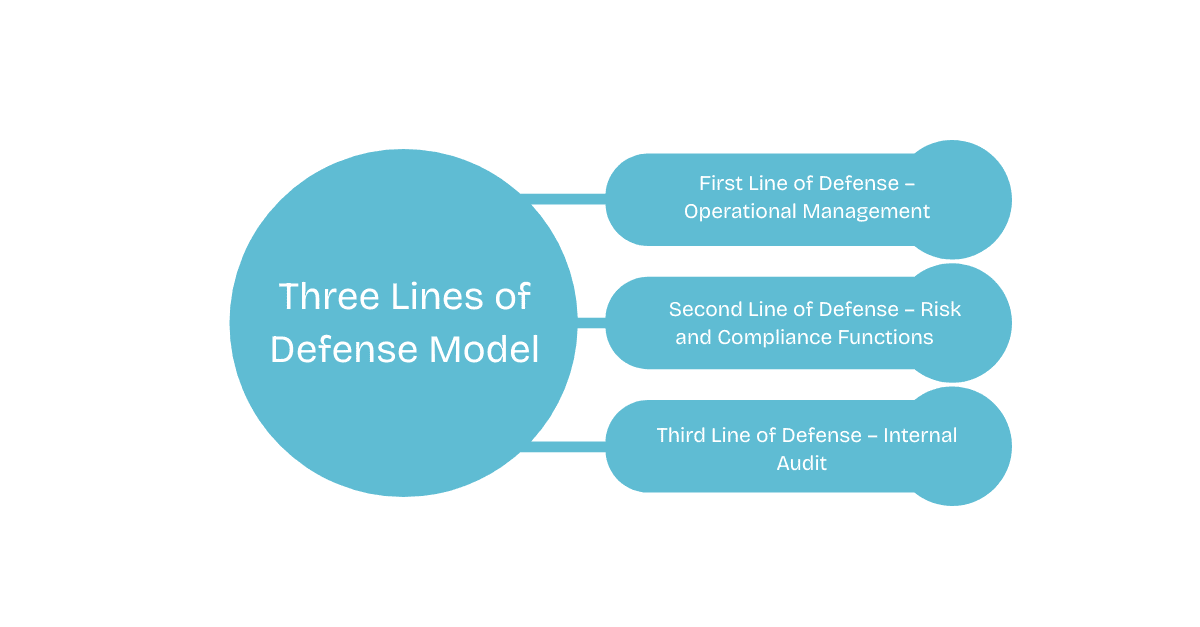
The Three Lines of Defense model (updated by the IIA in 2020 as the “Three Lines Model”) clarifies who owns, oversees, and independently assures risk management in an organization.
- First line – operational management: Business and operational teams own and manage risks day to day. They follow policies, put controls in place, and check that processes work as intended.
- Second line – risk and compliance functions: Risk management, compliance, and security teams provide oversight, guidance, and monitoring so risks stay within acceptable limits.
- Third line – internal audit: Internal audit gives management and the board an independent, objective opinion on whether the first and second lines are working effectively.
Scenario-Based GRC Interview Questions (new)
Q11. A senior manager asks you to bypass a security control to meet a deadline. What do you do?
Avoid a flat “no” or a quiet “yes.” First understand the business reason for the deadline. Then assess the risk of bypassing the control and look for compensating controls that meet the goal safely. If the risk stays above appetite, document it and route it through the formal risk-acceptance process so the right executive owns the decision.
Q12. How do you assess the risk of a new third-party vendor?
Start by classifying the vendor by the data and systems it will access. Send a security questionnaire and request evidence such as a SOC 2 Type II report or ISO 27001 certificate. Review contract clauses for security, breach notification, and right to audit. Assign a risk rating, agree remediation for gaps, and set a reassessment cycle based on that rating.
Conclusion
To answer GRC interview questions confidently, you need a clear grasp of GRC fundamentals: risk appetite, COSO ERM, COBIT, inherent vs residual risk, KRIs, and the Three Lines of Defense model. Knowing these concepts helps you explain how companies manage risk and stay compliant — in interviews and on the job, especially in IT auditing and GRC functions. For cloud-focused roles, also review our cloud risk and compliance interview questions.
Demand for governance, risk, and compliance professionals keeps growing. Combining an IT auditing and GRC certification with regular practice of these questions gives you a real edge.
Whether you are preparing for a risk analyst, compliance analyst, IT auditor, or GRC consultant role, mastering these topics will help you answer confidently and show practical understanding of risk and compliance frameworks.