

I get some version of this message every week: “I have zero tech background; I have maybe four months. What do I actually do?” My answer hasn’t really changed in the last two years, but the specifics behind it have—because the market backing that answer keeps shifting.
In 2026, the honest, unglamorous truth is that IT certification courses for jobs are the fastest, cheapest, most verifiable way to prove you can do the work, especially if a four-year degree isn’t in your near-term plan.
This isn’t a “just get certified and you’re set” article. Certifications don’t hand you a job. What they do is get your resume past the automated filter and give a hiring manager one less reason to say no.
This guide walks through which credentials are actually worth your time heading into 2027, what real employers are paying for the skills behind them, and how to sequence your learning so you’re not collecting badges nobody asked for.
Why Are IT Certification Courses for Jobs Aren’t They Optional Anymore?
Hiring has changed shape. Fewer companies are defaulting to a four-year degree requirement for entry-level technical roles, and more are running skills-based hiring processes instead—meaning they screen for what you can prove, not what school you attended.
That shift is exactly why IT certification courses for jobs have moved from “nice to have” to something closer to a baseline expectation for anyone trying to break into the field without a computer science degree.
The data backs this up. The entry-level credentials like CompTIA A+ still anchor foundational hiring because they cover hardware, operating systems, and basic troubleshooting in a format employers already trust.
Once you’re past that first credential, the market splits into clear lanes—networking, cybersecurity, cloud, and project leadership—and each lane has its own recognized sequence that most working professionals in that specialty followed to get where they are.
None of this means every certification pays off equally. It means picking the right one, in the right order, for the job family you’re actually targeting.
The Certifications Worth Your Time: A Side-by-Side Look
Rather than list credentials randomly, here’s how the major IT certification courses for jobs actually stack up against each other by career lane, cost, and what role they typically unlock.
|
Certification |
Career Lane | Typical Cost | Best For |
Median Salary Tied to Role |
|
CompTIA A+ |
IT Support / Help Desk | 500–800 (two exams) | Absolute beginners with no IT background |
~51,000–61,550 |
|
CompTIA Network+ |
Networking | $370 | Building core networking fundamentals before specializing |
65,000–85,000 |
|
Cisco CCNA |
Networking | $300 exam fee | Cisco-heavy environments, network administration |
75,000–95,000 |
|
CompTIA Security+ |
Cybersecurity | $400 | Baseline cybersecurity roles, SOC analyst tracks |
80,000–100,000 |
|
CompTIA CySA+ |
Cybersecurity | $440 | Threat detection and analysis specialists |
95,000–115,000 |
|
AWS/Azure Cloud Practitioner or Associate |
Cloud | 100–300 | Cloud support and junior cloud engineering roles |
111,000–149,000 |
|
PMP |
Project/Service Delivery | 400–700 | Moving from technical execution into leadership |
$110,000+ |
This table is a starting point, not a scorecard to complete top to bottom. A smart certification strategy picks one lane and goes two or three levels deep before it wanders into another. It’s also worth deciding early whether you want a vendor-neutral credential (CompTIA’s line) that travels across employers or a vendor-specific one (Cisco, AWS, or Microsoft) tied to whatever infrastructure your target company actually runs—both are legitimate, but they solve different problems, and picking blind wastes both time and exam fees.
Networking Skills: Still the Foundation Nobody Talks About Enough
Cloud and AI get the headlines, but networking fundamentals remain the quiet backbone of almost every IT career path, and skipping them tends to catch up with people later. Whether you end up in cybersecurity, cloud infrastructure, or systems administration, you’ll eventually need to understand how data actually moves between machines—and that’s exactly what strong networking skills teach you early.
CompTIA Network+ and Cisco’s CCNA are the two credentials most employers recognize for validating networking skills at the working level. ACI Learning notes that CCNA is particularly valuable in Cisco-heavy environments, while Network+ stays vendor-neutral and travels well across almost any employer. If you’re building this foundation from zero, start with Network+—it assumes less prior knowledge and gives you the vocabulary you’ll need before tackling anything Cisco-specific.
Here’s the part that surprises people: even cybersecurity and cloud roles quietly expect a solid grasp of networks underneath them. You can’t secure a network you don’t understand, and you can’t troubleshoot cloud connectivity issues without knowing what’s happening at the packet level.
Investing early here isn’t a detour from your real goal—for most tracks, it is the real foundation your real goal sits on top of. This is also why so many networking-focused IT certification courses for jobs pair Network+ with a hands-on lab component instead of pure theory, since employers are checking for applied understanding, not just memorized definitions.
Technical Training vs. Self-Teaching: What Actually Gets You Hired
There’s a persistent myth that free YouTube tutorials and a GitHub profile can fully replace structured technical training. Some self-taught learners do make it work. Most don’t, mainly because unstructured learning rarely builds the specific, verifiable IT skills employers are screening for, and it almost never comes with a credential a resume-scanning system recognizes.
Structured technical training—whether through a certification prep course, a bootcamp, or an employer-sponsored program—solves a problem self-teaching can’t: it forces sequencing, deadlines, and a proof point at the end.
When a hiring manager sees CompTIA Security+ or an AWS Associate credential on a resume, they know exactly what preparation that person went through and what baseline of IT skills it guarantees. A self-taught portfolio, however good, asks the hiring manager to do more verification work, and busy hiring managers reliably reward the path that requires less of that.
This doesn’t mean self-teaching is worthless. It means the strongest candidates combine both: they use free or low-cost resources to build initial IT skills, then validate that foundation with a recognized credential and the exam that proves it. That combination—proof plus practice—is what IT certification courses for jobs are actually selling you, more than the piece of paper itself.
Best IT Jobs for Beginners in 2027 and the Certifications Behind Them
According to npower’s 2026 outlook on entry-level tech roles, the most accessible IT jobs for beginners right now don’t require a four-year degree, and several pay well above what people assume an “entry-level” title implies.
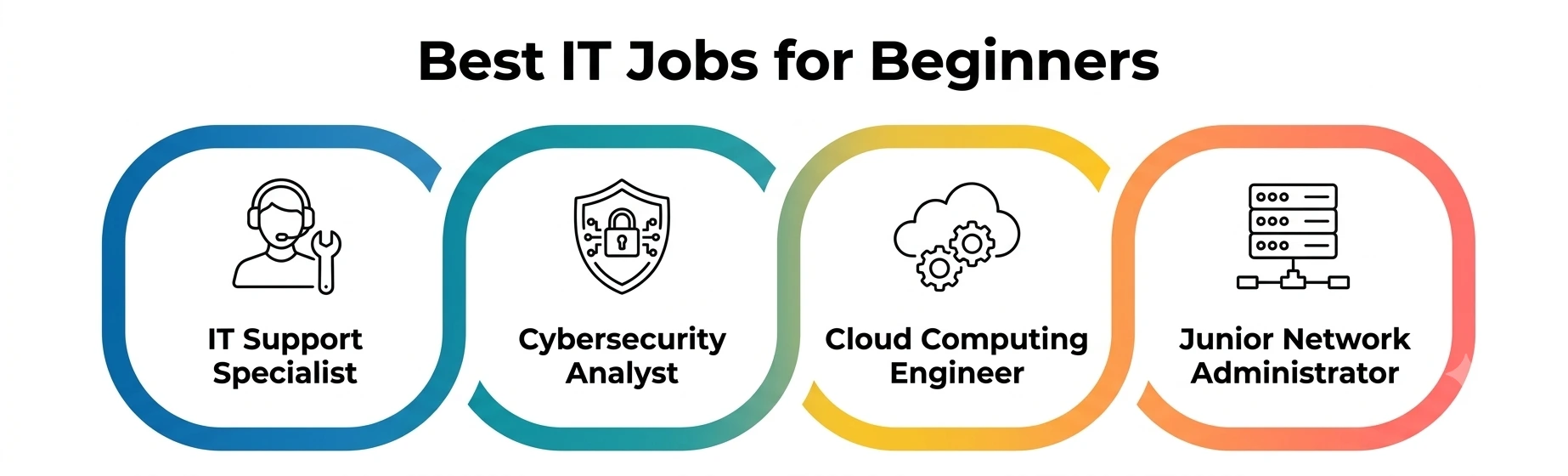
- IT Support Specialist (51,000–69,000): The classic entry point. CompTIA A+ plus a support-focused credential like the Google IT Support Certificate covers most of what employers ask for.
- Cybersecurity Analyst (80,000–160,000+): One of the highest-paying IT jobs for beginners willing to start with Security+ and build toward CySA+ as they gain experience.
- Cloud Computing Engineer (111,000–149,000): Requires comfort with at least one major cloud platform—AWS, Azure, or Google Cloud—validated through an associate-level credential.
- Junior Network Administrator: Built directly on Network+ or CCNA, and one of the more stable IT jobs for beginners since networking demand rarely disappears even as other tech trends shift.
The pattern across all four: none of these IT jobs for beginners actually demand a computer science degree. They demand a specific, provable set of IT skills, and a certification is still the fastest way most people prove they have them.
Nearly every one of these openings is filled through the same short list of IT certification courses for jobs that recruiters already recognize on sight, which is exactly why gambling on an obscure, unfamiliar credential rarely pays off the way a well-known one does.
Building Your Own IT Certification Roadmap
A scattered collection of certifications looks worse on a resume than one clear, logical IT certification roadmap. Here’s a sequence that works for most people starting from zero:
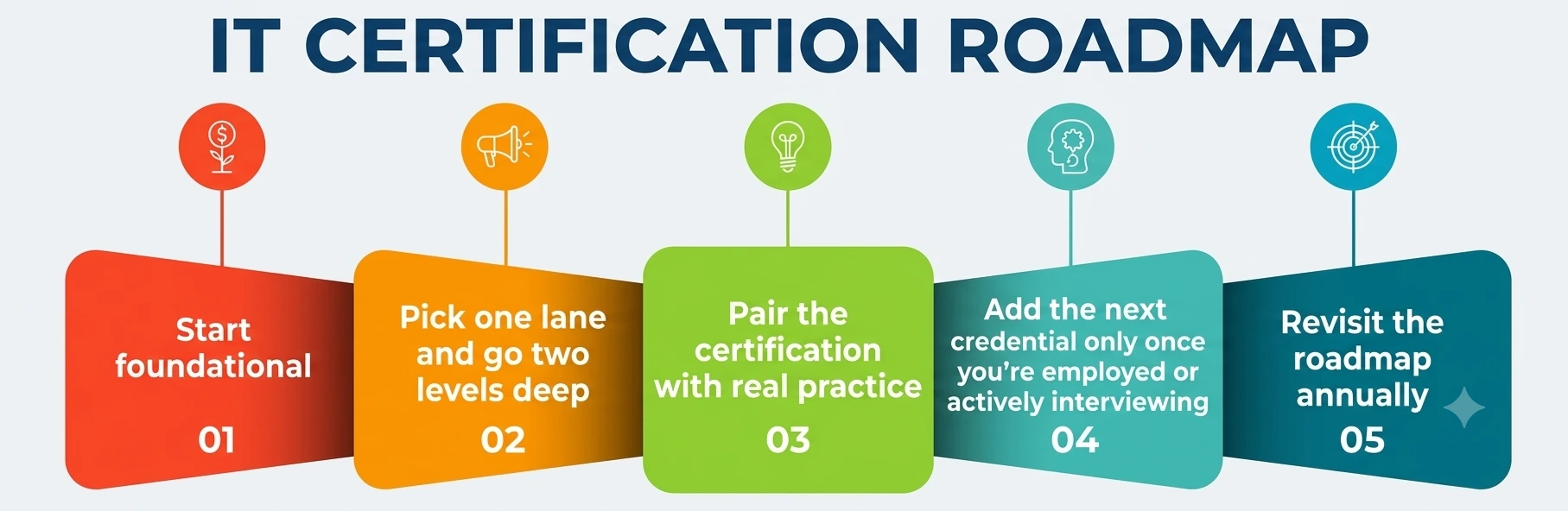
- Start foundational. CompTIA A+ if you’re aiming broadly at support, help desk, or general IT; skip straight to Network+ if you already know you want networking or infrastructure.
- Pick one lane and go two levels deep. Networking, cybersecurity, or cloud—commit to one before branching. Jumping between lanes early is the most common way this kind of planning turns into an expensive, unfocused hobby.
- Pair the certification with real practice. Home labs, volunteer IT work, or a structured bootcamp turn the certification from a multiple-choice memory test into something you can actually talk through in an interview.
- Add the next credential only once you’re employed or actively interviewing. An IT certification roadmap should follow your career, not run ahead of it and pile up certificates nobody’s asked to see yet.
- Revisit the roadmap annually. The CompTIA IT Industry Outlook for 2026 points to skills-based hiring and continuous workforce development as defining trends this year, which means what counted as a strong credential in 2023 may already need a refresh by 2027.
What the Salary Data Actually Says?
It’s worth being blunt here, because a lot of marketing around certifications overstates what a single exam does for your paycheck. As one detailed breakdown of the highest-paying IT certifications puts it plainly: a certification rarely raises your salary on its own—what it does is remove a reason somebody had to say no to you.
The real salary jumps show up at the senior end: Information Security Analysts pull a median of roughly $124,910 (with the top 10% clearing $186,420), and Computer and Information Systems Managers median around $171,200. Those numbers aren’t for someone fresh out of an exam room; they’re for people who stacked years of IT skills and hands-on experience on top of that first credential.
That’s not a reason to skip certification. It’s a reason to see it correctly — as the entry ticket, not the destination.
Common Mistakes That Slow People Down
The biggest one is collecting certifications with no plan behind them, hoping volume compensates for direction. It doesn’t. A hiring manager scanning a resume with five unrelated certifications reads confusion, not ambition.
The second is treating a certification exam as a substitute for hands-on ability. Passing a multiple-choice test and being able to actually configure a switch, harden a server, or troubleshoot a live outage are related but different skills — and interviews increasingly test for the second one directly, through scenario questions or practical assessments.
The third is ignoring networking skills entirely because a specialty like cybersecurity or cloud feels more exciting. Skipping that foundation tends to show up later as a gap that’s harder to patch once you’re already working, rather than something that helps you at that lane’s entry point.
The fourth, and the one people notice too late, is forgetting that most credentials expire. CompTIA certifications generally need renewal every three years through continuing education, and CISSP requires ongoing professional development credits to stay active.
It’s worth repeating: not all IT certification courses for jobs are created equal, and the ones tied to vendor-neutral, widely recognized exams tend to hold their value years after whatever’s trending on social media that month has faded.
A Personal Note
A few years ago I watched a friend spend almost a year bouncing between certification study guides for three completely unrelated specialties, convinced that more letters after her name would eventually add up to a job offer. It didn’t, not because she wasn’t capable, but because nobody reading her resume could tell what she was actually going for.
The turnaround came when she picked one lane — networking, in her case — finished Network+, built a small home lab, and stopped there long enough to actually apply. She had an offer within ten weeks.
I think about that often when someone asks me which certification to start with: the honest answer is usually less about which one, and more about picking one and finishing it before starting the next. The people I’ve seen struggle the longest aren’t the ones who chose “wrong” — they’re the ones who never chose at all.