A few years back, I sat with a cousin who was stuck. She had a commerce degree, a decent job in data entry, and absolutely no idea how to break into tech. Everyone kept telling her “learn cloud computing,” but nobody explained what that actually meant in practical terms.
That conversation is the reason I keep coming back to this topic — because so many people are in the exact same spot, staring at job listings full of words like “AWS,” “Azure,” and “DevOps” without a map to get there.
That map, in my experience, almost always runs through a good cloud computing academy. Not a random YouTube playlist, not a scattered mix of blog posts, but a structured program built specifically to take a beginner from confusion to confidence.
In this blog, I want to walk you through exactly why that structured path matters, what you actually learn, and how to pick the right one for your goals.
Why Are Cloud Skills No Longer Optional?
Let’s start with the plain truth: the world runs on computing services delivered over the internet now. Your bank app, your food delivery order, your favorite streaming show — all of it sits on servers owned by companies like Amazon, Microsoft, or Google, rented out to businesses that don’t want to build their own data centers anymore.
This shift has created a job market that’s growing far faster than most other tech fields. The global cloud computing market was valued at roughly $943.7 billion in 2025 and is expected to grow at a 16% annual rate through 2033. That’s not a niche market — that’s an economy inside the economy.
And the roles aren’t just for people with computer science degrees. Market analysis points out that U.S. employment in computer and IT occupations is projected to grow 15% between 2021 and 2031 — much faster than the average for all jobs — with cloud engineers and cloud architects specifically among the fastest-growing titles.
This is exactly the gap a cloud computing academy exists to fill. It takes the huge, intimidating subject of “the cloud” and breaks it into a learning path that an average student, career switcher, or working professional can actually follow.
What You’ll Actually Learn at a Cloud Computing Academy?
I think a lot of people imagine cloud training as just “learning to use a website.” It’s much broader than that. A solid cloud computing academy usually covers these core areas:
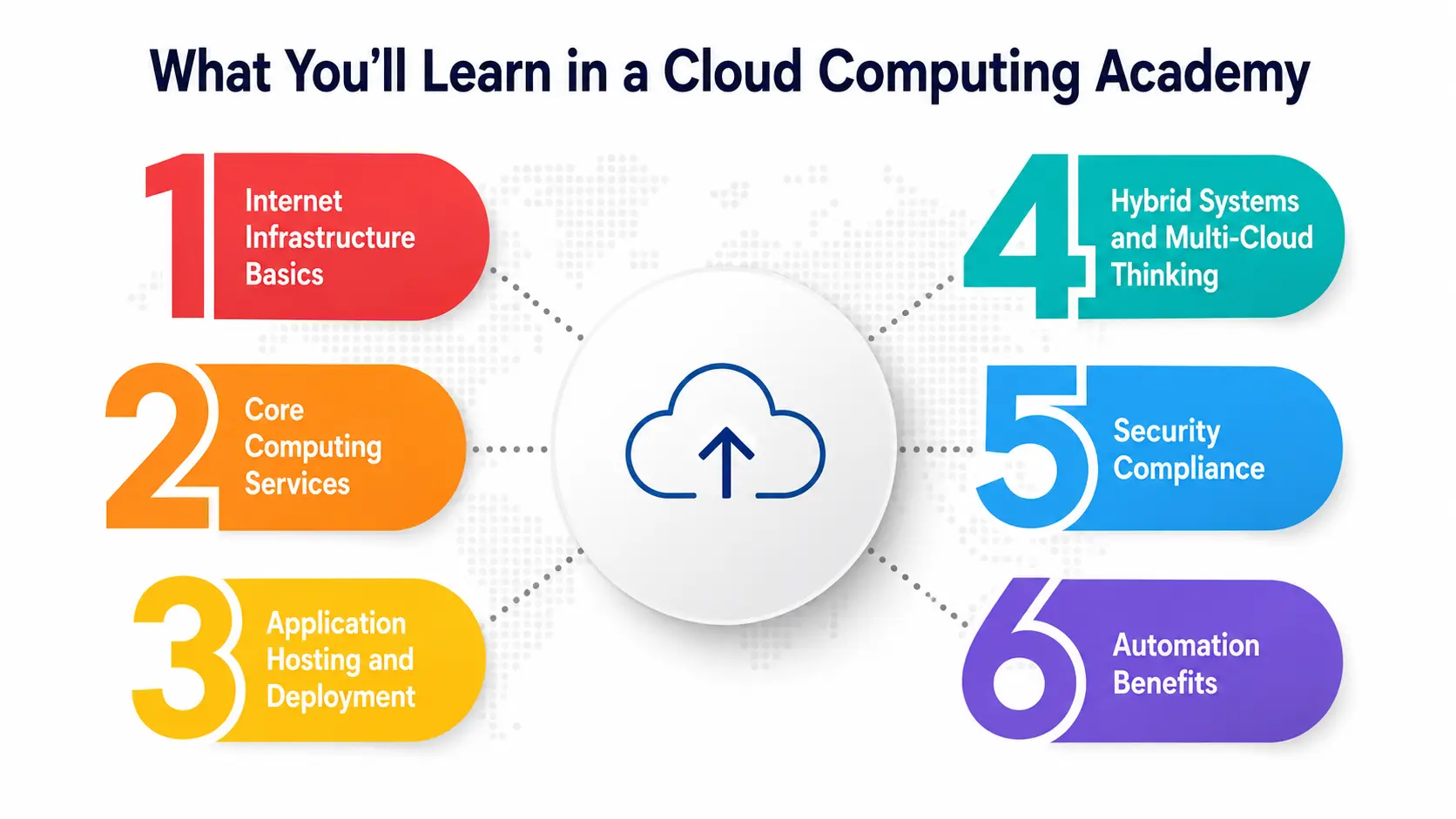
1. Internet Infrastructure Basics
Before touching any cloud platform, you need to understand the internet infrastructure that makes all of this possible — servers, networks, data centers, IP addressing, and how requests travel from your laptop to a server halfway across the world and back in milliseconds. Skipping this step is why so many self-taught learners hit a wall later; they can click buttons in a dashboard but can’t troubleshoot when something breaks.
A good academy treats internet infrastructure as the foundation, not an afterthought, because every advanced cloud concept — load balancing, content delivery networks, latency optimization — is really just infrastructure knowledge applied to a specific problem.
2. Core Computing Services
Next comes the heart of the curriculum: computing services like virtual machines, storage buckets, databases, and serverless functions. You’ll get hands-on with real dashboards from providers such as AWS, Microsoft Azure, or Google Cloud, learning how to spin up a server, attach storage, and connect it all together.
The Motion Recruitment 2026 salary guide notes that public cloud now hosts 62% of all small and medium business data and 63% of SMB workloads — which tells you just how central these computing services have become to ordinary business operations, not just giant tech firms.
3. Application Hosting and Deployment
A big chunk of any cloud course focuses on application hosting — how to actually take a website or app and put it live on the internet in a way that’s fast, reliable, and doesn’t fall over the moment traffic spikes. You’ll learn about containers, deployment pipelines, and scaling strategies, all built around real application hosting scenarios rather than toy examples.
This is often the part students enjoy most, because it’s tangible. You build something, deploy it, and can actually show someone a working link.
4. Hybrid Systems and Multi-Cloud Thinking
Very few real companies run on just one cloud provider. Most use hybrid systems — a mix of on-premises servers and public cloud, or a combination of two or three cloud vendors, to avoid depending too heavily on one company and to meet data location rules. According to VantaInsights’ 2026 market analysis, multi-cloud and hybrid architecture has shifted from a buzzword to the operational default for mid-market and enterprise buyers alike.
A serious cloud computing academy will teach you how to design and manage these hybrid systems, because interviewers increasingly expect candidates to understand this reality, not just a single-vendor setup.
5. Security Compliance
This one gets overlooked by beginners but is non-negotiable for employers: security compliance. You’ll learn about identity and access management, encryption, firewalls, and regulatory frameworks that businesses must follow depending on their industry (healthcare, finance, government, and so on).
Security compliance training isn’t just a checkbox topic — it’s often the difference between a junior candidate and someone who gets hired into a mid-level role quickly, because companies are terrified of data breaches and will pay well for people who can be trusted with access.
6. Automation Benefits
Finally, no modern cloud program is complete without automation. You’ll explore the automation benefits of tools that handle repetitive tasks — auto-scaling servers during traffic spikes, automatically backing up data, or deploying code changes without manual steps.
Understanding the automation benefits of scripting and infrastructure-as-code tools (like Terraform or CloudFormation) is one of the fastest ways to stand out, because it shows you can save a company time and money, not just operate a system manually.
Why Structured Learning Beats Random Self-Study
I’ve met plenty of self-taught cloud enthusiasts, and I respect the hustle. But there’s a reason structured programs consistently produce more job-ready graduates. A cloud computing academy gives you:
- A logical sequence, so you’re not learning advanced networking before you understand basic servers
- Hands-on labs instead of just video-watching
- Feedback from instructors who’ve actually worked in the field
- A recognized certificate or credential that recruiters trust
- Peer accountability — you’re far less likely to quit halfway when you have classmates and deadlines
Self-study can absolutely work, but it demands a level of discipline and prior knowledge that most beginners simply don’t have yet. A cloud computing academy removes the guesswork.
Is the Investment Worth It? Let’s Look at the Numbers
I’ll be honest with you — nobody wants to spend money or months of time on something without knowing the payoff. So let’s look at what the data says.
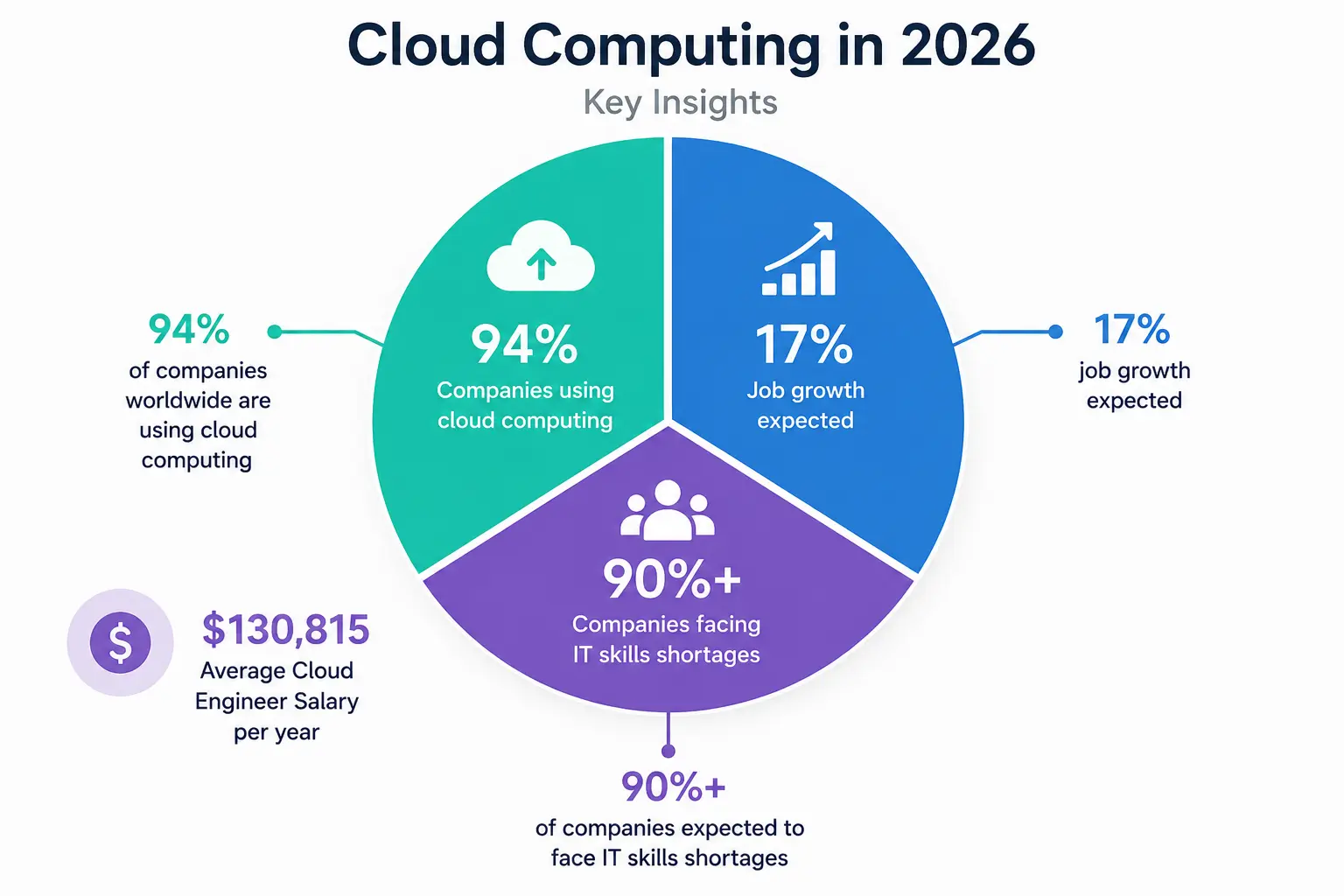
Boundev’s 2026 statistics report found that 94% of companies worldwide are now using cloud computing, and the average cloud engineer salary sits around $130,815 a year, with 17% job growth expected. The same report notes that over 90% of companies are expected to face IT skills shortages, which is genuinely good news for job seekers — fewer qualified candidates means more leverage for the ones who do get trained properly.
Separately, Refonte Learning’s career report mentions that mastering specific specializations, like container orchestration, can push senior professionals into offers above $160,000. That’s the kind of ceiling a well-chosen cloud computing academy can help you reach, especially if the curriculum includes those specialized, higher-paying skills.
Quick Comparison: Key Learning Areas at a Cloud Computing Academy
| Learning Area | What You Learn | Why It Matters for Your Career |
|
Internet Infrastructure |
Networks, servers, data flow, IP addressing |
Builds the foundation for troubleshooting and advanced topics |
|
Computing Services |
Virtual machines, storage, databases, serverless tools |
Core skill employers test for in almost every interview |
|
Application Hosting |
Deploying websites/apps, containers, scaling |
Gives you a visible portfolio and real deployment experience |
|
Hybrid Systems |
Combining on-premises and multi-cloud setups |
Matches how most real companies actually operate today |
|
Security Compliance |
Access control, encryption, regulatory rules |
Builds employer trust and opens higher-responsibility roles |
|
Automation Benefits |
Infrastructure-as-code, auto-scaling, scripting |
Shows efficiency and problem-solving, a top hiring differentiator |
How to Choose the Right Cloud Computing Academy?
Not every program is created equal, so here’s what I’d personally look for:
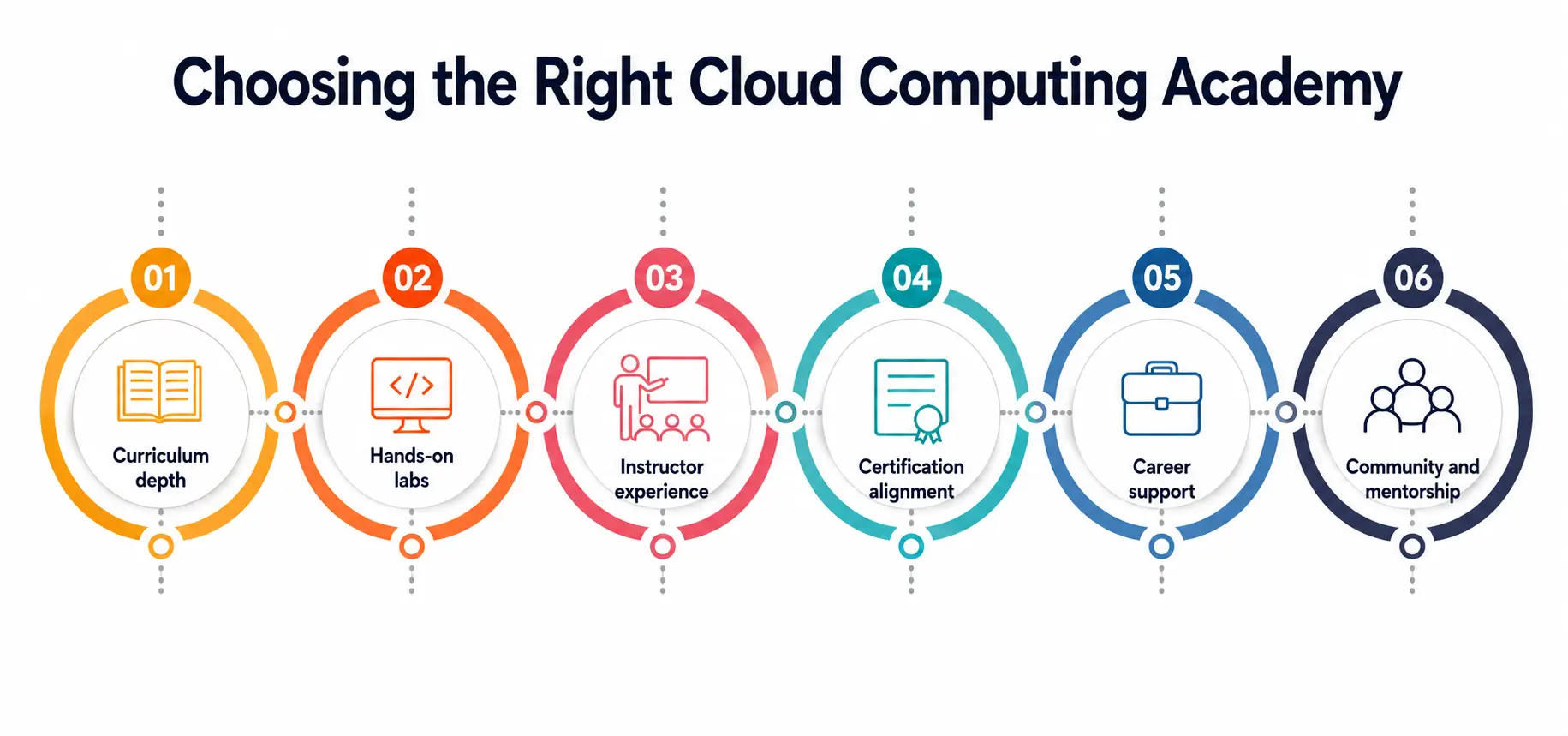
- Curriculum depth – Does it cover internet infrastructure, computing services, application hosting, hybrid systems, security compliance, and automation benefits, or just one or two of these?
- Hands-on labs – Theory alone won’t get you hired. Look for real practice environments, not just slideshows.
- Instructor experience – Are the teachers people who’ve actually worked in cloud roles, or just trainers reading a script?
- Certification alignment – Does the course prepare you for recognized certifications from AWS, Microsoft, or Google Cloud?
- Career support – Does the academy help with resume building, interview prep, or job placement?
- Community and mentorship – A good cohort or alumni network can matter more than people expect, especially in your first year of job hunting.
If a cloud computing academy checks most of these boxes, it’s likely worth your time and money.
The Growing Link Between AI and Cloud Careers
AI-related cloud spending now makes up about 19% of all cloud spending, up sharply from just 8% a few years ago, and a large majority of AI model training happens on public cloud infrastructure.
This means a cloud computing academy graduate today isn’t just learning old-school hosting skills — they’re stepping into a field that’s actively expanding to support the AI boom. If anything, this makes cloud skills more future-proof, not less.
Common Mistakes Students Make
- Jumping straight to certifications without hands-on practice – Passing an exam is not the same as being able to do the job. Labs matter more than memorized answers.
- Ignoring security compliance topics – Many beginners find this “boring” and skip ahead, then struggle in interviews when asked basic access-control questions.
- Choosing a course based on price alone – The cheapest option sometimes lacks proper labs, mentorship, or updated content, which costs you more time in the long run.
- Not building a portfolio – Employers want to see application hosting projects you’ve actually deployed, not just a list of completed modules.
- Trying to learn everything at once – A structured cloud computing academy paces this out so you’re not overwhelmed trying to learn hybrid systems and automation on day one.
Final Thoughts
If you’re standing where my cousin once stood — capable, motivated, but unsure where to start — a cloud computing academy is genuinely one of the smartest doors you can walk through right now.
Take your time choosing the right program, focus on hands-on practice over passive watching, and don’t skip the “boring” topics like security — they tend to matter most in real interviews. The demand is there. The path is clearer than it looks. You just have to take the first step.
A Personal Note
Writing this piece made me think back to how intimidating “the cloud” sounded to me when I first heard the term used seriously at work. It felt like something only engineers with years of experience could touch. What changed things for me — and for my cousin, who eventually did enroll in a structured program — was realizing that a good cloud computing academy isn’t about being a genius. It’s about showing up consistently, doing the labs even when they’re frustrating, and trusting that the fundamentals will click if you give them enough time. If you’re on the fence about starting, consider this your nudge. The best time to begin was a year ago; the second-best time is today.