



A few years ago, a cloud AI certification was a nice line on a resume—something that signaled curiosity more than competence. That’s no longer how Canadian employers are reading it. Hiring managers now treat it as proof that a candidate can operate inside a live AI pipeline without needing six months of hand-holding, and the compensation data backs that up.
According to Robert Half Canada’s 2027 Salary Guide, released in October 2026, 63% of employers are already raising pay for professionals with relevant AI expertise, and 32% say AI-related skills now command a bigger premium than any other technical competency on the market.
This piece looks at what’s actually driving that shift, which certifications employers weigh against each other, and what a cloud AI certification needs to be paired with before it translates into an offer letter rather than a polite rejection email.
Why Canadian Employers Are Raising Pay for a Cloud AI Certification in 2027
The demand isn’t abstract—it’s showing up directly in budgets and job descriptions. Here’s what the data points to:
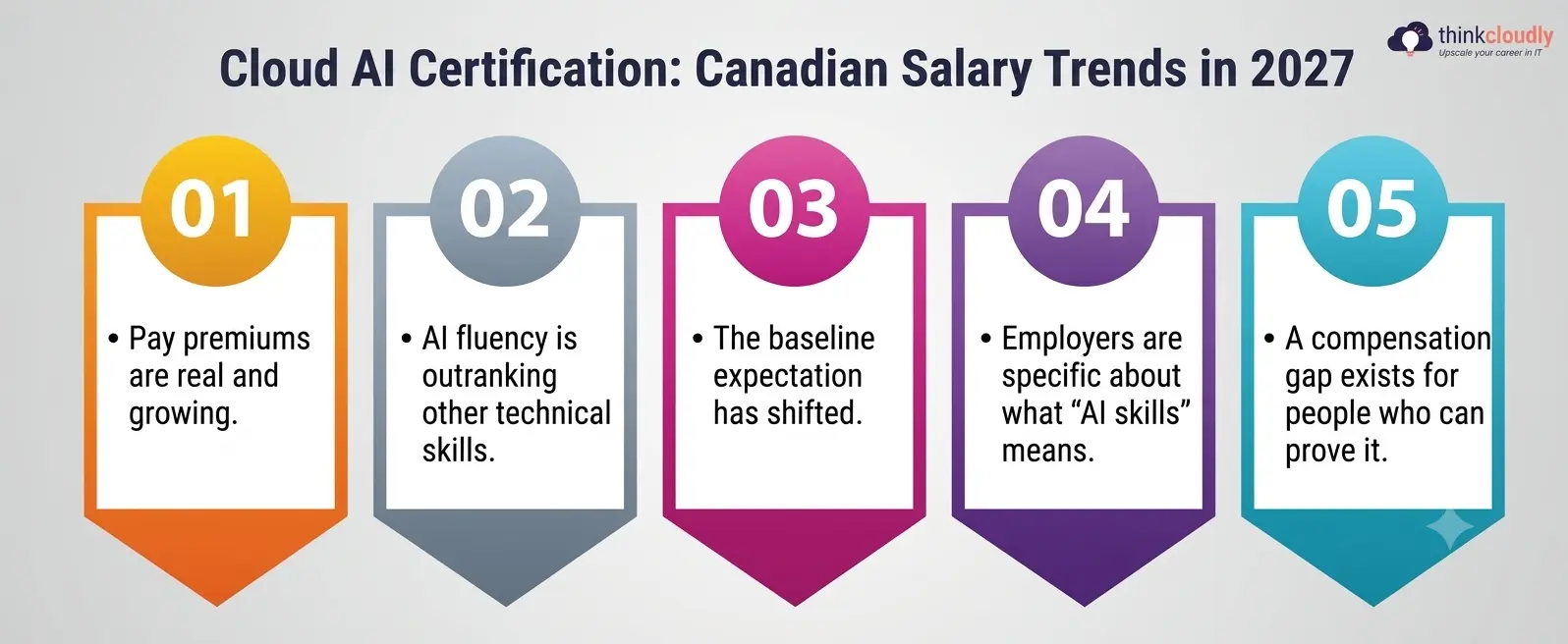
- Pay premiums are real and growing. Robert Half Canada found that 55% of hiring managers are offering pay above their original budget to win candidates, and 61% of those managers cite specialized skills, AI expertise included, as the main reason.
- AI fluency is outranking other technical skills. As Koula Vasilopoulos, senior managing director at Robert Half Canada, said, “AI fluency is ‘rapidly becoming the most premium capability of all.'”
- The baseline expectation has shifted. A recent Express Employment Professionals survey found that 80% of Canadian hiring managers now look for at least basic AI skills in candidates, and 53% expect intermediate-level ability at minimum.
- Employers are specific about what “AI skills” means. The same survey found evaluating AI outputs for reliability (30%), understanding bias (29%), and data privacy awareness (31%) rank among the most-cited capabilities—not just knowing how to use a chatbot.
- A compensation gap exists for people who can prove it. Six in ten Canadian organizations are increasing overall compensation budgets for 2027, and candidates who can back up their claims with a credential tend to clear screening faster than those relying on self-reported skills alone.
This matters because a credential like this is one of the few ways a candidate can demonstrate, rather than just claim, that they can work inside a cloud provider’s AI tooling under realistic constraints, and it is why screening tools now flag this line on a resume instead of skipping past it.
Azure AI Certification vs AWS AI Certification vs Google Cloud AI Certification
Employers rarely care which specific vendor path a candidate took, but they absolutely care whether it matches the stack their team already runs. This matters more in Canada than in some other markets, since a sizeable share of enterprise and public-sector employers in Toronto, Ottawa, and Montreal run on Microsoft’s cloud, while Vancouver’s startup and gaming scene leans more heavily toward AWS and Google Cloud—so the “right” certification really does depend on geography and industry, not just personal taste. Here’s how the three major options compare for someone deciding where to start:
|
Certification Path |
Best Fit For |
What It Signals to Employers |
|
Azure AI certification (e.g., AI-102) |
Candidates targeting enterprise, government, or Microsoft-stack employers |
Comfort with Cognitive Services, responsible AI, and enterprise security practices |
|
AWS AI certification (e.g., AWS Certified AI Practitioner / ML Specialty) |
Candidates targeting startups, e-commerce, and AWS-native teams |
Ability to deploy and scale ML workloads on infrastructure the company already runs |
|
Google Cloud AI certification (e.g., Professional ML Engineer) |
Candidates targeting data-heavy, analytics-first, or Google Cloud shops |
Strength in applied machine learning pipelines and large-scale data processing |
None of these paths is objectively “better”—the right choice depends entirely on which cloud platform the employer you’re targeting has already standardized on. A candidate chasing a job at a Microsoft-partner consultancy gains far more from a vendor-matched certification than from one aimed at a different cloud stack, even though both are respected credentials on their own terms. The mistake most job seekers make is picking a certification based on which one looks most impressive rather than which one matches the job postings they’re actually applying to.
The Cloud Engineer Skills Employers Expect Alongside a Cloud AI Certification
A certification opens the conversation, but Canadian hiring managers are explicit that it doesn’t close it on its own. Based on what Robert Half’s research into in-demand technical skills shows, here’s what employers expect to see sitting alongside the credential:
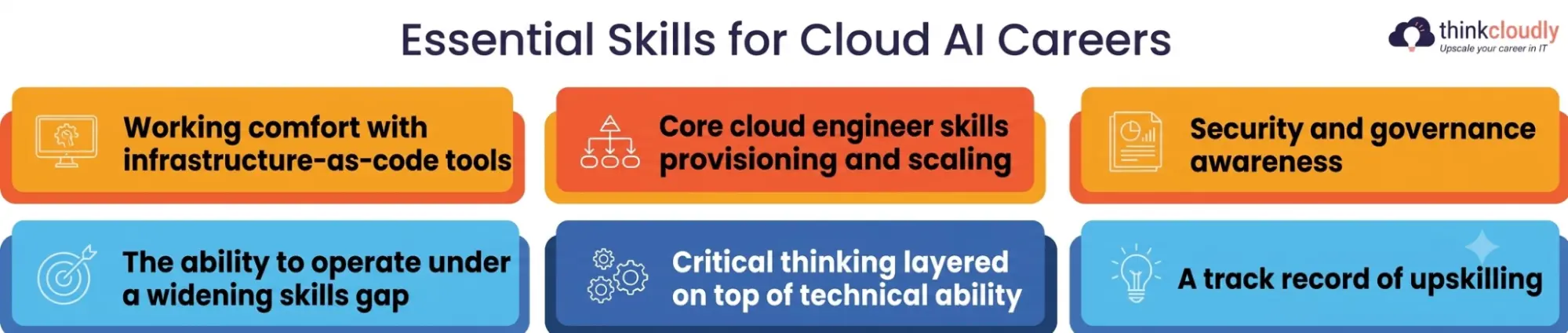
- Working comfort with infrastructure-as-code tools, since the same research lists Microsoft Azure and Terraform among the most requested tools in current job postings.
- Core cloud engineer skills around provisioning and scaling, not just theoretical knowledge of how a cloud region or availability zone works.
- Security and governance awareness, given that 35% of surveyed tech leaders cite IT governance and compliance as a major skills gap on their teams.
- The ability to operate under a widening skills gap, since 42% of Canadian tech teams report AI and machine learning as their single most significant skills shortage right now.
- Critical thinking layered on top of technical ability, which 67% of tech leaders rank as the soft skill that matters most when AI tools are involved.
- A track record of upskilling, since 69% of Canadian tech leaders say their current teams need further training just to hit 2026 and 2027 targets.
This is the part candidates underestimate. These two skill sets aren’t separate boxes to check—employers are increasingly looking for people who can do both at once, in the same project, without a six-week ramp-up period.
A short portfolio page showing one provisioned environment, one monitored deployment, and one documented incident response tends to carry more weight in a Canadian screening call than an exam score alone, because it answers the “can you actually do this” question before anyone has to ask it out loud.
Generative AI Skills: The Layer Employers Are Now Testing For
If AI fluency is the new baseline, generative AI skills are quickly becoming the differentiator inside that baseline. The gap here is wider than most candidates realize. The HR Reporter coverage of the Express Employment survey found that while 88% of job seekers believe they already have the AI skills employers want, only 23% of those same job seekers think employers expect advanced capability—when in reality, 22% of hiring managers are looking for exactly that level of skill.
That mismatch matters because this skill set, in practice, means something more specific than “I’ve used a chatbot.” Canadian employers evaluating candidates for cloud AI roles are looking for people who can:
- Write and refine prompts that produce consistent, usable output rather than one-off lucky results.
- Evaluate whether a generative model’s output is accurate, biased, or simply plausible-sounding.
- Understand where a generative AI tool fits inside a larger cloud architecture, rather than treating it as a standalone novelty.
- Communicate AI-driven findings clearly to non-technical stakeholders, which 28% of surveyed employers specifically flagged as a priority.
A cloud AI certification from Azure, AWS, or Google Cloud increasingly includes exam content touching on generative AI services, which is part of why certification bodies keep refreshing their blueprints. Treating that skill set as a bolt-on rather than a core competency is one of the fastest ways to look outdated in an interview, even with a recent certification in hand.
In practice, this shows up in follow-up interview questions that have little to do with the exam itself—a hiring manager asking how a candidate would catch a model quietly hallucinating a wrong policy number inside a customer-facing tool, for instance, which is exactly the kind of scenario where strong generative AI skills, not exam trivia, decide whether a candidate passes the interview.
What the Hiring Data Reveals About Canada’s Skills Gap
Here’s the uncomfortable part of this picture: demand for this credential is rising at the same time that employers admit they can’t fill the roles they already have open. Robert Half’s research found that 48% of tech hiring managers plan to increase headcount, but only 5% say they currently have the skills in place internally to meet those goals. That gap is exactly where a well-chosen certification, paired with real project experience, creates leverage for a job seeker.
It also explains why hiring managers keep raising the bar rather than lowering it. A PwC global analysis of AI’s impact on jobs, which includes a dedicated look at the Canadian labour market, points to AI-exposed sectors seeing both rising demand for specialized skills and a widening wage premium for workers who hold them—a pattern that lines up closely with what Robert Half and the Express Employment survey are finding on the ground in 2027.
This plays out a little differently depending on where in Canada someone is job hunting. Financial services and insurance employers in Toronto tend to screen hard for governance and compliance awareness alongside a certification; public-sector and defense-adjacent roles around Ottawa weigh security clearances and responsible-AI practices heavily, and the smaller but fast-growing AI startup scene in Vancouver and Waterloo often cares more about shipping speed than about which specific credential a candidate holds. None of that changes the baseline finding—certified candidates are being paid more—but it does mean the “why” behind the premium varies by region and sector.
For job seekers, the practical takeaway is that a cloud AI certification is no longer optional padding on a resume; it’s increasingly the minimum proof point an employer will ask for before they even get to interview questions that test applied AI judgment or core infrastructure ability in practice.
Building a Certification Pathway That Actually Gets Noticed in Canada
Given how specific Canadian employers have become about what they’re screening for, a scattershot approach to certification rarely pays off. A few things consistently separate candidates who convert interest into offers:
First, pick the certification path that matches the job postings you’re targeting, not the one with the most polished marketing. An Azure AI certification is close to worthless on a resume aimed at an AWS-native startup, and the reverse is just as true.
Second, treat the certification as the floor, not the ceiling. Pair it with at least one working project that demonstrates cloud engineer skills in a realistic setting — provisioning, scaling, securing, and monitoring something that actually runs, not a tutorial you followed once.
Third, prepare a clear answer about how you evaluate a generative model’s output for reliability before an interviewer brings it up — not just how you’d prompt it.
Fourth, keep an eye on how fast the exam content shifts. A Google Cloud AI certification earned two years ago may not reflect what the current blueprint tests, since providers are revising these exams almost as quickly as the underlying services change.
Fifth, don’t treat the AWS AI certification and its competing vendor paths as interchangeable trophies. Employers are reading each one as a signal about which stack you can walk into on day one, so choose with that lens, not with a “collect them all” mindset.
A Personal Note
I keep coming back to one pattern when I talk to people chasing a cloud AI certification: the ones who get hired aren’t necessarily the most certified — they’re the ones who can explain, in plain language, what they built with the credential and why it mattered. A certificate sitting next to an unopened sandbox account doesn’t move a hiring manager.
A small, slightly messy project that you can walk someone through for ten minutes does, especially if you can also say what broke the first time you tried it. If you’re starting this path in 2027, spend less time deciding which badge looks best and more time deciding what you’re going to build with it. That’s the part employers are actually paying for, and it’s the part no exam can hand you.