
If you’ve been scrolling through job portals at 1 AM wondering whether cloud computing is worth the hype, you’re not alone. I’ve had at least a dozen students and juniors ask me some version of the same question over the past year: “Is the cloud computing salary really as good as everyone says, or is it just LinkedIn noise?”
Short answer—it’s genuinely good, but the number you’ll actually see on your first offer letter depends on a lot more than just “I did a course.” In this blog, I’ll walk you through what a fresher can realistically expect to earn, why the pay varies so much between roles like a cloud engineer, solutions architect, or cloud administrator, and what you can do right now to push your own numbers higher.
Let’s get into it.
Why Is Everyone Talking About Cloud Computing Salaries Right Now?
Every company you can think of — banks, hospitals, e-commerce startups, even your local grocery delivery app — is running on cloud infrastructure today. That shift didn’t happen overnight, but it has accelerated massively in the last few years, and it’s the single biggest reason the cloud computing salary conversation has gotten so loud.
Think about it this way. A decade ago, most companies owned physical servers sitting in a room somewhere, managed by an in-house team. Today, almost none of that makes sense anymore.
Renting computing power on demand, scaling it up during a sale or a festival rush, and scaling it down when traffic dies — that’s cheaper, faster, and far more reliable than maintaining physical hardware. That single shift is what created an entire job market almost overnight, and it’s why students who wouldn’t have considered “cloud” as a career five years ago are now actively chasing it.
That kind of demand naturally pushes wages up. But here’s the part nobody tells beginners clearly enough—demand doesn’t automatically mean you get paid well on day one. Your cloud computing salary as a fresher depends on your role, your certifications, your city, and honestly, how well you can demonstrate hands-on skill rather than just theory.
So, What Does a Beginner Actually Earn?
Let’s talk real numbers instead of vague promises.
For most beginners, entry-level cloud computing roles typically start somewhere between $60,000 and $110,000 a year, with broader averages often landing around $90,000 to $130,000 depending on the employer and location. Support-focused roles tend to sit a bit lower, usually falling between $40,000 and $80,000 to start.
Having a recognized certification like AWS Cloud Practitioner or Microsoft’s AZ-900 tends to push offers toward the higher end of these ranges, and candidates who’ve also built real hands-on projects—not just passed an exam—often land the best offers of all.
Why Does the Same Job Title Pay Differently for Different People?
This is the bit that confuses most beginners. Two people with the same degree, same college, and even the same certification can walk out with very different cloud computing salary offers. Here’s why.
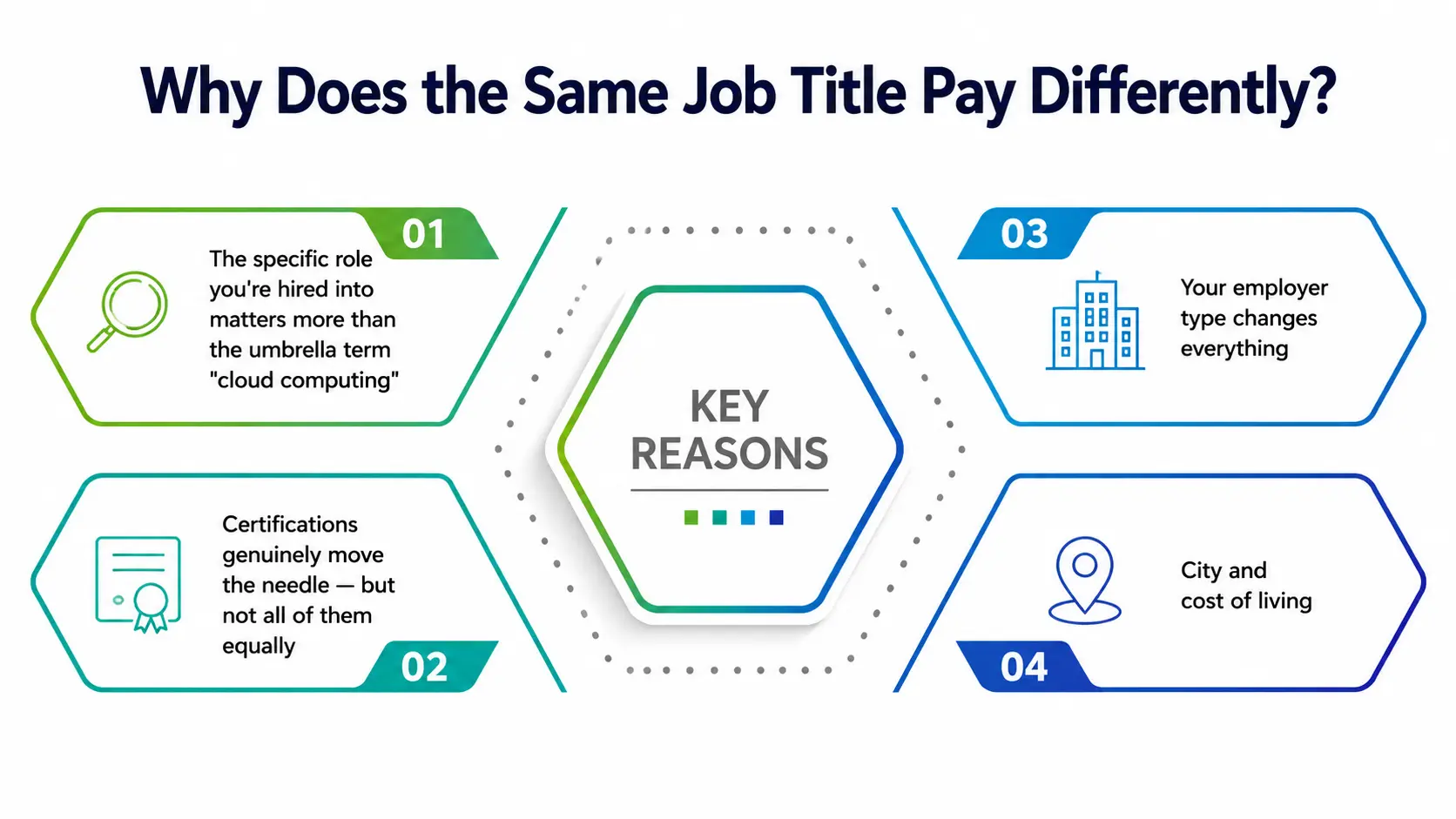
1. The specific role you’re hired into matters more than the umbrella term “cloud computing.”
A Cloud Engineer role focused purely on maintaining infrastructure pays differently than a solutions architect role, which involves designing entire systems and typically demands more experience and a broader skill set. Similarly, a cloud administrator handling day-to-day operations earns differently from someone doing site reliability work, which blends software engineering with operations and tends to command a premium because it directly affects uptime and business continuity.
2. Certifications genuinely move the needle—but not all of them equally
Foundational certificates like AWS Cloud Practitioner or AZ-900 help you get past the initial resume filter, but on their own they don’t add serious salary weight. What moves things is combining a certification with actual hands-on ability—deploying real infrastructure, understanding networking, and getting comfortable with virtualization concepts, since almost every cloud platform is built on top of virtualized infrastructure at its core.
3. Your employer type changes everything
IT services giants like Infosys, Wipro, TCS, and Cognizant typically offer entry-level cloud salaries in the ₹4–8 LPA range with structured growth paths, while sectors like BFSI (banking, financial services, insurance) pay a 15–25% premium over standard IT services roles for equivalent positions, simply because the environments are more complex and compliance-heavy.
4. City and cost of living
Even in a remote-friendly world. Metro hubs with concentrated tech ecosystems tend to offer higher starting packages than smaller cities, though this gap has been narrowing.
Cloud Computing Salary by Role — A Quick Comparison
Here’s a simplified table pulling together data points from multiple industry sources so you can see how things typically stack up for someone starting out versus a few years down the line.
|
Role |
Typical Fresher Salary |
What They Actually Do |
|
Cloud Support Engineer / Cloud Administrator |
$75,000 – $95,000 |
First line of technical support, ticket handling, day-to-day monitoring of cloud environments |
|
Cloud Engineer |
$80,000 – $110,000 |
Building, deploying, and maintaining cloud infrastructure and applications |
|
Systems Administrator (cloud-focused) |
$60,000 – $75,000 |
Managing servers, virtualization, and hybrid on-prem/cloud environments |
|
Site Reliability Engineer (entry-level) |
$95,000 – $150,000 |
Ensuring uptime, automating operations, blending dev and ops skills |
|
Solutions Architect (early career, rare at fresher level) |
$85,000 – $150,000 |
Designing scalable cloud systems, usually needs 2+ years first |
How Fast Does the Cloud Computing Salary Actually Grow?
This is honestly where cloud computing separates itself from a lot of other entry-level tech paths — the growth curve is steep if you keep learning.
The 2026 data shows that a mid-level cloud engineer with three to five years of experience can be earning anywhere from $18,000 to $38,000 at product-based companies and $33,000 to $60,000 at global capability centers or larger tech firms. By the time someone reaches a senior solutions architect level, packages can stretch well beyond $120,000 annually at top firms.
Most people start around $3,500 – $4,700 regardless of the exact job title, but once you cross the five-year mark with solid experience, a jump of $12,000 – $18,000 or beyond becomes realistic.
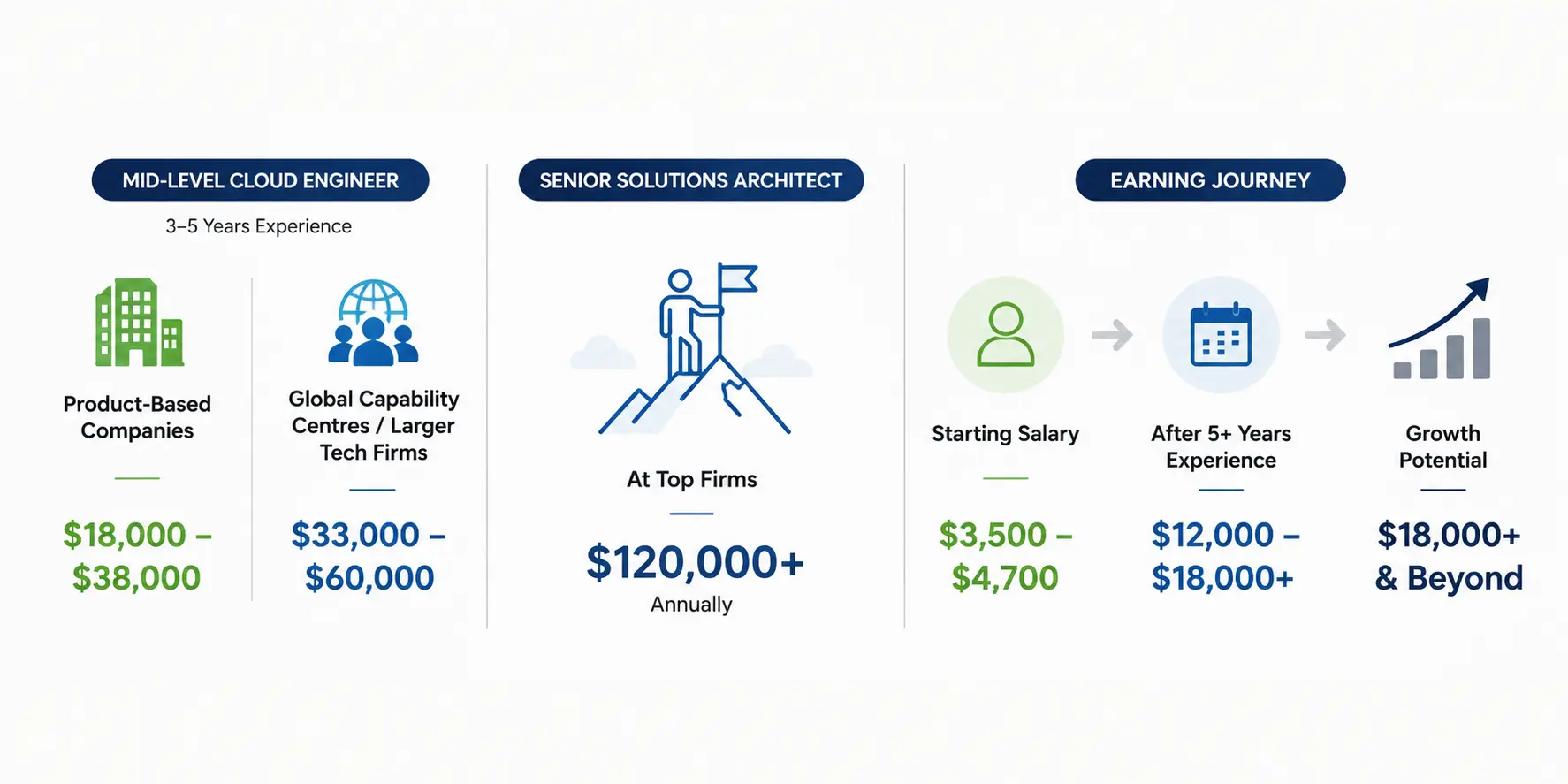
The pattern is consistent everywhere: cloud computing salary growth isn’t linear; it’s compounding. Every year of real hands-on experience, every certification stacked on top of practical skill, and every specialization you pick up adds disproportionately to your paycheck compared to standing still in a generic role.
There’s also a quieter reason this growth curve stays so steep—the field itself keeps evolving. A cloud engineer who was purely managing servers five years ago is now expected to understand automation, cost optimization, and often some AI workload management too.
Rather than making the job harder in a bad way, this constant evolution is exactly what keeps salaries climbing, because companies are willing to pay more for people who keep pace with the platform’s changes instead of relying on outdated skills.
What Actually Pushes a Beginner’s Salary Higher?
I want to be honest here rather than just optimistic. A lot of students assume that a certificate alone guarantees a great salary. It doesn’t. What genuinely helps:
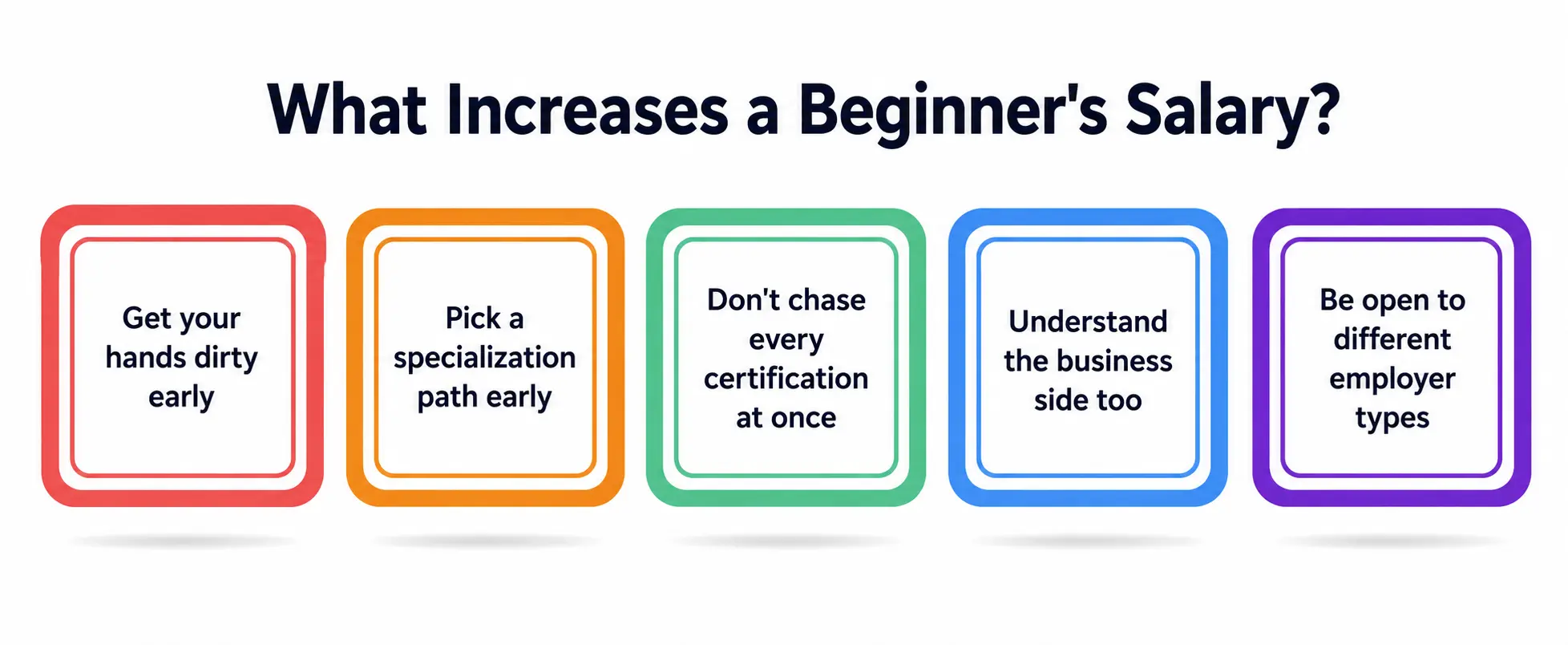
Get your hands dirty early
Set up a virtual machine, understand virtualization at a practical level, break something, fix it. Recruiters can tell the difference between someone who memorized slides and someone who’s actually touched a cloud console.
Pick a specialization path early
Even as a beginner—whether that’s leaning toward becoming a systems administrator who manages hybrid environments or aiming toward site reliability work that blends coding with operations.
Don’t chase every certification at once
One solid, well-understood certification with a portfolio of small projects beats five surface-level certificates.
Understand the business side too
A cloud administrator or cloud engineer who understands cost optimization and security basics stands out immediately, because companies care deeply about not overspending on cloud bills.
Be open to different employer types
Your first cloud computing salary at a startup might look different from one at an IT services firm—sometimes a lower base but faster growth, sometimes the reverse. Don’t chase only the biggest number on day one; chase the role that teaches you the most.
A Quick Personal Note
I’ll be honest with you — when I first started looking into this field years ago, I made the mistake of thinking the certificate was the finish line. It’s not. It’s the starting gun. The people
I’ve seen genuinely thrive in cloud roles, whether as a cloud engineer, a systems administrator, or eventually a solutions architect, are the ones who stayed curious after the course ended—the ones who broke their own test servers at 2 AM just to see what would happen, then figured out how to fix it.
If you’re a student reading this and feeling behind because your first offer isn’t a six-figure dollar package, please don’t panic. Almost nobody starts there. What matters is that you keep building, keep asking “why does this work this way,” and let your skills catch up to your ambition. The cloud computing salary you dream about is very much earnable — it just takes patience and real practice, not shortcuts.